
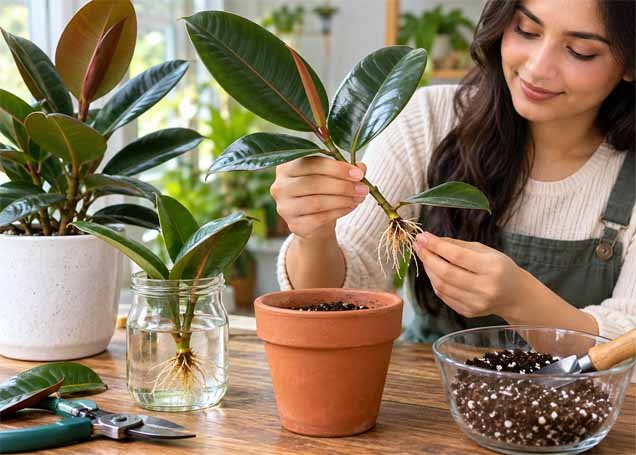
Rubber plants (Ficus elastica) are popular indoor plants known for their large, glossy leaves and attractive upright growth. If you already own one, learning how to propagate a rubber plant can help you grow new houseplants without buying another mature plant.
There are three approaches worth understanding: rooting stem cuttings in soil, rooting stem cuttings in water, and air layering. Each has advantages, but the best choice depends on your plant’s size, health, and growing conditions.
This guide explains the differences, when to propagate, what to expect during rooting, and how to care for a newly established rubber plant.
Quick Guide to Rubber Plant Propagation
| Feature | Recommendation |
|---|---|
| Botanical name | Ficus elastica |
| Best propagation season | Spring to early summer |
| Common methods | Stem cuttings and air layering |
| Water propagation | Possible, but results vary |
| Ideal lighting | Bright, indirect sunlight |
| Typical rooting period | Several weeks to a few months |
| Best for large, woody stems | Air layering |
| Can a single leaf grow into a plant? | Not without a viable stem node and bud |
According to university extension resources, rubber plants can be propagated through stem cuttings or air layering.
1. Understanding Rubber Plant Propagation
Propagation means producing a new plant from an existing one.
Unlike growing plants from seeds, vegetative propagation uses living plant material from a parent plant. The resulting plant generally retains the characteristics of the original variety.
Rubber plants are particularly interesting because their stems become woody as they mature. Younger growth may be suitable for stem cuttings, while larger plants often respond well to air layering.
Why propagate a rubber plant?
Propagation offers several benefits:
- Expand your indoor plant collection.
- Preserve a favorite rubber plant variety.
- Produce new plants from a healthy parent plant.
- Refresh the appearance of a tall or leggy plant.
- Share established young plants with friends or family.
Propagation is not guaranteed to succeed every time. Plant health, temperature, humidity, and seasonal growth all influence the outcome.
2. When Is the Best Time to Propagate a Rubber Plant?
Spring and early summer are generally the most convenient seasons for propagating rubber plants indoors.
During active growth, plants have more favorable conditions for developing roots and new leaves.
In many US homes, this period also brings longer daylight hours and warmer indoor temperatures.
Can you propagate a rubber plant in winter?
Yes, but rooting may be slower.
During winter, rubber plants often grow more slowly because of reduced daylight and cooler conditions.
If your plant is not actively growing, waiting until spring may improve the experience.
Avoid attempting propagation when the parent plant is showing serious signs of stress, including widespread yellowing, pest infestations, or root problems.
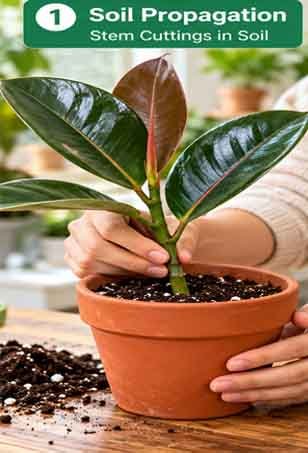
3. Method One: Propagating Rubber Plant From Stem Cuttings in Soil
Stem cuttings are a common propagation method for rubber plants.
A suitable cutting includes a healthy section of stem with a viable node. A node is the area where a leaf attaches and where a new growing point may develop.
Unlike an isolated leaf, a stem cutting with a viable bud has the potential to develop into a complete plant.
What conditions help stem cuttings root?
Stem cuttings generally benefit from:
- A healthy parent plant.
- A clean, well-draining rooting medium.
- Consistent but not excessive moisture.
- Warm indoor temperatures.
- Bright, indirect light.
- Adequate humidity without stagnant, overly wet conditions.
Rooting media such as perlite-based mixes can provide a useful balance of moisture and air around developing roots.
What happens during rooting?
After separation from the parent plant, a viable stem cutting must develop its own root system.
During this period, the cutting has limited ability to absorb water. Excessive moisture loss from its leaves can interfere with establishment.
New root growth may take several weeks, and visible leaf growth can take longer.
Rubber plants also release milky latex sap when damaged. This sap can irritate skin, so propagation involving cutting or wounding stems is best handled with adult assistance and appropriate protection.
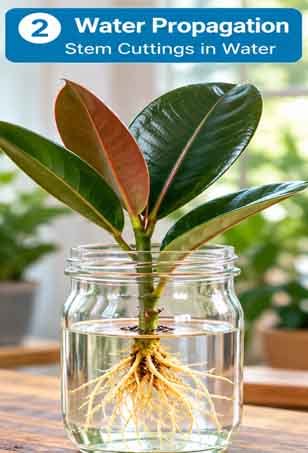
4. Method Two: How to Propagate Rubber Plant in Water
Water propagation is popular because it allows gardeners to observe developing roots.
However, it is important to understand that water propagation is not always the most dependable approach for Ficus elastica.
Some stem cuttings can root in water, while others may deteriorate before developing a healthy root system.
Advantages of water propagation
Water propagation offers a few practical benefits.
First, the roots are visible, making it easier to observe changes over time.
Second, the method avoids the uncertainty of checking roots beneath a potting medium.
Third, it can be an interesting way to observe plant development.
Disadvantages of water propagation
Water-rooted plants may experience additional adjustment when moved into potting soil.
Roots developed in water are exposed to different conditions than roots formed in an airy growing medium.
There is also a risk of stem deterioration if conditions are unsuitable.
For gardeners seeking a more established propagation method, soil rooting or air layering may be preferable.
5. Method Three: Rubber Plant Propagation by Air Layering
Air layering is especially useful for mature rubber plants with thick or woody stems.
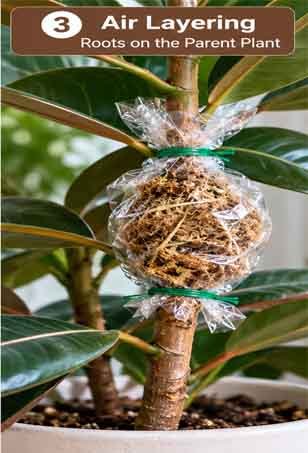
Unlike ordinary stem cuttings, air layering encourages roots to develop while the selected portion remains connected to the parent plant.
This allows the developing section to continue receiving water and nutrients during root formation.
How does air layering work?
A selected stem area is prepared to encourage rooting and surrounded by a moisture-retaining material, commonly sphagnum moss.
The rooting area is protected while roots develop.
Once a sufficiently established root system is present, the rooted section can eventually become an independent plant.
Because this technique involves wounding a woody stem, it is best performed by an experienced adult gardener.
Why choose air layering?
Air layering is particularly suitable when:
- A rubber plant has grown too tall.
- The lower stem has become bare.
- The plant has a substantial woody trunk.
- A larger new plant is preferred.
- Ordinary cuttings have been unsuccessful.
Iowa State University Extension identifies air layering as an established method for rubber tree propagation, while Illinois Extension highlights its usefulness for large tropical houseplants.
6. Rubber Plant Propagation: Soil vs. Water vs. Air Layering
| Method | Best suited for | Main advantage | Main limitation |
|---|---|---|---|
| Soil stem cuttings | Smaller healthy stems | Roots develop in growing medium | Roots are difficult to observe |
| Water stem cuttings | Small experimental propagation projects | Root growth is visible | Rooting and transplant success vary |
| Air layering | Tall or mature rubber plants | Roots form while attached to parent | More involved technique |
Which method is best?
For a mature rubber tree with a thick stem, air layering is often a particularly suitable choice.
For smaller plants with healthy shoots, stem cuttings are another established option.
Water propagation is possible, but it should not be assumed to work equally well for every cutting.
7. Can You Propagate a Rubber Plant From a Single Leaf?
This is one of the most common questions about rubber plant propagation.
A rubber plant leaf by itself is not normally sufficient to produce a complete new plant.
The key difference is the presence of a viable stem node and growing bud.
An isolated leaf may remain green for some time and may even develop roots under certain conditions. However, without the necessary growing point, it cannot reliably produce a new stem and leaves.
For a complete new plant, viable stem tissue is essential.
8. How Long Does Rubber Plant Propagation Take?
Rubber plant propagation requires patience.
Some cuttings may begin forming roots within several weeks. Others take longer, especially when temperatures or light levels are less favorable.
Air layering can take several weeks to a few months before a sufficiently developed root system is visible.
Illinois Extension notes that air layering may require several months under some conditions.
What affects rooting time?
Several factors influence propagation speed.
Temperature: Warm, stable indoor conditions generally favor active plant growth.
Light: Bright, indirect light supports photosynthesis without exposing stressed plant material to harsh sunlight.
Humidity: Adequate humidity can help reduce moisture loss.
Plant health: A healthy parent plant is generally a better starting point.
Season: Active growing periods are usually more favorable than winter dormancy or slowed growth.
Do not judge propagation success solely by how quickly new leaves appear. Root development and above-ground growth do not always happen simultaneously.
9. Best Light Conditions for Newly Propagated Rubber Plants
Newly rooted rubber plants benefit from bright, indirect sunlight.
An east-facing window is often a good option in US homes because it usually provides gentle morning light.
A location near a south- or west-facing window may also work if the plant is protected from intense direct sunlight.
Signs of unsuitable lighting
Too much direct sunlight may contribute to leaf scorching or excessive moisture loss.
Insufficient light can slow growth and make it harder for a young plant to establish.
Choose a stable location and avoid repeatedly moving the plant between very different lighting conditions.
10. Best Soil for Newly Rooted Rubber Plants
Once a new rubber plant has an established root system, it needs a potting mix that retains some moisture without remaining waterlogged.
A suitable houseplant mix should provide:
- Good drainage.
- Adequate air spaces around roots.
- Moderate moisture retention.
- Structural support for the growing plant.
A pot with drainage holes is important because excess water should be able to escape.
Heavy, compacted soil can remain wet for too long and contribute to root problems.
For more information on ongoing care, read our complete Rubber Plant Care Guide.
11. Common Rubber Plant Propagation Problems
Even with suitable conditions, some propagation attempts fail.
Understanding the symptoms can help gardeners improve future results.
| Problem | Possible cause | What to check |
|---|---|---|
| Cutting wilts | Excessive moisture loss | Humidity, heat, light exposure |
| Stem becomes soft | Excess moisture or decay | Rooting environment and drainage |
| Leaves turn yellow | Stress or unsuitable moisture | Light, moisture, temperature |
| No visible roots | Slow rooting or unsuitable conditions | Season and environmental stability |
| New plant drops leaves | Adjustment after transplanting | Watering and sudden environmental changes |
| Air layer produces few roots | Insufficient rooting conditions | Moisture and overall plant health |
Why is my rubber plant cutting not rooting?
Possible reasons include cool temperatures, poor plant health, insufficient light, or an unsuitable rooting environment.
Some rubber plants simply require more time.
Why are the leaves drooping?
Drooping can result from moisture stress, excessive heat, or inadequate root development.
A cutting without established roots is particularly sensitive to changes in its surroundings.
12. How to Care for a Newly Propagated Rubber Plant
Once a new rubber plant is established, its care gradually becomes similar to that of a mature Ficus elastica.
Water carefully
Check the growing medium rather than following a rigid daily watering schedule.
Allow some of the upper potting mix to dry between waterings, while avoiding prolonged severe dryness.
Provide stable lighting
Bright, indirect light supports healthy leaf development.
Avoid excessive fertilizer
Newly established plants generally do not need heavy feeding.
Wait until the plant is actively growing and has developed a healthy root system before beginning a modest fertilizing routine.
Keep the leaves clean
Rubber plants have broad leaves that can collect household dust.
Clean leaves help maintain their appearance and allow gardeners to notice pest problems early.
Read our guide on How to Clean Indoor Plant Leaves for safe maintenance tips.
13. Can You Propagate Variegated Rubber Plants?
Yes. Variegated rubber plants can also be propagated vegetatively.
Popular varieties include:
- Ficus elastica ‘Tineke’
- Ficus elastica ‘Ruby’
- Ficus elastica ‘Burgundy’
- Ficus elastica ‘Robusta’
Variegated varieties may have cream, pink, red, or differently shaded green foliage.
Because some variegated plants contain less chlorophyll in portions of their leaves, they may grow more slowly under certain conditions.
Provide adequate indirect light and avoid unnecessary stress during establishment.
Vegetative propagation is commonly used to preserve desirable characteristics of named plant varieties, although individual new shoots can still show differences in variegation.
14. Rubber Plant Propagation Mistakes to Avoid
Successful propagation depends as much on avoiding poor conditions as on choosing a suitable method.
Expecting a single leaf to become a complete plant: A viable growing point is necessary for new shoot development.
Starting with an unhealthy parent plant: Plants already weakened by pests or disease may struggle.
Keeping the growing medium constantly saturated: Roots need oxygen as well as moisture.
Placing new plants in intense direct sunlight: Stressed or poorly rooted material can lose moisture quickly.
Expecting immediate growth: Root development may occur long before new leaves become visible.
Frequently disturbing developing roots: Unnecessary handling can interfere with establishment.
Ignoring rubber plant sap: The milky latex may irritate skin and should be kept away from children and pets.
15. Frequently Asked Questions About Rubber Plant Propagation
Can you propagate a rubber plant in water?
Yes, some rubber plant stem cuttings can develop roots in water. However, success varies, and soil rooting or air layering may be more dependable in some situations.
What is the easiest way to propagate a rubber plant?
Stem cuttings are a common approach for smaller shoots. Air layering is often better suited to mature rubber plants with thick stems.
How long does it take for a rubber plant to root?
Root formation may take several weeks or longer. Air layering can require several months, depending on conditions.
Can a rubber plant grow from just a leaf?
An isolated leaf without a viable stem node and bud cannot normally develop into a complete new rubber plant.
Is spring the best time to propagate a rubber plant?
Spring and early summer are generally favorable because rubber plants are more actively growing.
Can I propagate a rubber plant in winter?
It is possible, but rooting may be slower because of shorter daylight hours and cooler indoor conditions.
Why is my rubber plant cutting turning yellow?
Yellowing may result from propagation stress, excess moisture, poor light, or unsuitable temperatures.
Can you propagate a Burgundy rubber plant?
Yes. Burgundy rubber plants can be propagated using suitable vegetative propagation methods.
Is rooting hormone necessary?
Not always. Rooting hormones may assist some propagation methods, but rubber plants can also develop roots without them.
Is rubber plant propagation safe for pets?
Rubber plants contain irritating latex and are considered toxic to cats and dogs. Keep plants and propagation materials out of their reach.
Final Thoughts
Learning how to propagate a rubber plant is a useful skill for anyone who enjoys growing indoor plants.
Stem cuttings and air layering are established ways to produce new Ficus elastica plants. Water propagation is another possibility, although success may be less predictable.
The best method depends on the condition and size of your parent plant. Smaller healthy shoots may be suitable for cuttings, while larger woody plants are often better candidates for air layering.
Regardless of the method, healthy plant material, appropriate light, stable temperatures, and patience are important.
Once your new plant is established, consistent care will help it develop the glossy foliage that makes rubber plants such attractive houseplants.
References
These horticultural resources provide further information about rubber plant propagation and care: