
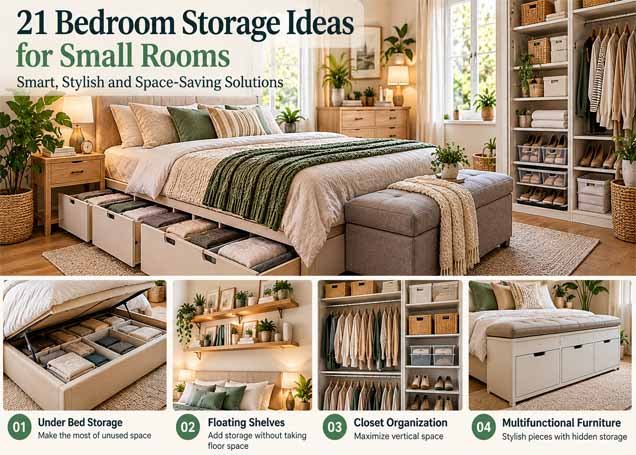
A bedroom should feel comfortable, relaxing, and easy to use. But when clothes, shoes, books, bedding, and everyday essentials start piling up, even a beautifully decorated room can feel crowded.
The good news is that effective bedroom storage doesn’t always require a large closet, expensive furniture, or a complete room makeover. With the right combination of under-bed storage, vertical shelving, multifunctional furniture, and simple organizing habits, you can make better use of almost any bedroom.
Whether you’re decorating a small apartment, organizing a guest room, or trying to make a shared bedroom more functional, the right storage solutions can help you reclaim valuable space.
In this guide, you’ll discover 21 practical bedroom storage ideas, learn which options work best for different spaces, and find budget-friendly ways to keep your room organized.
Why Bedroom Storage Matters
Good bedroom storage is about more than hiding clutter. It makes everyday routines easier by giving frequently used items a convenient home.
A well-organized bedroom can help you:
- Find clothes and accessories more quickly.
- Make better use of limited floor space.
- Keep surfaces clear for everyday activities.
- Protect seasonal clothing and bedding.
- Create a more comfortable and welcoming environment.
- Avoid buying unnecessary furniture.
The most effective storage system matches your room’s dimensions, your belongings, and your daily habits.
For example, someone with a large clothing collection may benefit from better closet organization, while a bedroom without a closet may need a wardrobe, dresser, and wall-mounted storage.
21 Bedroom Storage Ideas That Actually Work
1. Use Under-Bed Storage Drawers
The space beneath your bed is one of the most overlooked storage areas in a bedroom.
Low-profile drawers or rolling storage bins can hold seasonal clothing, spare sheets, extra blankets, and other items you don’t need every day.
Choose containers that fit beneath your bed frame and can slide out without hitting nearby furniture.
For bedrooms with limited clearance, soft-sided storage bags may be more practical than rigid plastic bins.
Best for: Small bedrooms, apartments, and seasonal storage.
Helpful tip: Measure the height between the floor and the bottom of your bed frame before purchasing containers.
2. Choose a Bed Frame with Built-In Storage
A storage bed can eliminate the need for extra furniture.
Many designs include drawers beneath the mattress, while others use a lift-up platform to reveal a larger compartment.
Drawer-style beds work well when there is enough space on the sides to open them.
Lift-up storage beds may be useful in narrow rooms where side drawers would be difficult to access.
Before buying, consider the bed’s weight, ease of opening, and the space needed for safe operation.
Best for: Bedrooms with limited closet or dresser space.
3. Install Floating Shelves Above a Dresser
Floating shelves add storage without taking up additional floor space.
They can hold lightweight books, decorative objects, small baskets, and personal accessories.
Install them above a dresser or another suitable wall area rather than filling the room with extra cabinets.
Use secure mounting hardware appropriate for the wall material and expected load.
Avoid placing heavy or poorly secured objects directly above a sleeping area.
Best for: Small bedrooms and rooms with unused wall space.
4. Add a Tall, Narrow Bookcase
When floor space is limited, think vertically.
A tall, narrow bookcase can provide several levels of storage while occupying relatively little floor area.
Use baskets or decorative boxes to organize small items.
Open shelves are useful for books and display pieces, while enclosed storage can hide visual clutter.
Secure tall furniture to the wall using suitable anti-tip hardware.
Best for: Bedrooms with limited floor space but adequate wall height.
5. Use a Storage Ottoman at the Foot of the Bed
A storage ottoman combines seating and hidden storage in one piece.
It can hold spare pillows, blankets, or other lightweight bedroom essentials.
A narrow bench-style ottoman works well at the foot of the bed, provided it doesn’t block a walkway.
Choose a design with a sturdy lid and a safe opening mechanism.
Best for: Medium-size bedrooms and multifunctional spaces.
6. Maximize Closet Space with Double Hanging Rods
Many closets waste vertical space beneath hanging shirts and jackets.
Installing a second hanging rod can increase capacity for shorter clothing items.
Keep one section for longer garments such as dresses and coats.
Before making changes, measure the closet height and the length of your clothes.
Best for: Closets with more short garments than long ones.
7. Use Hanging Closet Organizers
Fabric hanging organizers can create compartments for sweaters, handbags, folded clothes, and accessories.
They are particularly helpful when a closet has a hanging rod but limited shelving.
Choose an organizer that fits the available width and can support the intended weight.
Avoid overloading lightweight fabric compartments.
Best for: Rental apartments, dorm rooms, and small closets.
8. Organize Shoes with a Vertical Shoe Rack
Shoes can occupy a surprising amount of bedroom floor space.
A vertical shoe rack keeps pairs together while using less floor area than spreading them beneath furniture.
Slim shoe cabinets are another option, particularly near the bedroom entrance or inside a closet.
Choose a rack that fits your shoe sizes and doesn’t obstruct walking paths.
Best for: Bedrooms with limited closet floor space.
9. Add Over-the-Door Storage
An over-the-door organizer can hold accessories, small bags, scarves, and other lightweight items.
It is a useful solution for renters who want to avoid permanent wall modifications.
Before purchasing, check the door thickness and the clearance between the top of the door and its frame.
Make sure the organizer doesn’t prevent the door from closing properly.
Best for: Small apartments and bedrooms with minimal built-in storage.
10. Replace Bulky Nightstands with Wall-Mounted Shelves
Traditional nightstands can take up valuable space beside the bed.
A small floating bedside shelf can provide enough room for a lamp, phone, book, or glass of water.
Some wall-mounted designs include a drawer for small essentials.
Keep the shelf within comfortable reach and install it securely.
Best for: Narrow bedrooms with limited space beside the bed.
11. Choose a Dresser with Deep, Functional Drawers
A dresser can be one of the most useful bedroom storage pieces, but drawer design matters.
Look for drawers that open smoothly and provide enough depth for folded clothing.
Use internal dividers to separate socks, underwear, accessories, and smaller items.
Avoid overfilling drawers, which can make clothing difficult to find and damage the furniture.
Best for: Bedrooms without large closets.
12. Use Drawer Dividers to Reduce Clutter
Even a large dresser can become disorganized without a system.
Drawer dividers create separate sections for different clothing categories.
They work particularly well for socks, undergarments, belts, and small accessories.
Adjustable dividers allow you to change the arrangement as your storage needs evolve.
Best for: Dressers, bedside drawers, and closet storage.
13. Install Corner Shelves
Bedroom corners often remain unused because standard furniture doesn’t fit comfortably.
Compact corner shelves can hold lightweight decorative objects, books, or small storage baskets.
They are especially useful in rooms where a full-size bookcase would obstruct movement.
Choose shelves that complement the room’s proportions.
Best for: Small bedrooms with awkward corners.
14. Use Baskets for Everyday Essentials
Storage baskets are affordable, flexible, and easy to move.
Place them on shelves, inside closets, or beneath furniture.
Use separate baskets for different categories, such as accessories, electronics, or seasonal items.
Labels can make it easier to maintain the system.
Best for: Budget-friendly bedroom organization.
15. Create Storage Behind the Bedroom Door
The area behind a bedroom door may provide space for hooks or a shallow organizer.
This is a convenient location for robes, lightweight bags, and accessories.
However, avoid adding storage that interferes with the door’s movement or creates a safety hazard.
Use appropriate hooks and mounting methods.
Best for: Small bedrooms with limited closet space.
16. Choose a Wardrobe with Adjustable Shelves
A freestanding wardrobe is useful when a bedroom lacks built-in closet space.
Look for a combination of hanging space, drawers, and adjustable shelves.
Sliding-door wardrobes may require less clearance in front than wardrobes with outward-opening doors.
Measure the room carefully before purchasing.
Secure freestanding wardrobes appropriately to reduce tipping risks.
Best for: Older homes, apartments, and bedrooms without closets.
17. Add Storage Above the Closet Rod
The shelf above a closet rod is ideal for belongings used less frequently.
Store spare bedding, seasonal accessories, or lightweight boxes in clearly labeled containers.
Keep heavier items on lower shelves.
Avoid stacking items so high that they become unstable or difficult to retrieve safely.
Best for: Seasonal bedroom storage.
18. Use a Headboard with Built-In Shelves
A storage headboard can replace some of the functions of a nightstand.
It may provide compartments for books, small accessories, and other frequently used items.
Choose a design with smooth edges and secure construction.
Avoid storing heavy or breakable objects above your head.
Best for: Compact bedrooms where bedside furniture won’t fit.
19. Store Seasonal Clothing in Labeled Containers
Not every item needs to remain in your everyday closet.
Pack clean, completely dry off-season clothing in suitable containers and place them in an accessible storage area.
Use labels to identify contents.
Choose breathable storage options when appropriate for delicate fabrics, and avoid damp spaces that encourage mildew.
Best for: Bedrooms with limited closet capacity.
20. Use Small Bedroom Furniture with Hidden Storage
Multifunctional furniture can reduce the number of pieces needed in a room.
Examples include storage benches, beds with drawers, and desks with built-in cabinets.
When shopping for small bedroom furniture, compare usable storage capacity rather than appearance alone.
A compact piece with well-designed compartments may be more practical than a larger piece with inefficient storage.
Best for: Studio apartments and multifunctional bedrooms.
21. Create a Simple Daily Bedroom Organization System
The most attractive storage furniture won’t help if items don’t have designated places.
Develop a simple routine for returning belongings to their proper locations.
Keep frequently used items within easy reach.
Place rarely used belongings on higher shelves, in deeper drawers, or in under-bed containers.
Periodically review your storage system and adjust it as your needs change.
Best for: Every bedroom, regardless of size.
Best Bedroom Storage Solutions by Room Type
Different bedroom layouts benefit from different storage strategies.
| Bedroom Type | Recommended Storage |
|---|---|
| Small apartment bedroom | Under-bed drawers, floating shelves, slim dresser |
| Bedroom without a closet | Freestanding wardrobe, clothing rack, storage bed |
| Shared bedroom | Separate drawer organizers, labeled baskets, divided closet |
| Guest bedroom | Storage bench, compact dresser, spare bedding containers |
| Studio apartment | Multifunctional furniture, storage headboard, tall shelving |
| Narrow bedroom | Wall-mounted nightstands, sliding-door wardrobe, vertical storage |
The goal is to choose solutions that fit the available space without making the room difficult to move around in.
How to Choose Small Bedroom Furniture and Storage Solutions
Before buying storage furniture, consider five important factors.
Measure the Available Space
Record the width, depth, and height of the area where the furniture will sit.
Include enough clearance for opening drawers, closet doors, and storage compartments.
A storage bed with side drawers may not work well if a wall or nightstand blocks access.
Consider What You Need to Store
Different belongings require different storage types.
Hanging clothes need rods or wardrobe space, while folded clothes fit better in drawers or shelves.
Shoes, bedding, books, and accessories may require separate compartments.
Prioritize Everyday Accessibility
Items used daily should be easy to reach.
Seasonal or rarely used belongings can be stored in less accessible spaces.
Check Construction and Safety
Look for sturdy materials, reliable drawer mechanisms, and appropriate load ratings.
Anchor tall furniture where recommended.
Keep heavy items on lower shelves.
Set a Realistic Budget
A few well-chosen organizers may solve your storage problem without requiring expensive furniture.
Start by improving existing storage before buying additional pieces.
Small Bedroom Storage Ideas for Apartments and Compact Rooms
Small bedrooms require careful planning because adding storage can also reduce usable floor space.
Begin by identifying underused areas, such as beneath the bed, above a dresser, or inside the closet.
Choose furniture with a smaller footprint and avoid unnecessarily deep cabinets.
A wall-mounted shelf may be more practical than a full-size nightstand.
In rooms with very limited floor space, prioritize vertical storage and furniture that serves multiple purposes.
For a more complete room-planning approach, combine these bedroom storage ideas with practical furniture placement and a clear walking route.
Bedroom Organization Ideas for Rooms Without Closets
A bedroom without a built-in closet can still be functional.
Start with a wardrobe or sturdy freestanding clothing rack.
Use a dresser for folded clothing and smaller items.
Add storage containers beneath the bed for seasonal belongings.
Wall hooks can provide convenient storage for lightweight everyday accessories.
If using an open clothing rack, keep the collection manageable to reduce visual clutter.
A curtain or wardrobe door can help create a more streamlined appearance.
Budget-Friendly Bedroom Storage Ideas
You don’t need to replace every piece of furniture to improve bedroom organization.
Start with affordable changes:
- Reuse sturdy baskets or boxes you already own.
- Add adjustable drawer dividers.
- Organize existing closet shelves.
- Use labeled under-bed containers.
- Rearrange furniture to access unused space.
- Consider secondhand storage furniture after inspecting its condition.
Spend money on items that solve a specific problem rather than purchasing organizers simply because they look attractive.
Common Bedroom Storage Mistakes to Avoid
One of the biggest mistakes is buying storage furniture before measuring the room.
Another is choosing large cabinets that block windows, doors, or walking paths.
Overloading shelves and drawers can damage furniture and create safety risks.
Keeping everything in open storage may also make the room look cluttered, even when items are technically organized.
Try combining concealed storage for everyday belongings with a limited amount of open display space.
Finally, avoid creating a storage system that requires too much effort to maintain.
Simple, accessible organization usually works better over time.
Best Bedroom Storage Solutions: Comparison Table
| Storage Solution | Best For | Advantages | Limitations | Space Saving |
|---|---|---|---|---|
| Storage Bed | Small bedrooms and apartments | Hidden storage for clothes and bedding | Can be expensive and heavy | Excellent |
| Under-Bed Drawers | Seasonal clothes and blankets | Affordable and easy to access | Requires clearance under the bed | Excellent |
| Freestanding Wardrobe | Bedrooms without closets | Hanging space and shelves | Takes up floor space | Good |
| Dresser | Folded clothes and accessories | Organized drawers and easy access | Requires floor space | Moderate |
| Closet Organizers | Small or crowded closets | Maximizes existing closet space | Limited by closet dimensions | Excellent |
| Floating Shelves | Books and small accessories | Uses vertical wall space | Requires secure installation | Excellent |
| Storage Ottoman | Blankets and extra pillows | Combines seating and storage | Limited internal capacity | Good |
| Over-the-Door Organizer | Shoes and accessories | Affordable and renter-friendly | May interfere with door clearance | Excellent |
| Storage Headboard | Books and bedside essentials | Reduces need for nightstands | Limited storage capacity | Good |
| Tall Bookcase | Books, baskets, and accessories | Uses vertical space efficiently | Must be secured against tipping | Good |
For most small bedrooms, combining two or three bedroom storage solutions works better than relying on a single large piece of furniture. Under-bed drawers are ideal for hidden storage, while closet organizers and floating shelves help maximize vertical space. If your bedroom has no built-in closet, a freestanding wardrobe paired with a compact dresser can provide practical everyday storage.
Frequently Asked Questions About Bedroom Storage
What is the best bedroom storage for small spaces?
Under-bed drawers, tall shelving, compact wardrobes, and multifunctional furniture are useful options. The best choice depends on room dimensions and what you need to store.
How can I add bedroom storage without a closet?
Use a freestanding wardrobe, dresser, clothing rack, and under-bed containers. Wall shelves can provide additional storage where suitable.
What furniture is best for bedroom storage?
Storage beds, dressers, wardrobes, storage ottomans, and shelving units are among the most practical options.
How do I organize a bedroom with too many clothes?
Group clothing by type and frequency of use. Improve drawer and closet organization, store seasonal items separately, and review which belongings you still need.
Are storage beds worth it?
Storage beds can be worthwhile when they replace the need for additional furniture. Consider cost, accessibility, construction quality, and the amount of usable storage.
How do I maximize bedroom storage on a budget?
Start with existing furniture, use affordable drawer dividers, add labeled containers, and make better use of closet shelves and under-bed space.
How can I make bedroom storage look attractive?
Choose a consistent color palette, combine open and closed storage, and use matching containers where practical. Keep frequently used items organized and easy to reach.
Final Thoughts
Effective bedroom storage is not about filling every available corner with furniture.
It’s about creating an organized system that fits your lifestyle, protects your belongings, and keeps the room comfortable.
Start with your biggest storage challenge, whether that’s clothing, shoes, bedding, or limited closet space.
Then choose a combination of under-bed storage, vertical shelving, multifunctional furniture, and simple organizing habits.
With thoughtful planning, even a compact bedroom can offer practical storage without sacrificing comfort or style.
References and Further Inspiration
These resources provide additional storage and room-planning inspiration:
- IKEA — Bedroom Furniture and Storage
- The Spruce — Home Organization
- Apartment Therapy — Small-Space Living
- Houzz — Bedroom Design Inspiration
These are general inspiration resources, not sources for specific product testing or performance claims.
Read more: Standard Bedroom Size