
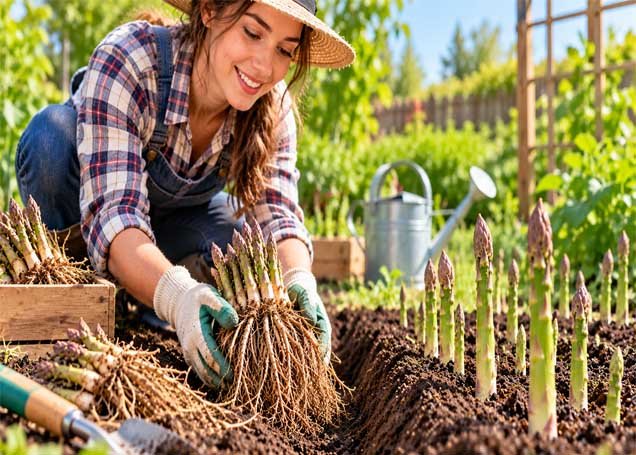
If you dream of harvesting fresh, tender asparagus from your own backyard, planting asparagus crowns is one of the best ways to get started. Unlike many vegetables that must be replanted every year, asparagus is a perennial crop that can produce delicious spears for 15 years or longer when grown in suitable conditions.
Asparagus crowns are dormant, established root systems that gardeners plant to create a new asparagus bed. They give plants a head start compared with growing asparagus from seed, making them a popular choice for beginners and experienced vegetable gardeners.
However, successful asparagus growing requires more than simply placing roots in the ground. Proper soil preparation, planting depth, spacing, drainage, and patience during the establishment period all play important roles in developing a productive bed.
In this complete guide, you’ll learn when and how to plant asparagus crowns, how deep to plant them, how far apart to space them, and how to care for your plants throughout their first few growing seasons.
What Are Asparagus Crowns?
Asparagus crowns are the dormant root systems of asparagus plants (Asparagus officinalis). They consist of a central crown with buds and fleshy roots that store energy for future growth.
When planted in suitable soil, these buds develop into asparagus spears. If the spears are allowed to grow, they become tall, fern-like foliage that produces energy through photosynthesis and stores it in the roots.
Most asparagus crowns sold to home gardeners are approximately one year old.
Planting crowns instead of seeds can shorten the establishment process, although asparagus still requires patience before regular harvesting begins.
Why Grow Asparagus from Crowns Instead of Seeds?
There are several advantages to starting with crowns:
- Faster establishment: Crowns are already developed plants rather than newly germinated seedlings.
- Simpler planting: You can place dormant crowns directly into a prepared garden bed.
- Reliable varieties: Named cultivars are often available as crowns.
- Less seedling care: You can avoid the indoor seed-starting process.
Asparagus seeds are still a good option, particularly when gardeners want to grow many plants economically. But for a small backyard garden, crowns are often more convenient.
Asparagus Crowns: Quick Growing Facts
| Growing Requirement | Recommendation |
|---|---|
| Botanical name | Asparagus officinalis |
| Plant type | Perennial vegetable |
| USDA hardiness | Commonly grown in Zones 3–8, depending on cultivar and local conditions |
| Sunlight | Full sun, preferably 6–8+ hours daily |
| Soil | Deep, fertile, well-drained |
| Preferred soil pH | Approximately 6.5–7.0 |
| Planting season | Early spring, when soil is workable |
| Typical crown spacing | 12–18 inches |
| Row spacing | Often 3–5 feet |
| Planting depth | Commonly 6–8 inches, adjusted for soil and climate |
| First substantial harvest | Usually the third growing season after planting crowns |
| Productive lifespan | Often 15 years or more with good care |
These figures are general guidelines. Follow cultivar instructions and recommendations from your local Cooperative Extension service, particularly for planting depth and harvesting.
When to Plant Asparagus Crowns in the USA
The best time to plant asparagus crowns is generally early spring, when the soil has thawed, excess water has drained, and the ground is workable.
Asparagus is a cool-season perennial that benefits from becoming established before summer heat arrives.
Unlike warm-season vegetables such as tomatoes and peppers, dormant asparagus crowns are commonly planted before the last spring frost. However, avoid planting into frozen or waterlogged soil.
General Planting Times by US Region
| Region | Typical Planting Window |
|---|---|
| Northeast | April–May |
| Midwest | March–May |
| Pacific Northwest | March–April |
| Mid-Atlantic | March–April |
| Southeast | February–April |
| Mountain West | April–May, depending on elevation |
| Warmer Southern Areas | Late winter to early spring where asparagus is suited to local conditions |
These are broad estimates, not fixed dates. Soil conditions, elevation, and regional climate can shift planting time considerably.
In warmer parts of the southern United States, asparagus may be less productive because plants receive insufficient winter dormancy or experience prolonged summer heat.
Gardening tip: Consult your local Extension office for recommendations before choosing asparagus varieties for warm climates.
How to Choose Healthy Asparagus Crowns
Healthy planting material is essential for establishing a long-lasting asparagus bed.
When buying asparagus crowns, choose a reputable nursery or garden supplier.
Look for crowns with firm, fleshy roots and a healthy central growing point.
The roots may appear tan or brown while dormant. That is normal.
Avoid crowns showing obvious mold, extensive decay, a foul smell, or severely damaged roots.
Popular Asparagus Varieties for Home Gardens
Several varieties are commonly grown in the United States.
Jersey Knight: A widely recognized hybrid known for productive spears and disease resistance.
Jersey Giant: Another established hybrid grown for large, attractive spears.
Mary Washington: An older, traditional variety often found in home gardens.
Purple Passion: A purple asparagus variety appreciated for its distinctive appearance and sweet flavor.
Millennium: A productive cultivar developed for cooler climates and valued in northern growing regions.
Variety availability and regional suitability differ. Some older cultivars may be less disease-resistant or productive than modern hybrids, so compare local recommendations before purchasing.
How to Prepare Soil for Asparagus Crowns
Because asparagus can remain in the same location for many years, soil preparation is one of the most important steps in the entire planting process.
A well-prepared bed supports strong root development, reduces weed competition, and improves long-term productivity.
Choose a Sunny Location
Select an area that receives at least six to eight hours of direct sunlight per day.
Although asparagus may tolerate some light shade, full sun generally produces stronger growth.
Choose a permanent location where the tall summer foliage will not shade smaller vegetables.
Asparagus ferns can grow several feet tall, so placing the bed toward the northern side of a vegetable garden may help reduce unwanted shading.
Improve Soil Drainage
Asparagus crowns are sensitive to prolonged waterlogging.
Heavy, compacted soil can restrict root growth and increase the risk of crown and root diseases.
If your garden has clay-heavy soil, consider improving its structure with compost and using a raised bed where drainage is poor.
Avoid low-lying areas where water remains after rain.
Test Your Soil
A soil test is one of the most useful preparations you can make before planting asparagus.
Asparagus generally grows best in soil with a pH around 6.5–7.0.
Your local Cooperative Extension office can provide soil testing guidance and fertilizer recommendations.
If the soil is too acidic, apply lime only according to a soil test recommendation, ideally well before planting so it has time to react.
Remove Perennial Weeds
Weeds are particularly troublesome in asparagus beds because the crop remains in place for many years.
Remove perennial weeds and their roots before planting.
Do not rely on regular deep cultivation after planting because asparagus crowns and roots can be damaged.
Mulching and careful shallow weed removal are useful maintenance strategies.
How to Plant Asparagus Crowns Step by Step
Planting asparagus crowns is straightforward once the soil has been prepared properly.
Follow these steps to give your plants a strong start.
Step 1: Dig a Planting Trench
Dig a trench approximately 6–8 inches deep and wide enough to spread the roots comfortably.
In heavier soils, shallower planting may be appropriate. Follow regional Extension recommendations rather than using one depth in every garden.
If planting multiple rows, allow approximately 3–5 feet between rows, depending on your gardening layout.
Step 2: Create a Small Soil Ridge
Form a low ridge of loose soil along the bottom of the trench.
This provides a slightly raised surface for positioning each crown.
Place the crown on the ridge with its buds facing upward and the roots spreading downward and outward.
Do not force the roots into a tight bundle.
Step 3: Space the Crowns Properly
Position crowns approximately 12–18 inches apart within the row.
Spacing requirements vary by variety, growing system, and regional recommendations.
Crowding plants can increase competition for moisture, nutrients, and sunlight.
Allowing sufficient space also makes future harvesting and bed maintenance easier.
Step 4: Cover the Crowns with Soil
After arranging the roots, cover the crowns with a few inches of loose soil.
Some traditional planting methods recommend filling the trench gradually as new shoots grow, while others allow the trench to be filled at planting.
Both methods appear in Extension guidance. Choose the approach recommended for your soil type and region.
Avoid burying crowns excessively deep in heavy or poorly drained soil.
Step 5: Water Thoroughly
Water the newly planted crowns to settle soil around the roots.
The goal is to provide adequate moisture without creating saturated conditions.
Continue checking the soil during the establishment period, especially during dry weather.
Step 6: Mulch and Control Weeds
Apply a light layer of suitable organic mulch after planting, taking care not to smother emerging shoots.
Mulch can help conserve moisture, moderate soil temperatures, and suppress weeds.
Inspect the bed regularly and remove weeds before they become established.
How Deep Should You Plant Asparagus Crowns?
Planting depth is one of the most common questions among beginner asparagus growers.
A traditional recommendation is to position crowns approximately 6–8 inches below the finished soil surface.
However, modern Extension recommendations vary. Some advise shallower planting, particularly in heavy soils or certain growing regions.
Excessively deep planting may delay spear emergence and reduce performance.
The most reliable approach is to follow your local Extension guidance and the planting instructions supplied with your cultivar.
Important: Measure planting depth from the final soil surface, not merely the temporary bottom of an open trench.
How Far Apart Should Asparagus Crowns Be Planted?
Correct spacing allows roots to expand and foliage to receive sufficient light.
For many home gardens, a spacing of 12–18 inches between crowns is practical.
Traditional row systems may require 3–5 feet between rows.
In raised beds, gardeners sometimes use alternative spacing arrangements, but crowding can reduce airflow and complicate harvesting.
Remember that mature asparagus plants become much larger than newly planted crowns.
Plan for their eventual size rather than the amount of space occupied at planting.
Watering Asparagus Crowns After Planting
Newly planted asparagus crowns require consistent moisture as their roots become established.
During dry periods, water deeply enough to moisten the root zone.
A general goal for established asparagus during active growth is approximately one inch of water per week from rainfall and irrigation combined, although soil, temperature, and plant age affect actual needs.
Young plants in sandy soil may need more frequent watering than plants in moisture-retentive loam.
Check the soil before watering rather than following a rigid daily schedule.
Signs of Too Little Water
- Weak or slow-growing shoots
- Dry soil around the roots
- Premature yellowing during drought
- Reduced fern development
Signs of Excessive Water
- Persistently soggy soil
- Poor shoot emergence
- Root or crown decay
- Stunted or declining plants
These symptoms may have several causes. Inspect soil drainage and plant health before making major changes.
Fertilizing Asparagus Crowns
Asparagus benefits from adequate nutrients, but excessive fertilizer is unnecessary and may cause problems.
The best approach is to test the soil before planting.
Incorporate mature compost or other appropriate organic matter during bed preparation.
Apply fertilizer according to soil test recommendations and regional growing guidance.
Avoid placing concentrated fertilizer directly against dormant crowns.
Once plants are established, annual nutrient management can help support healthy fern growth and long-term productivity.
Caring for Asparagus During the First Year
The first growing season is all about building a healthy root system.
New asparagus plants may produce thin spears that eventually develop into tall, feathery foliage.
Although these spears resemble the asparagus sold in grocery stores, resist the temptation to harvest them.
Allow the shoots to grow into ferns.
The foliage captures sunlight and produces energy that is stored in the crown for future seasons.
First-Year Care Checklist
- Keep the bed reasonably free of weeds.
- Water during prolonged dry periods.
- Allow spears to develop into mature ferns.
- Avoid unnecessary digging around the crowns.
- Watch for insect damage and disease.
- Maintain adequate drainage.
Healthy fern growth during the establishment years is essential for strong future harvests.
When Can You Harvest Asparagus After Planting Crowns?
Asparagus requires patience.
Most home gardeners should avoid harvesting during the first growing season after planting crowns.
Many Extension recommendations allow a short, limited harvest in the second year if plants are vigorous, while others recommend waiting until the third year.
By the third growing season, healthy plants may support a longer harvest period.
The exact schedule depends on crown age, plant vigor, cultivar, and local growing conditions.
General Harvesting Timeline
| Growing Season | Recommended Approach |
|---|---|
| Year 1 | Do not harvest; allow ferns to grow |
| Year 2 | Limited harvest only if plants are vigorous and local guidance supports it |
| Year 3 | Begin a more regular harvest, adjusted to plant strength |
| Year 4 onward | Harvest during the recommended spring period, then allow ferns to develop |
Stop harvesting when spear production becomes weak or the recommended harvest period ends.
Letting the remaining shoots develop into ferns replenishes the crown’s energy reserves.
How to Harvest Mature Asparagus
Once the bed is established, harvest spears while they are tender and before their tips begin to open.
Spears are commonly harvested when approximately 6–8 inches tall, although preferred length varies.
Cut them near the soil surface or snap them carefully by hand.
Avoid damaging nearby emerging spears or the underground crown.
During warm spring weather, asparagus can grow quickly and may require frequent checking.
Freshly harvested asparagus tastes best when used promptly or refrigerated.
Common Problems When Growing Asparagus Crowns
Asparagus is a relatively low-maintenance perennial once established, but several issues can affect growth.
1. Asparagus Crowns Are Not Sprouting
Dormant crowns may take time to produce shoots, particularly in cool soil.
Possible causes include cold temperatures, poor-quality planting material, excessive planting depth, or root rot.
Avoid digging up crowns repeatedly to check their condition.
Monitor soil moisture and temperature, and allow sufficient time for growth.
2. Asparagus Spears Are Very Thin
Thin spears are normal in young plants.
In established beds, consistently thin spears may indicate weak crowns, overcrowding, inadequate nutrition, or excessive harvesting.
Allowing healthy ferns to grow and following an appropriate harvest schedule can help maintain crown strength.
3. Asparagus Plants Turn Yellow
Yellowing can result from drought, nutrient deficiencies, disease, or normal seasonal dormancy.
Asparagus foliage naturally turns yellow or brown as plants enter dormancy in fall.
However, premature yellowing during active growth deserves closer inspection.
4. Asparagus Beetles
Asparagus beetles can damage spears and foliage.
Inspect plants regularly for beetles, eggs, and larvae.
Small infestations may sometimes be managed through hand removal.
Use local Extension recommendations for identifying and managing serious infestations.
5. Crown and Root Rot
Poor drainage and certain soilborne pathogens can contribute to crown and root diseases.
Prevention begins with healthy crowns, well-drained soil, and appropriate watering.
Avoid planting asparagus in areas with a history of serious asparagus root disease.
Growing Asparagus Crowns in Raised Beds
Raised beds can be useful where native soil is compacted or drains poorly.
However, asparagus needs substantial room for long-term root development.
Choose a sufficiently deep and wide raised bed rather than a shallow decorative planter.
Use a well-drained growing medium and avoid overcrowding crowns.
Because asparagus remains in place for many years, the bed should be durable and easy to access.
Consider how tall mature ferns will grow and whether they might shade nearby crops.
Can You Grow Asparagus Crowns in Containers?
Asparagus can be grown in large containers, but it is generally more productive and easier to maintain in garden soil or spacious raised beds.
Container-grown asparagus needs adequate root volume, excellent drainage, and consistent moisture.
Roots may become crowded over time, limiting the plant’s productivity and lifespan.
For gardeners with limited space, a large, deep container may be worth trying, but expectations should be more modest than for a permanent in-ground bed.
Best Companion Plants for Asparagus
Some gardeners grow shallow-rooted annuals near established asparagus beds.
However, companion planting claims should be treated cautiously because strong scientific evidence for specific plant partnerships is limited.
The most important considerations are avoiding excessive root competition, maintaining access for harvesting, and ensuring that asparagus ferns receive adequate sunlight.
Avoid planting aggressive, deeply rooted crops directly among asparagus crowns.
Common Mistakes to Avoid When Planting Asparagus Crowns
Even experienced gardeners can make mistakes when establishing asparagus.
Planting in poorly drained soil: Excess moisture can damage crowns and roots.
Harvesting too early: Removing spears during establishment can weaken developing plants.
Ignoring perennial weeds: Established weeds are difficult to remove without disturbing asparagus roots.
Planting crowns too close together: Overcrowding may reduce long-term performance.
Using unsuitable planting depth: Planting too deeply, especially in heavy soil, can delay growth.
Cutting healthy green ferns too early: Ferns replenish energy stored in the crown.
Skipping soil preparation: A poorly prepared bed may remain difficult to improve once asparagus is established.
Avoiding these mistakes can improve the chances of a healthy, productive asparagus patch.
Frequently Asked Questions About Asparagus Crowns
How long does it take asparagus crowns to grow?
Crowns may begin producing shoots during their first spring after planting, but establishing a productive bed usually takes two to three growing seasons.
How many asparagus crowns should I plant per person?
A commonly suggested starting point is approximately 10–20 crowns per person for households that enjoy fresh asparagus. Actual needs depend on plant productivity, serving size, and how frequently you plan to harvest.
Do asparagus crowns come back every year?
Yes. Asparagus is a perennial vegetable. Healthy crowns can produce new spears each spring for many years.
Should asparagus crowns be soaked before planting?
Some nurseries recommend briefly rehydrating dry crowns before planting, while others advise planting them directly. Follow your supplier’s instructions and avoid prolonged soaking that could damage the roots.
Can you plant asparagus crowns in the fall?
Spring is generally the preferred planting season in much of the United States. Fall planting may be possible in certain climates, but local conditions and supplier recommendations should guide the decision.
Do asparagus crowns need full sun?
Full sun is strongly preferred. Plants receiving six to eight or more hours of direct sunlight generally develop more vigorous growth.
How deep should I plant asparagus crowns in clay soil?
Shallower planting may be recommended in heavy soils, but drainage is the larger concern. Follow local Extension guidance and consider a raised bed if the soil remains waterlogged.
Can asparagus crowns grow in pots?
Yes, but asparagus develops an extensive root system. Large, deep containers are needed, and yields may be lower than in a well-prepared garden bed.
Why are my asparagus crowns not producing spears?
Possible reasons include cool soil, damaged crowns, poor drainage, excessive planting depth, or insufficient establishment time.
How long will an asparagus bed produce?
With suitable conditions and good maintenance, an asparagus bed can remain productive for 15 years or longer.
Final Thoughts
Planting asparagus crowns is an investment in your garden’s future.
Unlike annual vegetables that require replanting each season, a well-established asparagus bed can provide fresh spring harvests for many years.
The most important steps are choosing healthy crowns, preparing well-drained soil, planting at an appropriate depth, spacing plants correctly, and allowing the roots to establish before harvesting heavily.
Although asparagus requires patience during its first few seasons, the reward is a dependable perennial vegetable that can become one of the most valuable crops in your home garden.
If you’re planning your first vegetable garden, asparagus can be a rewarding long-term addition alongside seasonal crops such as tomatoes, potatoes, and leafy greens.
References and Further Reading
For further guidance, consult these university and horticultural resources:
- University of Minnesota Extension — Growing Asparagus in Home Gardens
- Iowa State University Extension — Home Gardening Resources
- University of Illinois Extension — Vegetables
- Royal Horticultural Society — Asparagus Growing Guide
These references are useful for checking regional growing practices, soil management, asparagus establishment, and harvesting recommendations.
Know more: How to Grow Zinnia Seedlings