Table of Contents
A laundry room does not need to be large to feel organized, practical, and inviting. With the right laundry room shelving, even a narrow laundry closet or a compact utility room can offer convenient storage for detergents, baskets, cleaning supplies, and everyday essentials.
The secret is choosing shelves that work with your available wall space, appliance layout, and household routine. Floating shelves can make a small room feel open, while adjustable shelving and closed cabinets help accommodate changing storage needs.
In this guide, explore 17 practical laundry room shelving ideas for American homes, including affordable options, renter-friendly alternatives, shelving above washers and dryers, useful measurements, and design tips that combine storage with style.
Quick Answer: What Is the Best Laundry Room Shelving?
The best laundry room shelving depends on the size of your space and what you need to store.
- Floating shelves: Best for a clean, open appearance and lighter everyday supplies.
- Adjustable wall shelving: Best for flexible storage and changing container sizes.
- Wire shelving: Best for affordable, ventilated storage.
- Wooden shelves: Best for adding warmth and decorative appeal.
- Closed cabinets: Best for keeping clutter and household products out of sight.
- Freestanding shelves: Best for renters or rooms where wall installation is not possible.
For most small laundry rooms, a combination of sturdy wall-mounted shelving, labeled storage containers, and accessible lower storage offers a practical starting point.
Laundry Room Shelving Ideas: Quick Comparison
| Shelving Type | Best For | Main Advantage | Consideration |
|---|---|---|---|
| Floating shelves | Small laundry rooms | Open, streamlined appearance | Must be properly anchored |
| Adjustable shelves | Flexible storage | Easy to reposition | Visible tracks or standards |
| Wire shelves | Budget-friendly storage | Lightweight, ventilated | Small bottles may tip |
| Solid wood shelves | Decorative spaces | Warm, natural finish | Needs moisture-resistant protection |
| Open shelves above appliances | Compact layouts | Uses vertical space | Appliance clearance matters |
| Closed cabinets | Concealed storage | Reduces visual clutter | Can feel bulky in tight rooms |
| Corner shelves | Unused corners | Makes awkward areas useful | Limited capacity |
| Freestanding shelving | Renters | No permanent wall mounting | Must be stable and tip-resistant |
| Pull-out shelves | Deep cabinets | Easier access to supplies | More expensive to retrofit |
| Shelf-and-rod combinations | Multipurpose laundry rooms | Storage plus hanging space | Requires suitable wall support |
17 Best Laundry Room Shelving Ideas
1. Install Floating Shelves Above the Washer and Dryer
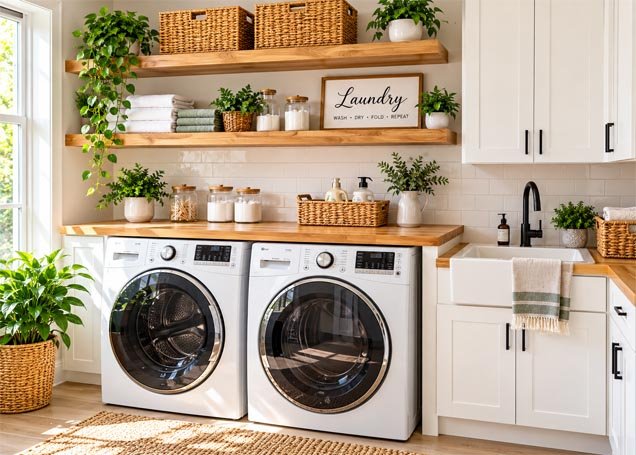
Floating shelves are among the most attractive laundry room shelving ideas because they create useful storage without making the room feel crowded.
Install shelves above a washer-dryer pair to hold lightweight baskets, folded towels, or frequently used supplies. A natural wood finish adds warmth, while white shelves blend into pale walls.
Before installation, check the appliance manufacturer’s required clearances, wall construction, and the shelf hardware’s rated load. Avoid positioning shelves where they obstruct appliance lids, doors, hoses, electrical connections, or ventilation.
Best for: Small laundry rooms with available wall space above appliances.
Design tip: Use two matching shelves with a little open space between them instead of filling the entire wall.
2. Choose Adjustable Laundry Room Shelving
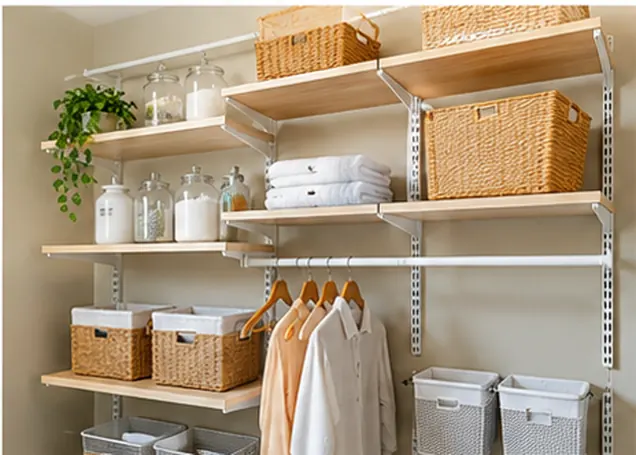
Adjustable shelving is especially useful when your storage needs change.
Wall-mounted standards and brackets allow you to reposition shelves to accommodate tall detergent bottles, baskets, or cleaning tools.
This system works well in busy family laundry rooms because you can rearrange the storage without replacing the entire unit.
Choose hardware designed for the wall type and intended load. The mounting instructions matter more than the shelf’s appearance.
Best for: Households that want flexible, long-term storage.
3. Use Wire Shelving for an Affordable Upgrade
Wire shelves are a practical option for utility-focused laundry rooms.
They are generally lightweight, allow air to circulate, and are available in several depths and configurations.
Wire shelving works particularly well for baskets, folded linens, and larger containers. If smaller items wobble or tip between the wires, add a compatible shelf liner.
Choose coated shelving suitable for potentially humid environments, and inspect the finish if moisture or rust becomes a problem.
Best for: Budget-friendly laundry closets and utility rooms.
4. Add Wooden Shelves for a Warm Farmhouse Look
Wooden laundry room shelving can make an ordinary utility space feel like a thoughtfully designed part of the home.
Natural oak tones, painted pine, and other wood finishes pair well with white cabinetry, woven baskets, and neutral walls.
For a farmhouse-inspired look, combine sturdy wooden shelves with simple brackets and matching storage containers.
Because laundry rooms may experience moisture and temperature changes, choose an appropriate finish and wipe up spills promptly.
Best for: Farmhouse, rustic, transitional, and modern laundry room designs.
5. Build Shelving Around a Laundry Room Window
A window can make shelving placement more challenging, but it also creates an opportunity for a custom-looking layout.
Instead of blocking natural light, install narrow shelves on either side of the window.
You can use these for lightweight baskets, decorative containers, or supplies that do not require frequent access.
Keep window handles, blinds, ventilation, and emergency access unobstructed.
Best for: Laundry rooms with a central window and limited wall space.
6. Install Corner Shelves to Use Awkward Spaces
Corners often become wasted space in small laundry rooms.
Compact corner shelves can hold baskets, folded cleaning cloths, or small household items without requiring a large wall-mounted unit.
Choose a design that does not project into a narrow walkway or interfere with opening appliance doors.
For a cohesive look, match the shelf finish to the cabinets or countertop.
Best for: Small utility rooms and unusual floor plans.
7. Combine Open Shelving With Closed Cabinets
Not everything in a laundry room needs to be displayed.
Open shelves work well for neatly arranged baskets and folded linens, while closed cabinets can conceal less attractive supplies.
This combination offers a balance between convenience and visual simplicity.
Place frequently used items where they are easy to reach. Keep hazardous laundry products in secure storage inaccessible to children and pets.
Best for: Family laundry rooms where both appearance and practical storage matter.
8. Add Shelves Above a Laundry Sink
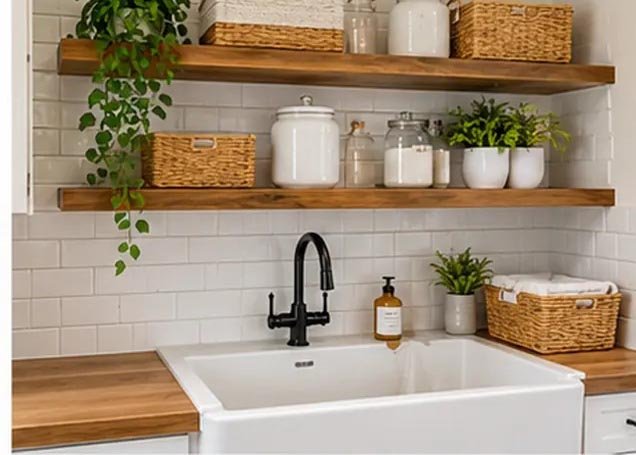
A utility sink is useful for rinsing, cleaning, and handling messy household tasks, but the surrounding wall can also provide storage.
Install a moisture-resistant shelf or cabinet above the sink where it will not interfere with the faucet or splash area.
Store appropriate cleaning cloths, spare towels, or other nonhazardous essentials in accessible containers.
Avoid positioning untreated wood directly where it will be repeatedly splashed.
Best for: Laundry rooms with a utility sink.
9. Use Narrow Shelves in a Laundry Closet
A laundry closet often has limited space around a stacked washer and dryer or a compact appliance pair.
Slim shelves can make use of the side walls without blocking access.
Measure the full appliance footprint, including doors, hoses, and required service clearances, before choosing a shelf depth.
In particularly narrow closets, shallow shelving may be more useful than deep shelves that make supplies difficult to reach.
Best for: Apartments, townhouses, and compact homes.
10. Install a Shelf-and-Hanging-Rod Combination
A shelf with a hanging rod underneath provides two functions in one wall area.
Use the upper shelf for baskets or folded items and the rod for air-drying suitable garments.
Position the rod where hanging clothes will not interfere with appliance operation, walking space, or electrical equipment.
Use hardware rated for the expected weight of wet clothing, which can be considerably heavier than dry garments.
Best for: Laundry rooms that double as clothing-care spaces.
11. Create Floor-to-Ceiling Storage
If floor space is limited, vertical storage may offer more capacity than adding another cabinet along the floor.
A tall shelving unit can hold seasonal linens, extra towels, baskets, and household supplies.
Keep heavier items on lower shelves and lighter, less frequently used items above.
Tall freestanding units should be secured against tipping according to the manufacturer’s instructions.
Best for: Laundry rooms with limited floor area but generous wall height.
12. Try Freestanding Laundry Room Shelving
Renters may prefer shelving that does not require drilling into walls.
A narrow freestanding unit can provide practical storage without permanent modifications.
Choose a stable design that fits around the available appliance space and allows required ventilation and servicing.
Do not place a freestanding unit where appliance vibration could cause it to shift, and follow anti-tip safety instructions.
Best for: Rental homes and flexible laundry room layouts.
13. Add Pull-Out Shelves Inside Cabinets
Deep cabinets often make it difficult to reach supplies stored at the back.
Pull-out shelves improve accessibility by bringing stored items forward.
They can be particularly useful for baskets, folded cleaning cloths, and everyday laundry accessories.
Check the cabinet’s internal dimensions, hardware clearance, and weight capacity before choosing a pull-out system.
Best for: Existing laundry cabinets with deep storage spaces.
14. Use Shelves With Matching Storage Baskets
Laundry room shelving looks more organized when smaller items are grouped into containers.
Matching baskets can hold dryer balls, stain-treatment accessories, clothespins, and other everyday essentials.
Use clear or readable labels so household members can find and return items easily.
Baskets should not become a substitute for secure storage of hazardous products.
Best for: Open shelving that needs to look tidy without sacrificing function.
15. Add a Shelf Above a Folding Counter
If your laundry room has a folding counter, the wall above it can provide additional storage.
A shallow shelf offers a convenient place for folded towels, empty baskets, or lightweight accessories.
Keep the main folding surface clear so it remains usable.
Avoid installing shelves so low that they obstruct the workspace or create a head-bumping hazard.
Best for: Laundry rooms with dedicated folding areas.
16. Choose Industrial-Style Metal and Wood Shelving
Metal brackets paired with wooden shelves can create a clean industrial look.
This combination suits modern farmhouse homes, loft-inspired interiors, and utility spaces where exposed hardware fits the design.
Choose corrosion-resistant finishes where moisture may be present.
As with any wall-mounted shelving, the brackets, fasteners, and wall structure must support the expected load.
Best for: Modern and industrial laundry room designs.
17. Create a Custom-Looking Shelving Wall
For a more finished appearance, coordinate shelves, cabinets, wall color, and storage containers.
A simple shelving wall might include:
- Two matching open shelves
- One closed upper cabinet
- A hanging rod
- Coordinated baskets
- A clear countertop or folding area
Keep the design practical rather than filling every available inch with storage.
Best for: Homeowners planning a cohesive laundry room refresh.
Best Laundry Room Shelving for Small Spaces

Small laundry room ideas work best when they prioritize accessibility and reduce unnecessary visual clutter.
Start by measuring the space before purchasing shelves. Include the width and depth of the appliances, door swing, utility connections, and walking area.
Small Laundry Closet
Use shallow wall-mounted shelves or a narrow side storage unit. Keep access to appliance connections and ventilation clear.
Side-by-Side Washer and Dryer
Consider shelves above the machines, provided the installation respects appliance clearances and the wall can safely support the shelving.
Stacked Washer and Dryer
Use available side walls rather than assuming there is room directly above the stacked appliances.
Laundry Room With a Sink
Combine moisture-resistant shelving with cabinets or containers positioned away from frequent splashing.
Laundry Room With Limited Wall Space
Try a freestanding storage unit, a narrow cabinet, or an existing cabinet fitted with pull-out organizers.
The goal is not to maximize the number of shelves. It is to make the room easier to use.
Laundry Room Shelf Measurements: What Should You Know?
There is no single ideal shelf height or depth for every laundry room.
The correct dimensions depend on your appliances, available wall area, reach, storage containers, and the manufacturer’s installation requirements.
The following measurements are planning examples, not universal installation standards.
| Measurement | Planning Example | What to Check |
|---|---|---|
| Shelf depth | 8–12 inches for many shallow wall shelves | Container depth and available clearance |
| Space between shelves | 12–16 inches for many baskets and bottles | Actual height of stored items |
| Shelf length | Based on available wall width | Wall support and shelf deflection |
| Shelf above washer | Determined by appliance and room layout | Lid movement, ventilation and service access |
| Shelf above folding counter | Based on comfortable reach | Head clearance and working space |
| Shelf load capacity | Manufacturer-specific | Brackets, anchors, studs and shelf material |
For example, if your storage basket measures 11 inches deep, a shelf that is only 8 inches deep may not provide adequate support.
Similarly, a tall detergent bottle needs enough vertical clearance to be lifted off the shelf without hitting the shelf above.
How to Measure Before Installing Shelves
- Measure the available wall width and height.
- Record appliance dimensions and required clearances.
- Identify electrical outlets, water connections, vents, and access panels.
- Measure the baskets and supplies you plan to store.
- Determine a comfortable reach height for everyday items.
- Check the wall structure and shelf manufacturer’s installation instructions.
For uncertain wall construction or heavy shelving, consult a qualified installer.
Floating Shelves vs. Wire Shelves vs. Cabinets
Choosing between different laundry room shelving materials can be easier when you compare their everyday benefits.
| Option | Appearance | Flexibility | Typical Use |
|---|---|---|---|
| Floating shelves | Minimal and decorative | Usually fixed | Baskets, towels, light supplies |
| Wire shelves | Functional | Often adjustable | Utility storage |
| Solid wood shelves | Warm and natural | Depends on hardware | Decorative and everyday storage |
| Laminate shelves | Smooth and coordinated | Depends on system | Cabinets and general storage |
| Metal shelving | Industrial or utilitarian | Often adjustable | Durable utility storage |
| Closed cabinets | Clean, concealed | Depends on interior shelves | Supplies kept out of sight |
No single material is automatically best for every home.
Consider moisture exposure, cleaning requirements, wall support, installation complexity, and the manufacturer’s load rating.
Budget-Friendly Laundry Room Shelving Ideas
A laundry room refresh does not necessarily require custom cabinetry.
Start with the storage you already own. Rearranging baskets and removing unnecessary items may reveal that you need fewer shelves than expected.
For an affordable upgrade, consider basic adjustable shelves, a simple freestanding unit, or a modest set of wall-mounted shelves.
Budget Planning Comparison
| Project Type | Relative Budget | Best Starting Point |
|---|---|---|
| Reorganize existing shelves | Very low | Reuse baskets and labels |
| Add basic wire shelving | Low | Utility-focused storage |
| Install simple wooden shelves | Low to moderate | Decorative wall storage |
| Add adjustable shelving tracks | Moderate | Flexible long-term storage |
| Retrofit cabinet pull-outs | Moderate to higher | Improve deep cabinet access |
| Build custom cabinets and shelves | Higher | Full laundry room renovation |
These are relative budget categories rather than verified US retail price quotes. Actual costs depend on dimensions, materials, installation, and local labor rates.
Laundry Room Shelving With a Countertop

A washer-dryer countertop can provide a convenient folding surface when the appliance configuration allows it.
However, not every washer or dryer can safely support a countertop or enclosure.
Some appliances require specific ventilation, access, movement, or installation arrangements. Always consult the manufacturer’s instructions before building around them.
If a countertop is suitable, coordinating it with upper shelving can create a cohesive design.
Use the counter for folding and sorting while reserving shelves for baskets and storage.
Image placement: A compact laundry room with a wooden folding counter, floating shelves, and neatly arranged storage baskets.
How to Style Laundry Room Shelves Without Creating Clutter
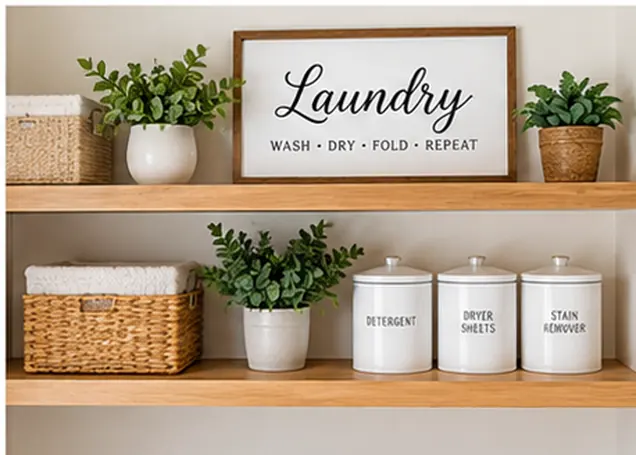
Attractive laundry room decor should make the space feel welcoming without interfering with daily chores.
A few simple choices can improve the appearance of open shelves.
Choose a Consistent Color Palette
White, natural wood, sage green, and soft gray can create a calm look.
Use one or two main finishes rather than mixing too many materials.
Group Similar Items
Keep folded towels together and place small accessories in labeled containers.
Leave Some Open Space
Shelves do not need to be filled edge to edge.
Empty space makes items easier to reach and helps the room look less crowded.
Prioritize Practical Storage
Decorative items should not occupy the most accessible shelves if you need those areas for everyday supplies.
Use Safe Storage for Laundry Products
Keep detergents, bleach, pods, and other hazardous products in their original labeled containers and securely out of reach of children and pets.
Avoid transferring these products into decorative jars or beverage-style containers.
Common Laundry Room Shelving Mistakes to Avoid
1. Installing Shelves Without Checking Appliance Clearance
Shelves should not obstruct appliance doors, ventilation, hoses, or service access.
2. Choosing Shelves That Are Too Deep
Deep shelves can make narrow rooms feel crowded and create awkward access.
3. Ignoring Weight Capacity
A shelf’s safe load depends on the complete installation, including its supports and wall structure.
4. Placing Heavy Items Too High
Store heavier items at lower, accessible levels to reduce the risk of falling objects.
5. Using Unprotected Materials in Damp Areas
Choose finishes appropriate for the laundry room’s moisture conditions.
6. Overfilling Open Shelves
Too many containers can make a small space feel cluttered and make supplies difficult to retrieve.
7. Forgetting About Household Safety
Secure tall furniture against tipping and keep hazardous laundry products safely stored.
Laundry Room Shelving Ideas for Different Home Styles
Modern Laundry Room
Choose clean-lined shelves, neutral finishes, and matching cabinets.
Farmhouse Laundry Room
Combine natural wood, simple brackets, woven baskets, and warm white walls.
Minimalist Laundry Room
Use fewer shelves, concealed storage, and consistent containers.
Traditional Laundry Room
Coordinate painted cabinetry with simple wooden or laminate shelves.
Industrial Laundry Room
Pair metal supports with durable wood-look surfaces and practical storage bins.
Regardless of style, a successful design begins with the way the room is used.
Frequently Asked Questions About Laundry Room Shelving
What type of shelving is best for a laundry room?
Adjustable wall shelving is a versatile option for many laundry rooms. Floating shelves are attractive for lighter items, while cabinets are useful when concealed storage is preferred. The best choice depends on the space, wall support, and intended load.
How deep should laundry room shelves be?
Shallow shelves around 8–12 inches deep can work for many baskets and everyday supplies, but there is no universal depth. Measure your containers and available clearance before selecting a size.
Can I install shelves above my washer and dryer?
Often, yes, provided the wall can support them and the shelves do not interfere with the appliances’ required clearances, ventilation, doors, connections, or servicing. Follow the appliance and shelving manufacturers’ instructions.
Are floating shelves strong enough for laundry supplies?
They can be, but strength depends on the shelf design, brackets, fasteners, wall structure, and installation. Follow the manufacturer’s rated load and mounting requirements.
What is the cheapest way to add laundry room shelving?
Reusing existing shelves or adding a basic utility shelving system can be economical. Compare the full cost of hardware, mounting supplies, and installation rather than considering shelf price alone.
How can I add storage to a laundry closet?
Use shallow shelves, narrow freestanding storage, or available side walls while preserving appliance clearance and access. A small number of well-positioned shelves often works better than bulky cabinets.
Should laundry room shelves be open or closed?
Open shelves offer convenient access and a lighter appearance. Closed cabinets hide visual clutter and can provide more secure storage when appropriately designed. Many laundry rooms benefit from a combination.
How do I make laundry room shelving look organized?
Group similar items, use matching baskets where practical, label containers, and avoid overcrowding. Keep frequently used supplies accessible and store hazardous products securely.
Final Thoughts
The best laundry room shelving combines practical storage, safe installation, and a design that suits your home.
Floating shelves can create a clean, modern look. Adjustable shelves make changing storage needs easier to manage. Wooden shelves add warmth, while cabinets and baskets help keep everyday clutter under control.
Whether you have a dedicated utility room, a narrow laundry closet, or a compact apartment laundry area, thoughtful shelving can make the space more functional without requiring a major renovation.
Start by measuring the room, identifying what needs to be stored, and choosing a shelving system that fits your available space. A few well-planned shelves can make laundry day considerably easier.
Further Reading and References
For additional guidance on safe storage, home organization, and household equipment, consult:
- U.S. Consumer Product Safety Commission (CPSC) — Home safety, furniture tip-over prevention, and product safety information.
- American Cleaning Institute — Laundry product safety and cleaning guidance.
- ENERGY STAR — Laundry appliance information and efficiency guidance.
- This Old House — Home improvement and storage project guidance.
Editorial note: Product load ratings, appliance clearances, and local building requirements vary. Always use the relevant manufacturer instructions for installation decisions.