Table of Contents
Open your bathroom vanity, and you might find half-used bottles in the back, a pile of washcloths, and a hairbrush somehow tangled with everything else. The cabinet looks full, yet the item you need is never where you expect it.
Learning how to organize bathroom cabinet storage starts with a better system, not a shopping cart full of matching bins. The goal is to make everyday products easy to reach, protect things that need dry storage, and leave room to access plumbing when necessary.
This guide covers a practical cabinet reset, 15 useful bathroom organization ideas, organizer measurements, and solutions for small vanities, deep shelves, and shared bathrooms. You’ll also learn what should stay out of a damp bathroom cabinet and how to keep the arrangement working after the initial cleanup.
Quick Answer: How to Organize Bathroom Cabinet Storage
To organize a bathroom cabinet, empty it, sort the contents by use, measure the usable interior, and choose organizers that fit around shelves, hinges, and sink pipes. Put daily essentials at the front, backups farther back, and small items in removable bins. Keep medicines and hazardous products securely stored in suitable locations, away from children.
For a fast reset, follow this order:
- Empty the cabinet and check for leaks or damp spots.
- Keep only items that belong in the bathroom.
- Separate daily-use products, occasional items, and backups.
- Measure the cabinet before buying anything.
- Add a few wipe-clean organizers, leaving plumbing accessible.
- Test the arrangement for a week before adding more storage.
The smartest way to learn how to organize bathroom cabinet space is to start with what you actually use, rather than trying to fill every inch.
Before Buying Organizers: Measure and Sort Your Bathroom Cabinet

A bathroom cabinet organizer isn’t helpful if the drawer cannot close or the bin blocks a water valve. A few minutes of preparation prevents expensive mistakes.
Remove Everything and Check the Cabinet
Take out the contents and place them on a clean towel. Check for empty packaging, damaged containers, expired products, and duplicates. Follow the product label when deciding whether something is safe to keep, donate, or dispose of.
Wipe suitable interior surfaces and let them dry completely. If the cabinet smells musty, has damp wood, or shows signs of a leak, address the moisture problem before adding baskets or liners. Don’t cover damage with shelf paper and assume it’s solved.
Sort by Use, Not Just by Product Type
Create four practical groups: morning routine, evening routine, weekly or occasional use, and unopened backups. Then separate anything that shouldn’t live in the bathroom, including products that need a cool, dry storage place.
If several people share the room, create a small group for each person. How to organize bathroom cabinet contents becomes much easier when each item has one predictable home.
Measure the Space You Can Actually Use
Take these measurements in inches:
| Measurement | Why it matters |
|---|---|
| Interior width | Determines which bins can sit side by side |
| Usable depth | Prevents organizers from hitting the back or blocking doors |
| Shelf-to-shelf height | Determines whether stackable drawers will fit |
| Door opening width | A wide organizer may fit inside but not pass through the opening |
| Plumbing clearance | Keeps the drain, supply lines, and shutoff valves accessible |
| Hinge and door clearance | Prevents over-door organizers from stopping the cabinet from closing |
For example, imagine a vanity cabinet with 22 inches of interior width, 18 inches of usable depth, and a drainpipe through the middle. Two narrow bins on either side of the pipe may work much better than one 20-inch-wide shelf. These are illustration measurements, not standard cabinet dimensions.
When deciding how to organize bathroom cabinet shelves, always measure the actual opening, not only the outer vanity width.
15 Smart Bathroom Cabinet Organization Ideas

These ideas address different problems. You probably won’t need all 15; choose the few that match your cabinet layout and daily routine.
1. Use Two Narrow Under-Sink Organizers Around the Pipes

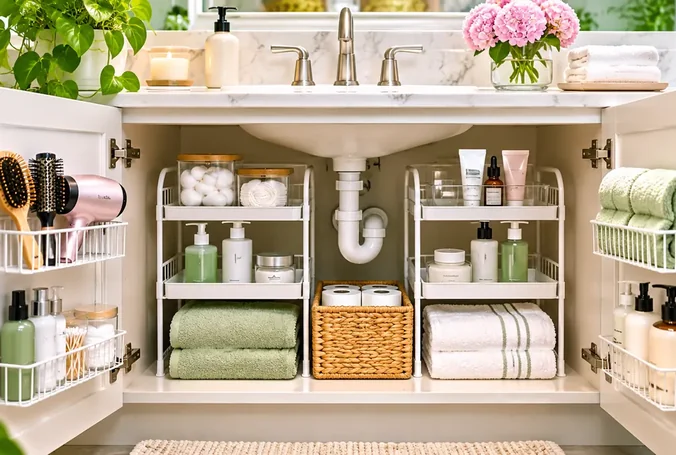
Under-sink storage often looks spacious until you account for the drainpipe and water lines. Instead of a large rectangular bin, place a narrow organizer on each side of the plumbing.
This under-sink storage approach keeps the center clear and makes items easier to retrieve. Removable two-tier units can work particularly well if there is enough vertical space. Avoid blocking shutoff valves or placing containers where they could strain plumbing.
Best for: Vanities with a central P-trap and limited usable shelf area.
2. Add a Pull-Out Drawer for Products at the Back
Deep cabinets encourage forgotten purchases. A sliding tray brings the back row forward without requiring you to move everything in front of it.
Choose a stable, appropriately rated pull-out organizer. Check whether the door opening and hinges allow it to extend fully. Renters may prefer freestanding sliding units rather than hardware that requires drilling.
Best for: Deep bathroom cabinet storage with hard-to-reach corners.
3. Group Daily Toiletries in a Clear Handled Bin
A washable, handled container gives toothpaste, floss, face wash, and similar items a single home. You can lift out the whole group when cleaning the shelf.
A clear bin makes contents easy to identify, but it doesn’t need to be see-through if a simple label works better. Select an easy-clean material suitable for your bathroom’s humidity.
Best for: Busy morning routines and shared vanity cabinets.
4. Use Drawer Dividers for Small Accessories

Hair ties, clips, cotton rounds, and grooming accessories tend to mix together inside a drawer. Adjustable dividers establish smaller spaces without adding bulky containers.
Measure the drawer’s inside dimensions and account for any raised sides or hardware. Start with only a few compartments, then revise them after you see which items need more room.
Best for: Shallow vanity drawers and small bathroom cabinet organization.
5. Install Cabinet Door Storage for Lightweight Items
The inside of a cabinet door can hold lightweight, nonhazardous accessories that would otherwise clutter a shelf. Look for slim adhesive pockets or a door-mounted rack specifically designed for the door material.
Before buying, close the door with a cardboard template in place. Make sure the organizer won’t hit a shelf, hinge, or nearby plumbing. Follow the manufacturer’s load rating, especially on thin cabinet doors.
Best for: Small vanities where every accessible surface matters.
6. Choose Stackable Clear Drawers for Vertical Space
A tall cabinet with one open shelf can waste usable height. Compact stackable drawers create separate levels for smaller items and help prevent top-heavy piles of loose products.
Look for drawers that can slide without lifting the entire stack. Keep heavier items low and leave adequate clearance above the top drawer.
Best for: Tall shelves with plenty of vertical clearance.
7. Try an Adjustable Shelf Riser
A shelf riser creates a second small platform above products that don’t need much height, such as folded washcloths or shallow containers.
Make sure the riser is stable and rated for the expected weight. Don’t place anything where it could fall when the cabinet is opened.
Best for: Simple bathroom cabinet storage without permanent installation.
8. Place Bottles on a Turntable in a Suitable Corner
A small turntable can make bottles easier to reach in a deep, open corner. Rotate it to find a product instead of moving several containers out of the way.
Choose a tray with a raised edge, check its diameter, and ensure nearby pipes or shelves won’t prevent rotation. This solution isn’t ideal for very narrow cabinets or tall bottles that could tip.
Best for: Deep corner shelves with open, unobstructed space.
9. Separate Everyday Products From Backup Supplies
One reason bathroom cabinet storage becomes messy is that opened products and unopened extras share the same space. Keep active items near the front and place one reasonable backup supply in a separate section.
If storage is tight, move surplus unopened items to a more appropriate dry location. Avoid keeping multiples simply because they were on sale.
Best for: Families and anyone who buys personal-care items in bulk.
10. Organize Skincare and Grooming by Routine
Instead of one mixed skincare box, create an everyday routine group and an occasional-care group. Keep containers capped and follow product-specific storage instructions.
Bathroom humidity can affect some cosmetics. The U.S. Food and Drug Administration notes that moisture and heat may affect product quality. If a label requires cool, dry storage, choose a more appropriate location outside the bathroom.
Best for: Cabinets filled with small bottles, tubes, and grooming products.
11. Store Folded Washcloths in a Small Open Bin
Clean, dry washcloths can disappear beneath larger towels. A shallow open bin keeps a limited supply together and makes it easy to see when you need to restock.
Fold or roll them consistently, but don’t squeeze so many into a container that they stay damp or become difficult to remove. Keep spare linens in a dry closet if bathroom storage is humid.
Best for: Cabinets with mixed linen and toiletries storage.
12. Create Personal Zones in a Shared Bathroom
When two or more people share a vanity, a divided cabinet can prevent daily items from becoming mixed up. Give each person a labeled small bin, shelf section, or suitable drawer compartment.
Keep shared items in their own central zone. Reserve the most accessible spots for frequently used products, while making sure any hazardous items remain securely stored away from children.
Best for: Family bathrooms, roommate apartments, and Jack-and-Jill layouts.
13. Use a Portable Caddy for Hair Accessories
Hairbrushes, combs, and hair accessories are easier to manage when they travel together in a removable caddy. Store unplugged hair tools only after they have cooled, following manufacturer instructions.
A portable unit is especially useful when the vanity doubles as a place for brushing hair, washing up, and getting ready.
Best for: Narrow cabinets where separate trays would create clutter.
14. Label Simple Storage Zones
Labels help more when they describe a routine than when they name every product. Try short categories such as DAILY, HAIR, WASHCLOTHS, or BACKUPS.
If you use clear containers, you may only need labels on the least visible ones. Choose labels that tolerate light humidity or can be replaced easily.
Best for: Shared cabinets and deep shelves with several bins.
15. Leave One Empty Zone for Flexibility
It sounds counterintuitive, but a completely packed cabinet rarely stays organized. Leave a small amount of free space for a new everyday product, a temporary extra supply, or easier access to existing items.
This also makes cleaning and spotting leaks simpler. Don’t force an extra shelf into a cabinet if it leaves you unable to reach the plumbing.
Best for: Almost every bathroom, especially small ones.
How to Organize Bathroom Cabinet Space Under the Sink
An under-sink cabinet has different limitations from a regular wall cabinet. Pipes, water connections, hinges, and occasional moisture all matter.
Start by mapping the left, right, front, and back sections. Use narrow, removable organizers beside the drain. Keep everyday nonhazardous items toward the front and store occasional items only where they remain visible and accessible.
A practical under-sink layout might look like this:
| Zone | Good use | Organizer |
|---|---|---|
| Front left | Everyday toiletries | Removable bin |
| Front right | Grooming accessories | Narrow slide-out tray |
| Back corners | Occasional items | Small labeled basket |
| Upper clear space | Lightweight extras | Stable shelf riser |
| Around pipes | Access area | Leave clear |
The goal of how to organize bathroom cabinet space beneath a sink isn’t to cover every opening with storage. It is to make the usable space work without compromising maintenance or safe storage.
If your cabinet shows water stains or has a persistent damp smell, investigate the cause before adding organizers. A decorative liner doesn’t fix a plumbing leak.
Small Bathroom Cabinet Storage: What Actually Works?
In a small bathroom, a few compact solutions usually outperform one oversized organizer. A narrow pull-out unit, one drawer divider, and a cabinet-door pocket may be enough.
If you have a pedestal sink: You may not have an enclosed cabinet at all. Consider a suitable wall cabinet or another stable storage solution rather than crowding the floor near the sink.
If your vanity has one narrow door: Check the opening width before purchasing sliding trays. Bins may fit inside the cabinet but fail to pass through the opening.
If your bathroom has no drawers: Use compact stackable units only when their contents remain easy to access, and they fit securely.
If you share the space: Give everyone a small, clearly defined zone rather than dividing the entire cabinet with bulky organizers.
These are the questions that matter when deciding how to organize bathroom cabinet storage in a small apartment: What must stay here? What do you reach for daily? What can move elsewhere?
For a related planning topic, see our entryway cabinet ideas guide, which explains how choosing appropriately sized storage can improve another high-traffic area of the home.
Bathroom Cabinet Organizer Comparison

Different products solve different problems. This table is a selection guide, not a claim that any particular organizer is the best on the market.
| Organizer type | Main advantage | Check before buying | Best use |
|---|---|---|---|
| Clear handled bin | Easy to remove and clean | Width and handle clearance | Everyday toiletries |
| Pull-out tray | Reaches deep shelves | Door and hinge clearance | Deep under-sink storage |
| Two-tier pipe-friendly unit | Uses space beside plumbing | Pipe height and access | Under-sink cabinets |
| Drawer dividers | Keeps small items separate | Drawer interior measurements | Accessories |
| Door rack | Uses overlooked vertical space | Door thickness and load rating | Lightweight items |
| Stackable drawers | Uses tall shelf height | Full drawer extension | Small bottles and supplies |
| Turntable | Makes corner items accessible | Diameter and rotation clearance | Bottle storage |
| Shelf riser | Adds a second level | Stability and weight rating | Folded towels and shallow bins |
Buying tip: Shop using your measurements, not pictures of perfect bathroom cabinet organization. A product’s exterior dimensions can differ from its usable interior size.
What Should You Not Store in a Bathroom Cabinet?
Not everything belongs in a bathroom, even when there is room.
Medicines: The FDA advises following medicine labels and generally using a cool, dry storage location rather than a damp bathroom cabinet. Medicines should remain in their original containers and be secured away from children.
Household cleaners: Keep hazardous products in original labeled containers and securely locked away from children. Avoid mixing cleaning chemicals or placing them in decorative containers.
Heat-sensitive cosmetics: Follow the manufacturer’s instructions, and don’t assume every cream or makeup product tolerates a humid room.
Electrical tools: Store unplugged equipment only after it has cooled, in a dry place away from water, following its manufacturer’s guidance.
Anything damp: Wet washcloths and towels should be dried before storage. A closed cabinet isn’t a substitute for drying or ventilation.
The FDA’s medicine storage guidance explains why moisture matters. The U.S. Consumer Product Safety Commission also emphasizes locking up medicines and household cleaners where children cannot reach them.
How to Keep Bathroom Cabinet Storage Organized
The first cleanup is only the beginning. Build a system that requires very little maintenance.
Every day: Return products to their assigned bin or shelf instead of leaving them on the counter.
Once a week: Straighten one crowded zone and wipe up any spills. Check that products are closed and the cabinet stays dry.
Once a month: Look for duplicate purchases, forgotten samples, packaging you can recycle, and signs of leaks. Review expiration or use-by information where provided.
Every season: Reconsider the layout if household routines or the number of people using the bathroom have changed.
If you already maintain other household storage zones, our guide on how to organize a laundry room offers a complementary approach for sorting supplies and assigning storage areas.
Common Bathroom Cabinet Organization Mistakes
Buying bins before measuring. This often leads to wasted shelf space or organizers that won’t pass through the cabinet door.
Blocking sink plumbing. Leave water connections and shutoff valves accessible for inspection and maintenance.
Keeping every backup in the bathroom. Extra stock can crowd daily essentials and may need a drier storage location.
Mixing personal products with hazardous cleaners. Store hazardous products securely in accordance with their labels and keep them away from children.
Stacking containers that cannot open. A tall arrangement is useless when you must dismantle it every morning.
Ignoring moisture. Solve leaks or dampness before adding liners, cardboard boxes, or shelves.
Expecting labels to fix clutter. A storage label can’t make up for having too many items in the cabinet.
Learning how to organize bathroom cabinet interiors becomes simpler when you avoid these mistakes before they turn into habits.
Bathroom Cabinet Organization Checklist
- Remove everything and inspect for moisture.
- Discard unusable items appropriately.
- Move unsuitable or unsafe products to secure storage.
- Group toiletries by daily routine and use.
- Measure the opening, depth, height, and plumbing clearance.
- Select only the organizers that fit and solve a problem.
- Keep daily items near the front.
- Separate personal-use products from backups.
- Leave water connections accessible.
- Label shared storage zones if helpful.
- Review the system after one week.
Use this as your starting point for how to organize bathroom cabinet storage without buying things you don’t need.
Frequently Asked Questions
What is the best way to organize a bathroom cabinet?
Empty the cabinet, group products by use, and put daily essentials in easy-to-reach bins. Choose organizers according to cabinet measurements rather than appearance. Leave plumbing access clear and keep medicines and hazardous products securely stored in suitable places.
How do you organize a bathroom cabinet with no drawers?
Use removable handled bins, stable shelf risers, or stackable drawers that fit the interior. For small items, a narrow door organizer can help if it doesn’t obstruct hinges or prevent the door from closing.
How do you organize under a bathroom sink with pipes?
Measure around the plumbing and use narrow bins or pipe-friendly organizers on either side. Don’t block valves, force trays against pipes, or cover signs of moisture damage.
How can I organize a bathroom cabinet on a budget?
Start by decluttering and reusing suitable wipe-clean containers. Purchase a drawer divider or sliding organizer only if you have a specific problem that the existing storage cannot solve.
What should go in a bathroom cabinet versus a drawer?
Cabinets often work well for taller bottles, washcloths, and larger removable bins. Drawers are convenient for small daily accessories. The exact layout depends on your vanity, routine, and storage conditions.
Are clear bins better for bathroom cabinet organization?
Clear bins make contents visible, but they aren’t essential. A solid container with a useful label can work just as well. Choose washable, appropriately sized materials and prioritize easy access.
Should medicine be stored in a bathroom cabinet?
Usually, a cool, dry location is preferable because bathrooms can be humid. Follow medicine storage labels and keep all medicines locked or otherwise securely out of children’s reach.
How often should I reorganize bathroom cabinet storage?
A short weekly reset and a monthly check are often enough. Reconsider the layout when products, routines, or household needs change rather than repeatedly buying new containers.
The same storage principles can work in utility spaces. See our laundry room shelving ideas for more ways to organize everyday household supplies.
Final Thoughts
A tidy vanity doesn’t depend on expensive organizers or a perfectly styled photograph. It depends on accessible daily essentials, containers that fit, and enough room for the cabinet to function safely.
Once you know how to organize bathroom cabinet storage around real measurements and actual routines, the space becomes much easier to maintain. Start with one drawer or one under-sink shelf, test your arrangement for a week, and add storage only where it helps.