Table of Contents
An entryway cabinet can make a surprising difference in how your home looks and functions. Instead of stepping over shoes, searching for keys, or leaving bags on the floor, you can give everyday belongings a convenient place near the front door.
The challenge is finding a cabinet that actually fits.
Some American homes have spacious foyers with room for substantial furniture. Others open directly into a living room or have a narrow hallway where every inch matters. Choosing the wrong entryway cabinet can make either space feel crowded.
Fortunately, there are plenty of attractive options, from slim shoe cabinets and modern storage units to farmhouse furniture and compact benches with hidden compartments.
In this guide, you’ll discover 15 practical entryway cabinet ideas, along with furniture measurements, organization tips, decorating inspiration, and advice for choosing storage that suits your home.
How to Choose the Right Entryway Cabinet
Before choosing a style or finish, consider what your entryway needs to store.
A cabinet that looks beautiful in a photograph may not work well if its doors block the hallway or its shelves cannot accommodate your shoes.
Start with four simple considerations.
1. Measure Your Entryway Carefully
Measure the width and depth of the available space, including baseboards, door trim, and nearby furniture.
Then check how the front door opens.
A cabinet should not interfere with the door swing, block access to electrical outlets, or obstruct a frequently used walkway.
As a general planning target, try to preserve approximately 36 inches of clear circulation space where possible. This is a practical design starting point, not a substitute for applicable building or accessibility requirements.
For a narrow hallway, a shallow cabinet may be more useful than a traditional deep storage unit.
Always compare the cabinet’s actual dimensions with the usable floor space.
2. Decide What You Need to Store
Think about what your household brings through the door every day.
Common items include:
- Everyday shoes and boots
- Keys, wallets, and sunglasses
- Handbags and backpacks
- Gloves, scarves, and hats
- Dog leashes and walking accessories
- Mail and small packages
A family with several children may need adjustable shoe storage and labeled compartments.
A couple living in a compact apartment may only need two drawers and a small cabinet for footwear.
Choose storage around your habits rather than buying the largest cabinet that fits.
3. Choose Open or Closed Storage
Closed storage helps hide clutter and creates a calmer appearance.
Cabinets with doors work particularly well for shoes, seasonal accessories, and miscellaneous belongings.
Open shelves make frequently used items easier to reach. However, they also require more consistent organization.
A combination of closed cabinets, drawers, and a small open shelf can provide a useful balance.
4. Consider Durability and Maintenance
Entryway furniture often experiences heavy daily use.
Choose finishes that are easy to clean and surfaces that tolerate occasional moisture from wet shoes or umbrellas.
Wood, engineered wood, metal, and mixed-material cabinets each have advantages.
The best choice depends on construction quality, local humidity, maintenance requirements, and your budget.
For tall or unstable furniture, follow the manufacturer’s wall-anchoring instructions. Never assume a narrow freestanding cabinet is stable simply because it looks substantial.
For more inspiration, explore these entryway storage ideas from Homes & Gardens, including practical ways to organize shoes, coats, and everyday essentials.
15 Brilliant Entryway Cabinet Ideas
These entryway cabinet designs offer practical storage for different homes, from compact city apartments to suburban houses with busy family entrances.
1. Slim Entryway Cabinet for Narrow Hallways
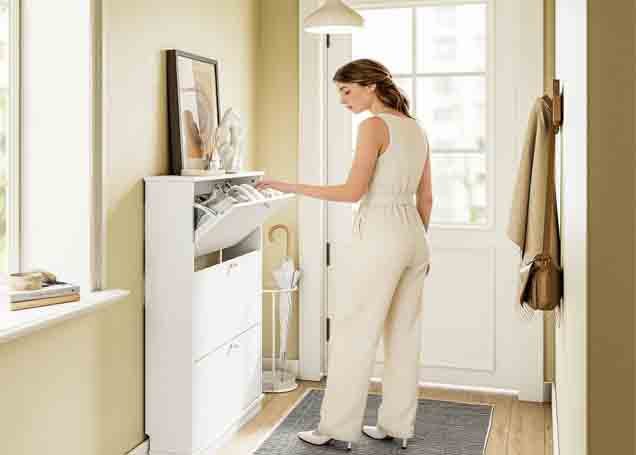
A slim entryway cabinet is one of the most practical choices for a hallway with limited floor space.
Look for a shallow unit that sits close to the wall while still providing storage for shoes, accessories, or everyday essentials.
Some slim cabinets use tilting shoe compartments instead of conventional shelves. This design can reduce the amount of floor space required, although it may not accommodate every type of footwear.
Choose a light finish if your hallway receives limited natural light.
A small wall mirror above the cabinet can complete the arrangement without adding another piece of furniture.
Best for: Narrow hallways, small apartments, and townhouse entrances.
Design tip: Check the cabinet’s depth with compartments fully open, not just when closed.
2. Entryway Storage Cabinet With Drawers
An entryway storage cabinet with drawers helps keep smaller belongings organized.
Use one drawer for keys and wallets, another for sunglasses and accessories, and a third for frequently used household items.
Drawer dividers can prevent everything from becoming mixed together.
If your entryway has room for a wider cabinet, consider a low unit with drawers above enclosed storage.
The top provides a convenient surface for a decorative bowl, lamp, or small plant.
Best for: Households that regularly misplace small essentials.
Design tip: Keep one drawer dedicated to items you need when leaving home.
3. Modern Entryway Cabinet With Hidden Shoe Storage

Shoes can quickly make a small entrance look untidy.
A modern entryway cabinet with concealed shoe storage offers a cleaner alternative to an exposed shoe rack.
Choose a unit with compartments that suit the footwear your household actually wears.
Tall boots, bulky sneakers, and high-top shoes may not fit in shallow tilt-out cabinets.
Ventilation also matters, especially when storing damp footwear.
Allow wet shoes to dry appropriately before placing them in enclosed compartments.
Best for: Families, apartments, and homes with a shoe-free indoor routine.
Design tip: Select a cabinet with removable or adjustable dividers when possible.
4. Farmhouse Entryway Cabinet With Rustic Character
A farmhouse-style entryway cabinet can bring warmth to a simple entrance.
Natural wood finishes, shaker-style doors, and understated hardware work well in this setting.
A medium-height cabinet with enclosed shelves can hold shoes, bags, and seasonal accessories.
Pair it with a woven basket or simple ceramic vase rather than filling the top with decorative objects.
For a modern farmhouse look, combine warm wood with white walls and black metal accents.
Best for: Farmhouse-inspired homes, cottages, and traditional suburban interiors.
Design tip: Choose durable finishes that can withstand daily contact with shoes and bags.
5. Small Entryway Cabinet With a Mirror
A mirror above a compact cabinet creates a useful getting-ready station near the door.
The cabinet stores everyday essentials while the mirror provides a convenient place for a final appearance check.
This arrangement can also reflect available light, making a small entrance feel brighter.
Choose a mirror that is proportional to the cabinet rather than extending far beyond its width.
For a narrow space, a tall oval or rectangular mirror may work better than a large round design.
Best for: Small entryways without a separate foyer.
Design tip: Leave enough space above the cabinet for useful items without overcrowding the surface.
6. Entryway Cabinet With Bench Seating
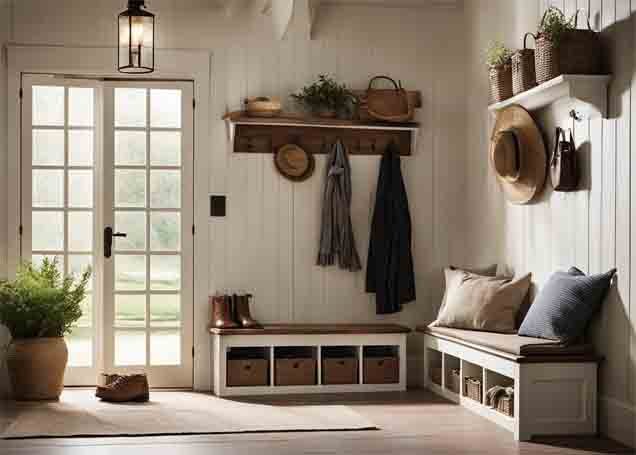
An entryway cabinet with a bench combines storage and seating.
It is especially useful when household members prefer to sit while putting on shoes.
Some designs feature drawers beneath the seat, while others use enclosed compartments or open cubbies.
Choose a bench with a comfortable seat height and enough strength for its intended users.
If the bench has a hinged storage lid, check that it opens safely and does not pinch fingers.
A washable cushion can add comfort without requiring elaborate decoration.
Best for: Family entrances, mudrooms, and homes where shoes are removed near the door.
Design tip: Leave sufficient space in front of the bench for sitting and standing.
7. Tall Entryway Cabinet for Vertical Storage
When floor space is limited, vertical storage may be the answer.
A tall entryway cabinet can hold seasonal accessories, bags, and household supplies without occupying a wide section of the hallway.
Adjustable shelves are particularly useful because storage needs change throughout the year.
Keep frequently used items at comfortable reaching heights.
Place heavier items on lower shelves, and avoid overloading upper compartments.
Tall cabinets should be secured according to the manufacturer’s instructions to reduce tipping risks.
Best for: Compact homes with limited closet space.
Design tip: Choose a cabinet with doors to keep the tall storage unit from looking visually busy.
8. Floating Entryway Cabinet for a Modern Look

A floating entryway cabinet creates storage while keeping the floor beneath it visible.
This can make a compact entrance feel less crowded.
Wall-mounted cabinets work well for keys, mail, small accessories, and lightweight everyday items.
However, they must be installed using suitable wall supports and hardware rated for the expected load.
Drywall anchors alone may not be appropriate for every cabinet or wall condition.
If you’re renting, confirm whether permanent wall installation is permitted.
Best for: Modern apartments and minimalist interiors.
Design tip: Keep the cabinet shallow and avoid storing heavy objects unless the installation is designed for them.
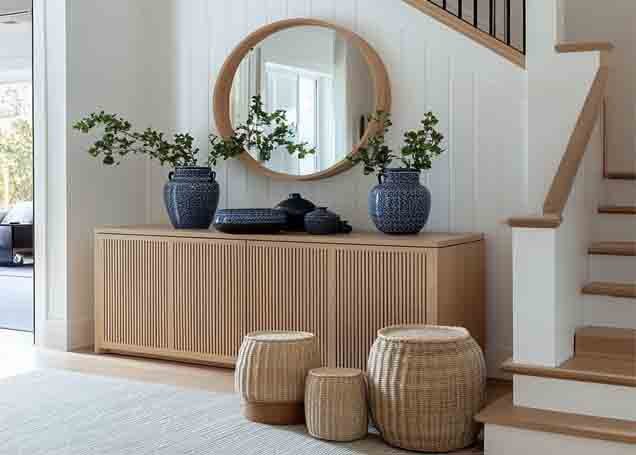
9. Rattan-Door Entryway Cabinet
A cabinet with woven or rattan-style doors adds texture without overwhelming a neutral interior.
This style works especially well with natural wood, soft white walls, and simple greenery.
Depending on the construction, woven door panels may provide some airflow, although they should not be treated as a complete solution for damp shoe storage.
Choose a cabinet with practical internal shelving rather than selecting it solely for appearance.
A small tray on top can keep keys and other accessories contained.
Best for: Coastal, bohemian, and relaxed contemporary homes.
Design tip: Repeat natural textures through one basket or a simple rug rather than adding too many decorative elements.
10. Corner Entryway Storage Cabinet
Corners are often overlooked when planning entryway furniture.
A compact corner cabinet can make use of an awkward area without occupying an entire wall.
Look for a design that allows cabinet doors and drawers to open fully.
In a tight corner, a narrow cabinet with open shelves may be more practical than one with wide swinging doors.
You can also use a small cabinet positioned diagonally, provided it doesn’t interfere with circulation.
Best for: Small foyers and irregularly shaped entrances.
Design tip: Mark the cabinet footprint on the floor before purchasing.
11. Minimalist White Entryway Cabinet
A white entryway cabinet can create a bright, simple appearance, particularly in a space with limited natural light.
Choose a design with clean lines and discreet handles.
Closed doors keep shoes and everyday clutter out of sight.
A matte or satin finish may be easier to coordinate with existing furniture than a highly reflective surface.
Add a small mirror or framed artwork above the cabinet.
Keep decorative accessories minimal so the storage remains the main functional feature.
Best for: Contemporary apartments and Scandinavian-inspired interiors.
Design tip: Consider an easy-clean finish because entryway surfaces frequently collect fingerprints and marks.
12. Entryway Cabinet With Adjustable Shelves
Adjustable shelves are useful when your storage needs change.
A cabinet that holds sneakers in summer may need to accommodate boots and heavier accessories in winter.
Movable shelves allow you to adapt the interior without replacing the entire cabinet.
Before purchasing, check how much weight each shelf can support.
Also consider whether shelves can be removed easily for cleaning.
A flexible cabinet is often a better long-term choice than one with several fixed compartments of identical size.
Best for: Families and households with changing seasonal storage needs.
Design tip: Measure your tallest frequently used items before choosing shelf spacing.
13. Entryway Cabinet for Small Apartments
Not every apartment has a separate entryway.
In some homes, the front door opens directly into the living room.
A compact entryway cabinet can help create a designated drop zone without building a new wall.
Place a slim cabinet near the entrance, then add a mirror or a small piece of artwork above it.
Choose furniture that matches the nearby living room so the arrangement feels intentional.
If space is especially limited, consider a narrow cabinet with a drawer and a small enclosed compartment.
For more ideas on making compact rooms feel comfortable, explore our small living room layout ideas.
Best for: Studio apartments, condos, and smaller rental homes.
Design tip: Avoid placing furniture where it interferes with the front door or an emergency exit route.
14. Entryway Cabinet With Coat Hooks
Combining a low cabinet with coat hooks creates a practical entryway organization station.
The cabinet can hold shoes and small accessories, while hooks provide a convenient place for everyday jackets and bags.
Use hooks rated for the items you intend to hang.
Install them into suitable wall supports, particularly when storing heavy backpacks.
For families, place frequently used hooks at heights appropriate for the people using them.
A narrow shelf above the hooks may provide additional storage, but keep heavier items securely stored lower down.
Best for: Busy households without a dedicated coat closet.
Design tip: Limit the number of items hanging on each hook to avoid a crowded appearance.
15. Multi-Purpose Entryway Cabinet for Families
A family entryway needs to accommodate several people’s belongings without becoming chaotic.
A multi-purpose entryway cabinet with drawers, adjustable shelves, and enclosed compartments can help.
Assign each family member a designated area.
Use small labels or drawer organizers if necessary.
Keep daily essentials close to the door, while seasonal items can occupy less accessible shelves.
For larger households, combining one cabinet with a storage bench may work better than buying an oversized cabinet.
Best for: Family homes with children, school bags, and multiple pairs of everyday shoes.
Design tip: Make the organization system simple enough for everyone to maintain.
Entryway Cabinet Size and Storage Comparison
Choosing the right cabinet dimensions is often more important than choosing a particular decorating style.
The table below provides approximate shopping ranges for common entryway furniture categories. These are planning examples, not universal product specifications.
| Cabinet Type | Typical Width to Explore | Depth to Explore | Best Use |
|---|---|---|---|
| Slim shoe cabinet | 24–36 inches | 7–12 inches | Narrow hallways |
| Compact storage cabinet | 24–40 inches | 12–16 inches | Shoes and accessories |
| Drawer cabinet | 30–48 inches | 12–18 inches | Keys, mail, and mixed storage |
| Storage bench | 30–48 inches | 14–20 inches | Seating and shoes |
| Tall hallway cabinet | 18–36 inches | 12–20 inches | Vertical storage |
| Low entryway sideboard | 40–60 inches | 14–20 inches | Larger foyers |
Always check the exact manufacturer’s dimensions, including handles, open doors, and extended drawers.
How Deep Should an Entryway Cabinet Be?
The ideal depth depends on the available space and the items you need to store.
A shallow shoe cabinet may be suitable for a narrow hallway, but its compartments may not fit larger footwear.
A deeper cabinet can accommodate more varied belongings, although it also reduces available walking space.
Before buying, place painter’s tape on the floor to represent the cabinet footprint.
Open the front door and walk through the space as you normally would.
If the arrangement feels restrictive, consider a shallower model.
How Tall Should an Entryway Cabinet Be?
A low cabinet can provide a convenient surface for keys and small accessories.
A taller cabinet offers more enclosed storage but may dominate a compact room.
Consider whether you want the top surface for decoration or prefer to maximize vertical storage.
Tall cabinets also require careful attention to stability and wall anchoring.
Entryway Cabinet Ideas for Small Spaces
A small entrance doesn’t necessarily need less storage. It needs storage that fits the available space.
Use a Narrow Cabinet Instead of a Full-Size Sideboard
A shallow cabinet can provide enough room for essential belongings without making the hallway uncomfortable.
Choose one with drawers or enclosed compartments rather than a large decorative console with little usable storage.
Keep the Floor as Open as Possible
Visible floor space helps an entryway feel less crowded.
Wall-mounted storage may work well where appropriate, but installation requirements must be considered.
Slim legs can also create a lighter visual appearance than a solid cabinet base.
Combine Storage With a Mirror
A mirror and cabinet work well together because they provide two useful functions within the same wall area.
Choose proportional pieces and avoid covering the entire wall with accessories.
Use the Space Beneath Stairs
Some American homes have unused space beneath a staircase near the entrance.
A properly designed cabinet can make this area useful for shoes, bags, or seasonal accessories.
For built-in projects, check structural, electrical, ventilation, and local building requirements before modifying the space.
Create a Drop Zone in an Open-Plan Home
If your front door opens into the living room, place a compact cabinet along a nearby wall.
Add a tray for keys and a small basket for frequently used accessories.
This creates a recognizable entry area without changing the floor plan.
How to Organize an Entryway Storage Cabinet
Even a beautiful cabinet becomes frustrating when items are difficult to find.
A simple organization system can make everyday routines easier.
Step 1: Empty and Sort Everything
Remove all items from the cabinet.
Separate belongings into categories such as shoes, accessories, mail, and seasonal items.
Move anything that doesn’t belong near the entrance to a more suitable storage area.
Step 2: Keep Daily Essentials Accessible
Store frequently used items in the easiest compartments to reach.
Keys, sunglasses, and dog leashes should have consistent locations.
Occasionally used accessories can go on higher or lower shelves.
Step 3: Use Drawer Dividers
Small dividers help prevent drawers from becoming cluttered.
Assign separate sections to keys, wallets, charging accessories, and other everyday items.
Step 4: Organize Shoes by Frequency of Use
Keep everyday shoes in the most accessible compartments.
Store occasional footwear elsewhere when space is limited.
Allow damp footwear to dry before placing it in enclosed storage.
Step 5: Review the Cabinet Seasonally
Storage needs change throughout the year.
In winter, you may need more room for gloves, scarves, and boots.
During warmer months, lighter accessories may take priority.
A quick seasonal review helps prevent unnecessary clutter.
If you’re organizing other areas of your home, our bedroom storage ideas and laundry room shelving ideas offer additional approaches.
Entryway Cabinet Decorating Ideas
Your entryway cabinet can be practical without looking purely functional.
The key is keeping decoration proportional to the space.
Add a Mirror Above the Cabinet
A mirror provides a useful function and can reflect available light.
Choose a shape that complements the cabinet and surrounding architecture.
Use a Decorative Tray
A tray helps contain keys, sunglasses, and other small items.
It also makes the cabinet surface easier to clean.
Introduce Greenery
A small houseplant can soften the appearance of wood or metal furniture.
Choose a plant suited to the entryway’s available light.
If natural light is limited, avoid placing a sun-loving plant in a dark corner.
Choose Practical Lighting
A small lamp can make an entrance feel welcoming when an appropriate outlet is available.
Use safe cord placement and avoid obstructing walkways.
Where outlets are limited, a suitable rechargeable light may be an alternative.
Keep the Color Palette Consistent
Choose finishes that coordinate with nearby furniture.
Warm wood, soft white, muted green, and black accents can work well in different interior styles.
There is no need to match every item exactly.
A few coordinated materials usually look more intentional than many competing finishes.
Common Entryway Cabinet Buying Mistakes
An attractive cabinet isn’t necessarily the right cabinet for your home.
Avoid these mistakes before purchasing.
Choosing Appearance Over Function
A cabinet may look beautiful but offer very little usable storage.
Check shelf dimensions, drawer capacity, and door operation.
Ignoring the Front Door Swing
Always measure how far the door opens.
A cabinet that blocks an entrance can create an everyday inconvenience and potentially interfere with safe movement.
Buying a Cabinet That’s Too Deep
A large cabinet can make a narrow hallway feel cramped.
Prioritize circulation space over maximum storage capacity.
Forgetting About Shoe Sizes
Some narrow shoe cabinets cannot accommodate bulky sneakers or tall boots.
Check internal dimensions before purchasing.
Overlooking Furniture Stability
Tall and narrow cabinets may require wall anchoring.
Follow manufacturer instructions, especially in households with children.
Choosing Difficult-to-Clean Materials
Entryways collect dust, dirt, and moisture.
Select finishes and surfaces that suit the amount of maintenance you’re willing to perform.
Filling Every Available Corner
Too much furniture can make an entrance less useful.
Choose one well-designed cabinet before adding benches, shelves, and decorative accessories.
Entryway Cabinet vs. Console Table: Which Is Better?
An entryway cabinet and a console table serve different purposes.
| Feature | Entryway Cabinet | Console Table |
|---|---|---|
| Hidden storage | Usually available | Often limited |
| Shoe organization | Some models support it | Usually requires baskets or added storage |
| Visual appearance | More substantial | Often lighter and more open |
| Best for clutter control | Strong option | Depends on accessories |
| Small hallway suitability | Choose a shallow model | Slim models can work well |
| Decorating surface | Usually available | Usually available |
Choose an entryway cabinet if concealed storage is your main priority.
A console table may be enough if you primarily need a surface for keys and decorative accessories.
For many households, a compact cabinet with drawers offers a useful compromise.
Frequently Asked Questions About Entryway Cabinets
What is the best entryway cabinet for a small hallway?
A slim cabinet with shallow depth and enclosed storage is often a practical choice. Measure the available space, door swing, and walking route before purchasing. A tilt-out shoe cabinet may work well if its compartments fit your footwear.
What is the difference between an entryway cabinet and a shoe cabinet?
An entryway cabinet may store shoes, accessories, bags, and other household items. A shoe cabinet is designed primarily for footwear. Some entryway storage cabinets combine both functions.
How deep should a narrow entryway cabinet be?
Some slim cabinets are approximately 7–12 inches deep, while general-purpose storage cabinets may be deeper. The appropriate size depends on your hallway and the items you need to store. Always check the exact product dimensions.
Can I put an entryway cabinet in a living room?
Yes. In an open-plan home, a compact cabinet near the front door can establish a convenient entryway zone. Choose a style that coordinates with the living room furniture and doesn’t obstruct movement.
Are floating entryway cabinets practical?
They can be useful for lightweight everyday items and compact spaces. However, safe installation requires suitable wall construction, mounting hardware, and adherence to the manufacturer’s load limits.
What should I store in an entryway cabinet?
Common items include everyday shoes, keys, sunglasses, wallets, gloves, scarves, and dog leashes. Keep frequently used belongings accessible and move rarely used items to other storage areas.
How can I make an entryway cabinet look expensive?
Choose furniture with balanced proportions, consistent finishes, and simple hardware. Keep the surface organized and add one or two decorative accessories, such as a mirror and a small vase. Good styling doesn’t require expensive materials.
Is an entryway cabinet better than a storage bench?
It depends on your needs. A cabinet generally provides more concealed organization, while a storage bench adds a place to sit. If your entryway is large enough, combining the two can be useful.
How do I keep shoes from smelling inside a cabinet?
Allow shoes to dry before storing them, clean the cabinet regularly, and avoid overcrowding. Choose a cabinet with suitable ventilation and follow footwear care instructions. Persistent moisture problems should be addressed rather than covered with fragrance.
Final Thoughts
The right entryway cabinet can make your home easier to organize while creating a more welcoming entrance.
For a narrow hallway, a shallow shoe cabinet may be the best solution. A family home may benefit from a storage bench and drawers, while a modern apartment might need only a compact cabinet with a mirror above it.
Focus on measurements, everyday storage needs, and clear walking space before choosing a design.
A carefully selected cabinet will do more for your entryway than several decorative pieces that don’t serve a practical purpose.