Table of Contents
A kitchen can have beautiful countertops, attractive cabinets, and carefully chosen lighting yet still feel crowded. Sometimes, the problem isn’t a lack of space. It’s how the walls are being used.
That’s where floating shelves kitchen ideas can make a difference.
A pair of natural wood shelves can soften a modern kitchen. A narrow shelf beside the sink can keep everyday mugs within reach. Even an awkward corner can become useful storage without installing another bulky cabinet.
But floating shelves aren’t automatically practical. Choose the wrong depth, place them too close to cooking heat, or fill them with too many dishes, and the result can be disappointing.
The good news? You don’t need to replace every upper cabinet to make this design work.
This guide covers 17 beautiful kitchen floating shelves ideas, along with shelf dimensions, material choices, styling tips, and common mistakes to avoid.
Quick Answer: Are Floating Shelves Good for Kitchens?
Yes. Floating shelves can be an attractive and practical addition to a kitchen when they’re properly supported, positioned conveniently, and used for suitable items.
They’re particularly useful for everyday mugs, dishes, small serving bowls, and a few decorative pieces.
However, open shelves require more cleaning than closed cabinets because their contents remain exposed to dust and cooking residue.
For most homes, combining floating kitchen shelves with existing cabinets is a sensible starting point.
17 Beautiful Floating Shelves Kitchen Ideas
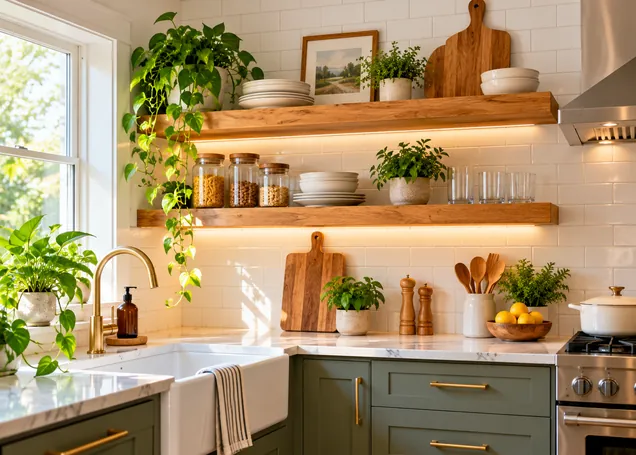
1. Natural Wood Floating Shelves for a Warm Kitchen
Natural wood is one of the easiest ways to introduce warmth into a kitchen dominated by painted cabinets, tile, and stone countertops.
Oak, maple, and walnut each create a different appearance. White oak feels light and relaxed, maple offers a smoother grain, and walnut brings richer brown tones.
For a fresh modern farmhouse kitchen, combine natural wood floating shelves with white cabinets and a soft green backsplash.
Keep the styling simple. A few ceramic bowls, everyday plates, and clear drinking glasses allow the wood grain to remain visible.
Best for: Modern farmhouse, Scandinavian, and transitional kitchens.
Practical tip: Choose a properly finished surface that tolerates normal kitchen humidity and frequent wiping. Unfinished wood can absorb moisture and become stained.
2. White Floating Shelves for a Bright, Minimalist Look
White floating shelves work beautifully in smaller kitchens because they blend into light-colored walls.
The effect is especially attractive against white subway tile or a cream-colored backsplash.
Rather than creating a strong horizontal contrast, white shelves visually become part of the wall. This helps the arrangement feel lighter.
Try displaying neutral stoneware, clear glasses, and one small wooden accessory.
If your kitchen already has white cabinets, matching the shelf finish can create a consistent appearance.
Best for: Small kitchens, contemporary apartments, and minimalist interiors.
Design tip: Use a durable, washable finish. Kitchen shelves need to withstand more frequent cleaning than purely decorative wall shelves.
3. Floating Kitchen Shelves Above the Sink
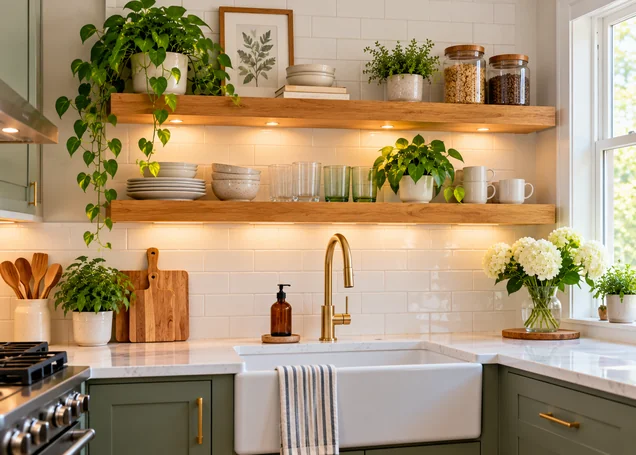
The wall above a kitchen sink is often a convenient location for open shelving.
A floating shelf here can hold everyday glasses, mugs, or small dishes. It also provides an opportunity to display a small plant near a window.
If the sink sits between two upper cabinets, a short wood shelf can create a pleasant transition without adding visual weight.
Be careful with shelf depth. A shelf that projects too far may make the sink uncomfortable to use.
Keep frequently used items within easy reach, and use moisture-resistant finishes where splashing is likely.
Best for: Kitchens with an open sink wall or window.
Design tip: Leave comfortable headroom and ensure the faucet remains easy to operate.
4. Rustic Solid Wood Floating Shelves
For a farmhouse-inspired kitchen, consider solid wood floating shelves with visible grain and a slightly textured finish.
Reclaimed-looking wood can add character, particularly when paired with shaker cabinets, vintage-style hardware, or a simple tile backsplash.
You don’t need to cover the shelves with decorative objects.
A stack of white plates, a ceramic pitcher, and a wooden serving board can create a welcoming arrangement.
When choosing genuine reclaimed wood, inspect its condition and select material appropriately prepared and sealed for indoor use.
Best for: Rustic, farmhouse, and cottage kitchens.
Practical tip: Solid wood floating shelves can be heavy before anything is placed on them. Confirm that both the mounting hardware and wall structure can support the complete load.
5. Black Floating Shelves for a Modern Kitchen
Black floating shelves create a sharp contrast against white walls and light-colored cabinetry.
They work particularly well when the kitchen already includes black cabinet handles, pendant lights, or faucet fixtures.
For a softer contemporary look, combine matte black shelves with warm wood countertops and cream-colored dishes.
Avoid filling every shelf with dark objects. Mixing light ceramics with the darker shelf finish creates better visual definition.
Best for: Modern, industrial, and monochrome kitchen designs.
Design tip: Matte finishes can show dust and fingerprints, so choose a surface that’s straightforward to clean.
6. Corner Floating Shelves for Awkward Spaces
Kitchen corners often become difficult areas to use efficiently.
Corner floating shelves can turn a small unused section into storage for mugs, small bowls, or decorative pottery.
For a compact kitchen, two short shelves may work better than one deep corner unit.
You can also extend shelves along one wall and stop them before the adjoining cabinet.
Before choosing a corner design, check cabinet-door movement and available wall support.
Best for: Compact kitchens and layouts with awkward corners.
Practical tip: Avoid creating deep, inaccessible storage. Items placed at the back should remain easy to reach without disturbing everything in front.
7. Floating Shelves Beside Kitchen Cabinets
One of the most balanced ways to use kitchen floating shelves is to install them beside existing cabinets.
This gives you the visual openness of shelves without sacrificing all your enclosed storage.
For example, a pair of wooden shelves between an upper cabinet and a window can make an otherwise ordinary kitchen wall feel more intentional.
Use the cabinets for food packaging, bulky equipment, and less attractive necessities.
Reserve the shelves for everyday dishes or objects you enjoy seeing.
Best for: Kitchens where storage capacity is already limited.
Design tip: Align the shelves thoughtfully with nearby cabinet edges or backsplash lines for a coordinated appearance.
8. Floating Shelves With a Full-Height Tile Backsplash
A backsplash extending from the countertop toward the ceiling creates an attractive background for floating shelves.
White rectangular tile offers a clean appearance. Handmade-look tile adds subtle texture, while deep green or blue tile creates stronger contrast.
Natural wood shelves can soften colorful tile.
For a modern look, consider thin shelves in a finish that coordinates with the cabinetry.
The backsplash pattern should remain visible, so avoid crowding the shelves with too many objects.
Best for: Kitchens with a feature wall or recently updated backsplash.
Practical tip: Installing shelves over tile requires appropriate mounting methods. Have a qualified installer assess the wall construction, concealed services, and shelf loads before work begins.
9. Small Kitchen Floating Shelves for Extra Storage

In a small kitchen, every storage decision matters.
A narrow shelf can accommodate coffee mugs without occupying additional counter space. Another can hold lightweight bowls or frequently used accessories.
However, more shelving isn’t always better.
Too many shelves can make a small kitchen appear crowded, especially when every surface is filled.
Start with one or two shelves in a location that doesn’t interfere with cabinets, windows, or movement through the room.
Best for: Apartments, condos, and small urban kitchens.
Design tip: Match the shelf color to the wall for a subtle look, or choose natural wood to create a single focal point.
For additional small-space decorating inspiration, explore our guide to living area design for small spaces.
10. Floating Shelves for a Coffee Station
A dedicated coffee station is one of the most practical uses for kitchen floating shelves.
Install shelves above a suitable countertop area to keep clean mugs, coffee accessories, and a few attractive containers organized.
Place frequently used items within easy reach.
A small tray on the countertop can organize accessories and reduce the number of objects that need to be displayed.
Keep shelf materials and stored items away from excessive steam or heat, and maintain the clearances required by the coffee machine manufacturer.
Best for: Breakfast corners and kitchens with a dedicated beverage area.
Design tip: Repeat the color of the coffee machine or cabinet hardware in one or two shelf accessories.
11. Floating Shelves With Under-Shelf Lighting

Lighting can make a simple shelving arrangement feel more finished.
Suitable under-shelf lighting helps illuminate the backsplash and countertop below.
A warm, diffused light can also highlight natural wood grain and ceramic dishes.
Choose lighting specifically rated for its intended kitchen location. Electrical products should be installed according to their instructions and applicable requirements.
Avoid placing lights where they can be exposed to unsuitable heat or water.
Best for: Modern kitchens with limited task lighting.
Design tip: Concealed lighting produces a cleaner appearance than visibly hanging wires.
12. Two-Tone Kitchen Floating Shelves
Two-tone shelving adds interest without requiring a major kitchen renovation.
For example, combine walnut shelves with cream-colored cabinets or light oak with deep green lower cabinets.
A darker shelf finish can create contrast, while a lighter wood tone keeps the room feeling open.
Try repeating the shelf color elsewhere in the kitchen through a countertop accessory, cabinet detail, or dining furniture.
That small connection makes the design feel more intentional.
Best for: Transitional and contemporary homes.
Design tip: Limit competing wood tones. Several unrelated finishes can make a compact space feel visually busy.
13. Long Floating Shelves Across an Empty Wall
If your kitchen has a generous uninterrupted wall, a long floating shelf can create a strong horizontal feature.
It may be suitable for a carefully arranged collection of dinnerware, serving pieces, or decorative items.
The longer the shelf, however, the more important its support system becomes.
Length, depth, shelf material, mounting locations, and expected weight all affect structural performance.
Don’t assume a long decorative shelf can hold heavy stacks of dishes.
Best for: Spacious kitchens with suitable wall construction.
Practical tip: Choose a purpose-designed, load-rated system and have the installation assessed when substantial loads are expected.
14. Floating Shelves for a Small Breakfast Nook
A breakfast nook can benefit from a modest amount of open storage.
One short shelf above a side counter might display a few favorite mugs or serving dishes.
A pair of shallow shelves can complement a small dining area without the heaviness of full upper cabinets.
Use finishes already present in the dining table or chairs for visual continuity.
Avoid placing heavy objects above seating areas, particularly where they could fall or be knocked loose.
Best for: Eat-in kitchens and open-plan dining corners.
Design tip: Keep the styling restrained so the shelving doesn’t compete with the dining area.
15. Floating Kitchen Shelves With Greenery
Plants can soften the straight lines of cabinets and shelves.
A compact herb plant near a bright window can add color, provided the plant receives suitable growing conditions.
Trailing foliage can also look attractive on a higher shelf, but it must be positioned securely and kept away from cooking heat.
Use a waterproof saucer or suitable container to protect the shelf surface from moisture.
Avoid placing plants where leaves or soil could contaminate food-preparation areas.
Best for: Bright kitchens with natural light.
Design tip: One healthy plant can be more effective than several overcrowded pots.
If you’re choosing greenery for other parts of the home, our low-light indoor plants guide explains options for spaces with less sunlight.
16. Floating Shelves With a Modern Farmhouse Style
Modern farmhouse kitchens often combine straightforward storage with natural textures.
Floating wood shelves fit this approach particularly well.
Pair medium-toned wooden floating shelves with white shaker cabinets, black hardware, and a neutral backsplash.
Use practical items as part of the display: stacked dishes, simple mugs, and wooden boards.
A few contrasting ceramic pieces can add interest without making the shelves look crowded.
Best for: Farmhouse kitchens that need functional, attractive storage.
Design tip: Keep everyday storage at accessible heights and use closed cabinets for larger appliances and miscellaneous supplies.
17. Mixed Open Shelving and Closed Cabinet Storage
For many households, combining open shelving with closed cabinets is the most practical design.
Floating shelves provide convenient access and attractive display space.
Cabinets conceal pantry products, extra cookware, plastic containers, and items that don’t need to remain visible.
This combination also reduces the amount of dusting and rearranging required.
You might replace one small upper cabinet section with floating shelves while keeping the rest of the cabinetry unchanged.
Best for: Busy family kitchens and homeowners trying open shelving for the first time.
Practical tip: Test the idea visually before committing to cabinet removal. You may discover that a short shelf beside existing cabinets provides everything you need.
How to Choose the Right Floating Shelves Kitchen Size
The right dimensions depend on the objects you plan to store, your available wall space, and the shelf manufacturer’s requirements.
A shallow shelf may be suitable for small mugs and decorations, while wider dinner plates generally need additional depth.
Use the following dimensions as early planning ranges rather than universal building standards.
| Shelf purpose | Suggested starting depth | Typical use |
|---|---|---|
| Small decorative items | 6–8 inches | Small pottery, lightweight decor |
| Coffee station | 8–10 inches | Mugs and small accessories |
| Everyday dishes | 10–12 inches | Plates, bowls, and glasses |
| Narrow wall display | 6–8 inches | Limited-space kitchens |
| Large serving pieces | Measure each item | Depends on size and rated support |
A shelf should fully support whatever sits on it.
Deeper shelves also place different demands on their support hardware. The manufacturer’s stated limits take priority over general planning dimensions.
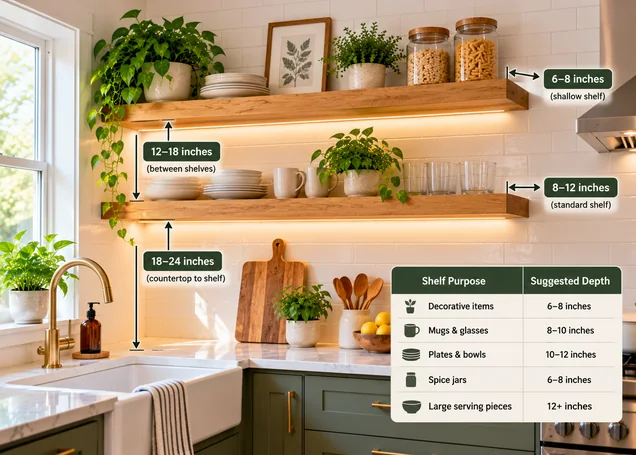
How High Should Kitchen Floating Shelves Be?
Many kitchen designs begin by considering approximately 18–24 inches between the countertop and the lowest shelf.
That isn’t a mandatory height.
The correct position depends on the countertop arrangement, the tallest appliance below the shelf, access requirements, and the user’s comfortable reach.
For stacked shelves, approximately 12–18 inches of vertical clearance may be useful, depending on the objects being stored.
Before finalizing a design, measure your tallest dishes and check that you can lift them out comfortably.
Avoid applying these general countertop measurements to areas around cooktops, ovens, or range hoods. Those locations require appliance-specific safety clearances.
Best Materials for Kitchen Floating Shelves
Different materials suit different budgets, interior styles, and maintenance needs.
| Material | Appearance | Advantages | Considerations |
|---|---|---|---|
| Solid wood | Warm and natural | Attractive grain, refinishing potential | Heavy; needs suitable finish |
| Engineered wood | Smooth, consistent | Many affordable finishes | Moisture resistance varies |
| Metal | Modern or industrial | Durable when properly finished | Can show marks or corrosion |
| Glass | Light and contemporary | Easy-to-wipe surface | Requires appropriate glass and hardware |
| Stone | Luxurious and substantial | Distinctive appearance | Heavy and often requires specialist support |
Are Solid Wood Floating Shelves Better?
Solid wood floating shelves can be an excellent choice when you want visible grain and a long-lasting natural finish.
However, they aren’t automatically stronger than every engineered or metal system.
Overall performance depends on the complete assembly: the shelf material, support hardware, mounting method, wall construction, and intended load.
Choose the system according to its documented suitability rather than appearance alone.
How to Style Floating Kitchen Shelves Without Clutter
A well-designed shelf should be easy to use, not merely attractive in photographs.
Start with the objects you need most often.
Place everyday dishes and mugs in convenient positions. Group similar pieces together and avoid stacking items so high that they become unstable.
Next, add a small amount of decoration.
A ceramic pitcher, one framed print, or a wooden serving board can introduce personality without overwhelming the shelves.
Use a restrained color palette. For example, white dishes, natural wood, and a few green accents often work together nicely.
Finally, leave some empty space.
Open shelves look better and are easier to clean when objects aren’t packed tightly together.
A Simple Shelf-Styling Formula
For a typical pair of shelves:
- Lower shelf: frequently used plates, bowls, and mugs.
- Upper shelf: lighter accessories and occasionally used serving pieces.
- Decorative accents: one or two pieces that complement the room.
- Empty space: enough room to remove and replace items comfortably.
Adjust this arrangement to suit your household rather than following a fixed decorative rule.
For more ways to coordinate colors, finishes, and room layouts, see our interior design styles guide.
Floating Shelves vs. Kitchen Cabinets: Which Is Better?
Floating shelves and closed cabinets serve different purposes.
| Feature | Floating shelves | Closed cabinets |
|---|---|---|
| Visual appearance | Open and airy | More enclosed |
| Everyday access | Items remain visible | Doors must be opened |
| Dust protection | Limited | Generally better |
| Visual clutter | Requires careful organization | Contents are concealed |
| Storage flexibility | Depends on shelf dimensions | Often accommodates more varied items |
| Cleaning | Shelves and exposed items need attention | Exterior and interior cleaning |
| Best use | Selected everyday or display items | General household storage |
For a busy family, replacing every upper cabinet with open shelving may create more work than expected.
A mixed arrangement offers a useful compromise.
Planning Safe Floating Shelves in Your Kitchen
Floating shelves should be selected and installed with their intended load in mind.
Before installation, review these points:
- Wall construction: Determine whether the wall contains suitable structural framing or another approved support system.
- Load rating: Consider the combined weight of the shelf, hardware, and stored objects.
- Mounting requirements: Follow the shelf manufacturer’s installation instructions.
- Concealed services: Account for electrical wiring, plumbing, and other services behind the wall.
- Cooking clearance: Keep shelves and stored items outside unsafe heat, splash, and ventilation areas.
- Accessibility: Avoid placing heavy or frequently used objects where they’re difficult to retrieve.
A qualified installer is advisable when wall structure, mounting strength, or concealed services are uncertain.
For installation guidance, see the Lowe’s floating shelf installation guide and The Home Depot installation guide.
How to Keep Kitchen Floating Shelves Clean
Open shelving is attractive, but it needs regular attention.
Dust can accumulate on shelves and dishes, while cooking grease may settle on nearby surfaces.
A simple maintenance routine helps.
Wipe accessible surfaces regularly with a cleaning method suitable for the shelf material. Wash dishes that have accumulated dust or cooking residue before using them.
Pay particular attention to areas near food preparation and cooking.
Avoid leaving damp cloths against unfinished wood or allowing water to collect around mounting points.
It also helps to review what’s on the shelves every few weeks.
If an object is never used and constantly needs cleaning, it may belong in a cabinet instead.
Common Floating Shelves Kitchen Mistakes
Choosing Shelves That Are Too Deep
Oversized shelves can make a narrow countertop area uncomfortable.
Measure the available space and consider how you move while cooking or washing dishes.
Overloading the Shelves
Heavy dishes need an appropriately rated and installed support system.
Never assume a shelf is safe simply because it looks thick.
Placing Shelves Too Close to Cooking Heat
Shelves near cooktops can be exposed to heat, moisture, and grease.
Follow appliance and ventilation clearance requirements rather than relying on decorative examples.
Using Too Many Decorative Items
Crowded shelves are difficult to clean and may make the kitchen feel smaller.
Choose a few meaningful pieces and prioritize daily usefulness.
Ignoring the Existing Kitchen Style
Floating shelves look more intentional when their color, material, or shape connects with another part of the room.
Coordinate them with cabinets, countertops, hardware, or nearby furniture.
Frequently Asked Questions About Kitchen Floating Shelves
Are floating shelves still a good idea for kitchens in 2026?
Yes, when they suit the household’s needs. Floating shelves can provide attractive display space and convenient access, but they aren’t ideal for every kitchen. A combination of open shelves and cabinets is often more practical than removing all upper storage.
How deep should floating kitchen shelves be?
A starting depth of 8–10 inches can suit mugs and smaller accessories, while 10–12 inches may better accommodate dinner plates. Always measure the actual items and check the shelf system’s specifications.
How much weight can kitchen floating shelves hold?
There is no universal weight limit. Capacity depends on the shelving system, bracket design, mounting method, wall structure, and shelf depth. Use the manufacturer’s documented load rating.
What should I put on floating shelves in my kitchen?
Everyday plates, mugs, glasses, and a small number of decorative items are useful choices. Avoid overcrowding, and reserve suitable closed storage for heavy or unattractive household items.
Are wood floating shelves suitable for kitchens?
Yes. Properly finished wood can work well in kitchens. Select a finish appropriate for moisture and regular cleaning, and avoid locations exposed to excessive heat or water.
Are floating shelves cheaper than upper cabinets?
They can be, particularly for a small wall section. However, costs vary with shelf material, support hardware, installation, wall repairs, and finishing work. Compare complete project costs rather than shelf prices alone.
Can floating shelves replace all upper kitchen cabinets?
They can in some layouts, but replacing all cabinets sacrifices concealed storage and increases the amount of exposed material requiring cleaning. Many households benefit from keeping at least some closed cabinetry.
How far apart should kitchen floating shelves be?
Approximately 12–18 inches of vertical clearance is a useful starting range for many designs. The ideal distance depends on the height of stored objects and the room layout.
Final Thoughts
The best floating shelves kitchen ideas combine attractive design with storage you’ll genuinely use.
You might choose warm oak shelves beside white cabinets, narrow shelving for a coffee station, or a simple pair of shelves above a suitable countertop.
Whatever style you prefer, start with your kitchen’s layout and everyday storage needs.
Measure the available space, choose materials suited to the room, and make sure the shelves are properly supported.
A small, thoughtfully planned shelving arrangement can improve the kitchen without requiring an entire renovation.