
Table of Contents
Watermelon is one of the fruits most closely associated with summer in the United States. Whether you enjoy it at a backyard cookout, picnic, or chilled on a hot afternoon, watermelon is at its best when warm weather brings the domestic harvest into full swing.
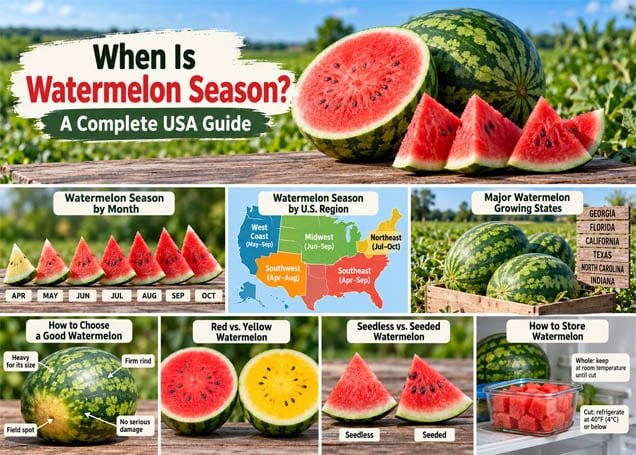
So, when is watermelon season? In the United States, domestically grown watermelon is generally available from April through October, with the strongest domestic shipments typically occurring from June through August. USDA data shows shipments commonly peak around July. Economic Research Service
However, not every part of the country has the same watermelon season. Harvest dates depend on location, temperature, planting time, weather, and variety. Southern states can begin harvesting much earlier than northern growing regions.
This guide explains watermelon season in the USA, the best months to buy it, how the season changes by region, how to choose a good watermelon, and why you may still find watermelon at the grocery store in winter.
When Is Watermelon Season in the USA?
The main watermelon season in the USA runs from spring into early fall.
According to the USDA Economic Research Service, U.S.-grown watermelon is available from approximately April to October, while domestic shipments are typically highest between June and August. Economic Research Service
That makes summer the heart of watermelon season.
A simple way to think about it is:
| Time of year | U.S. watermelon availability |
| March | Limited domestic supply |
| April | Domestic season begins |
| May | Availability increases |
| June | Peak-season period begins |
| July | Excellent availability; shipments often peak |
| August | Strong availability |
| September | Domestic supply begins declining |
| October | Late domestic season |
| Novemeber-February | U.S. supply relies much more on imports |
These periods are general guidelines, not fixed harvest dates. Weather conditions can cause harvests to start earlier or later in a particular year.
What Months Are Watermelons in Season?
If you’re wondering what month watermelon is in season, June, July, and August are the months most closely associated with peak U.S. availability.
USDA data offers a particularly useful picture. In 2025, U.S. watermelon cultivation began in spring and continued into early fall, while shipments typically peaked around July. Economic Research Service
April
April marks the beginning of meaningful domestic watermelon availability. Warm areas such as Florida can provide some of the earliest U.S.-grown fruit.
Imported watermelon also plays a role during this transitional period.
May
By May, watermelon availability increases significantly.
Florida and Texas can contribute to spring production, while imports continue helping meet demand. USDA has documented Florida and Texas as early contributors to the U.S. spring harvest. Economic Research Service
June
June is an excellent month for watermelon.
Production expands as additional growing regions begin harvesting, and summer demand increases.
July
July is generally one of the best months for watermelon in the United States.
USDA reports that domestic shipments typically peak around July. Economic Research Service
By this point, several major producing states are supplying the market.
August
Watermelon remains widely available in August.
Production shifts toward other states and growing regions as some earlier southern harvests slow down.
September
You can still find domestically grown watermelon during September, although national production is moving away from its summer peak.
October
October represents the later part of the domestic season. Some U.S. production remains, but imports become increasingly important as domestic supply declines. Economic Research Service
When Is Peak Watermelon Season?
For most U.S. shoppers, June through August is the key peak-season window, with July especially important.
USDA’s March 2026 Fruit and Tree Nuts Outlook reports that domestic watermelon shipments are typically highest from June through August. Economic Research Service
That doesn’t mean a watermelon bought in May or September will necessarily be inferior. Quality depends on the individual fruit, where it was grown, when it was harvested, transportation, storage, and other factors.
It simply means that summer brings particularly abundant U.S. production.
Watermelon Season by U.S. Region
One reason there is no single nationwide harvest date is the enormous climate differences across the United States.
Watermelon loves warmth. As a result, harvest can begin earlier in warm southern areas and move into other regions as summer progresses.
Southeast
The Southeast is extremely important to U.S. watermelon production.
States such as Florida and Georgia have long growing seasons and warm conditions suitable for commercial production.
Florida can contribute fruit relatively early in spring. Georgia becomes especially important as the summer season gets underway.
Southwest and South
Texas is another major watermelon-producing state.
Production timing can even vary within Texas because the state covers several different growing regions.
USDA reported, for example, that in 2024 harvesting began in the Lower Valley and South Texas around mid-May, while the Trans-Pecos and Southern High Plains followed in June. Economic Research Service
West Coast
California is one of America’s major watermelon producers.
The state’s different agricultural regions allow harvest periods to vary. USDA reported harvesting in California’s Imperial and San Joaquin valleys during June in 2024. Economic Research Service
Midwest
As summer progresses, production from farther-north states becomes more important.
Indiana, for example, is among the states included in USDA’s annual watermelon production reporting. Economic Research Service
Warm summer temperatures allow these areas to supply watermelon after some early southern growing regions have passed their main harvest.
Northeast
The Northeast has a shorter warm growing season.
Watermelons grown locally therefore tend to appear later than those produced in Florida and other warmer southern locations.
If buying local watermelon matters to you, checking a nearby farmers market or local farm’s harvest calendar can give you more precise timing for your area.
Which States Grow the Most Watermelon?
Watermelon production spans the United States, but several states account for a large share of the crop.
According to the USDA, the leading states in 2025 included:
- Georgia
- Florida
- California
- Texas
- North Carolina
- Indiana
Georgia produced approximately 813 million pounds in 2025, narrowly exceeding Florida and becoming the country’s largest producer that year. Florida produced approximately 798 million pounds. Economic Research Service
Together, Georgia, Florida, and California accounted for about 55% of U.S. production reported for 2025. Economic Research Service
This ranking can change from year to year, so older articles may list Florida first.
Why Does Watermelon Season Vary by Location?
Watermelon is a warm-season crop.
Its growing and harvesting schedule depends heavily on environmental conditions.
Temperature
Watermelon needs warm conditions to grow successfully. Southern regions reach suitable temperatures earlier in the year than northern states.
Planting date
Earlier planting generally allows earlier harvesting when growing conditions are suitable.
Weather
An unusually cool spring can slow plant development, while excessive rain can interfere with fieldwork or harvest.
Conversely, warmer conditions can sometimes accelerate crop development. USDA reported that warmer-than-average spring temperatures contributed to earlier watermelon development in California during 2026. Economic Research Service
Variety
Different watermelon cultivars mature at different rates.
Growing region
Florida’s climate is dramatically different from that of Indiana or Michigan. As a result, harvest dates naturally shift as the season moves northward.
This staggered production is one reason Americans can enjoy domestically grown watermelon over a much longer period than would be possible if it came from only one region.
How Long Does Watermelon Take to Grow?
Watermelon isn’t an instant crop.
Different varieties have different maturity periods, and environmental conditions also affect development. Instead of relying on one universal number, gardeners should check the days-to-maturity information for the specific cultivar they are growing.
Warmth is particularly important. Cool conditions can slow development, while suitable summer temperatures support vigorous vine and fruit growth.
Home gardeners should also remember that the expected maturity period is a guide—not a guaranteed harvest date.
How to Tell When a Watermelon Is Ripe
Picking a ripe watermelon can seem mysterious, but you don’t need to depend on internet tricks.
If you’re harvesting your own watermelon, ripeness indicators can vary by variety, so seed or plant information is valuable.
When shopping, focus on the fruit’s overall condition.
A good watermelon should feel heavy for its size, which reflects its high water content. Look for a firm exterior without serious damage, soft areas, or significant bruising.
Many mature watermelons also develop a field spot where the fruit rested against the ground. Its appearance can vary according to variety and growing conditions, so it shouldn’t be your only test.
How to Choose a Good Watermelon at the Store
When watermelon season arrives, you may face a large display of nearly identical fruit.
Start with appearance and condition.
Choose a watermelon that feels substantial for its size and has a firm rind. Avoid fruit with serious damage, decay, or large soft areas.
FDA food-safety guidance recommends choosing produce that isn’t bruised or damaged. If you’re buying pre-cut watermelon, choose packages that are refrigerated or kept properly chilled. U.S. Food and Drug Administration
Don’t worry about finding a perfectly symmetrical watermelon. Natural variation is normal.
And although tapping or knocking on a watermelon is popular, it is better not to make a buying decision based on sound alone.
Red vs. Yellow Watermelon Season
Most people picture bright red flesh when they think of watermelon, but yellow watermelon is another interesting option.
Yellow-fleshed watermelons come in multiple varieties, and their availability depends on where they are grown, the cultivar, and the supplier.
Because both red and yellow watermelons are warm-season crops, their general growing seasons can overlap.
However, yellow watermelon may be less common in an ordinary supermarket than familiar red varieties.
If you’re especially interested, we’ll cover it separately in our upcoming IdeaSproutly guide to yellow watermelon, including its season, taste, varieties, and how to choose one.
Seedless vs. Seeded Watermelon: Is the Season Different?
Both seeded and seedless watermelons appear during the main U.S. watermelon season.
Seedless watermelon is not genetically modified simply because it lacks mature black seeds. The National Watermelon Promotion Board explains that commercial seedless watermelon is produced through plant breeding, not genetic modification. Watermelon Board
From a shopper’s perspective, choosing seeded or seedless watermelon is therefore mostly about availability, preference, size, and intended use rather than completely different seasons.
Individual varieties can still differ in maturity dates.
How to Store Watermelon During the Season
Proper handling matters most when you cut a watermelon.
Before cutting a whole melon, the FDA recommends rinsing produce under running water. You can scrub firm produce such as melons with a clean produce brush. Washing the rind helps reduce the chance of transferring contaminants from the outside to the edible portion when you cut it. U.S. Food and Drug Administration
After cutting watermelon, refrigerate it promptly.
FDA guidance recommends keeping refrigerated foods at 40°F (about 4°C) or below, and pre-cut vegetables should be refrigerated. U.S. Food and Drug Administration
For outdoor summer meals, food safety matters even more. Perishable foods generally shouldn’t remain at room temperature for more than two hours—or more than one hour when the outdoor temperature exceeds 90°F. U.S. Food and Drug Administration
Covering cut watermelon before refrigerating it also helps protect its quality.
Can You Buy Watermelon Outside the Main Season?
Yes.
This is where “available” and “in season locally” differ.
You can find watermelon in U.S. markets year-round because imports fill gaps when domestic production is low.
During spring and summer, much of the watermelon supply comes from U.S. farms. In fall and winter, imported fruit—particularly from Mexico and other warmer-producing countries—plays a larger role. Watermelon Board
USDA reported that U.S. watermelon imports totaled about 1.8 billion pounds in 2025, representing roughly 34% of domestic supply. Imports tend to rise again as the U.S. growing season winds down. Economic Research Service
So seeing watermelon at a supermarket in January doesn’t mean January is peak U.S. watermelon season.
It simply demonstrates how modern produce supply chains make seasonal foods available beyond their traditional local harvest periods.
Other Summer Fruits in Season With Watermelon
Watermelon isn’t the only fruit associated with summer.
Depending on your location, summer markets may also offer fruits such as peaches, berries, cherries, plums, nectarines, and grapes at different times in the season.
Exact timing varies considerably by crop and region.
If you’re planning seasonal meals or simply want to know what produce to look for each month, see our What Fruit Is in Season Right Now? A 12-Month USA Guide for a broader overview.
Frequently Asked Questions
What month is watermelon in season?
U.S.-grown watermelon is generally available from April through October, with domestic shipments strongest from June through August. Economic Research Service
What is peak watermelon season?
Summer is the main peak period. U.S. watermelon shipments typically peak around July. Economic Research Service
Is watermelon a summer fruit?
Yes. Watermelon is a warm-season crop, and summer is the main period for domestic production and availability in the United States.
When does watermelon season end?
Domestic U.S. production generally winds down during early fall. USDA describes U.S.-grown watermelon availability as extending through approximately October, although exact timing varies by region and year. Economic Research Service
Is watermelon available year-round?
Yes. Watermelon is sold year-round in the United States. Domestic production dominates the warmer months, while imports help maintain availability outside the main U.S. season. Watermelon Board
When is watermelon season in Florida?
Florida is one of the country’s earliest major watermelon-growing regions. Its commercial crop helps supply the U.S. market during spring and early summer. USDA shipment data has shown Florida contributing to the spring season beginning around April. Economic Research Service
When is watermelon season in Georgia?
Georgia becomes particularly important during the summer harvest. The state was the largest U.S. watermelon producer in 2025, producing approximately 813 million pounds. Economic Research Service
When is yellow watermelon in season?
Yellow watermelon is also a warm-season fruit, so its growing period can overlap with the broader watermelon season. Exact availability depends on variety, growing location, and retailer. Because yellow watermelon has its own search intent, we’ll cover it more thoroughly in a separate guide rather than overcrowding this article.
Final Thoughts
So, when is watermelon season?
For U.S.-grown watermelon, remember April through October, with June, July, and August forming the heart of the season and shipments typically peaking around July. Economic Research Service
The exact harvest changes as warm weather moves across the country. Early-season watermelon can arrive from southern growing areas such as Florida and Texas, while other states contribute as summer progresses.
Although watermelon may feel like the ultimate summer fruit, you can still find it in winter because imports help maintain year-round availability.
For the best seasonal experience, summer remains an excellent time to enjoy fresh watermelon—and to explore the many other fruits reaching their harvest season at the same time.