
Table of Contents
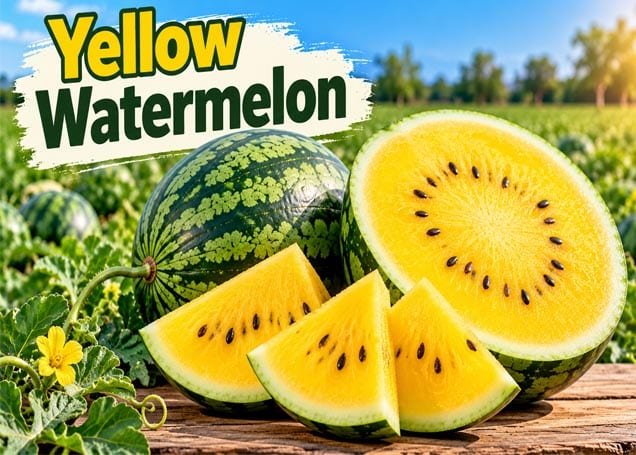
Yellow watermelon can be surprising the first time you cut one open. From the outside, it can look much like an ordinary green-skinned watermelon, but inside, the flesh ranges from pale yellow to a rich golden color.
So, when is yellow watermelon in season?
In the United States, yellow watermelon is primarily a warm-season fruit, with the best availability generally in summer. Because USDA market data generally reports watermelon as a category rather than separating yellow-fleshed varieties, there isn’t one official nationwide yellow-watermelon season. However, the broader U.S. watermelon season runs approximately April through October, with domestic watermelon shipments typically highest from June through August. Economic Research Service
For many shoppers, that means summer—especially June, July, and August—is the best time to start looking for yellow watermelon at supermarkets, farmers markets, specialty produce stores, and local farms.
In this guide, you’ll learn about yellow watermelon season, how it compares with red watermelon, what it tastes like, popular varieties, how to choose a ripe melon, and how to grow, store, cut, and serve it.
What Is Yellow Watermelon?
Yellow watermelon has naturally yellow or golden flesh instead of the familiar red or pink interior.
It isn’t simply a regular red watermelon that was picked too early. Yellow-fleshed watermelons are varieties bred and selected to produce their characteristic flesh color when ripe.
From the outside, some yellow watermelons can be difficult to distinguish from red ones. They may have the familiar green rind with lighter stripes, while the colorful difference becomes obvious after cutting.
Depending on the variety, yellow watermelons may be:
- Seeded or seedless
- Round or elongated
- Small or relatively large
- Pale yellow or deep golden inside
- Mildly sweet to very sweet
This variation is one reason you shouldn’t expect every yellow watermelon to look or taste exactly the same.
Yellow Watermelon Season in the USA
Yellow watermelon generally follows the same warm-weather growing pattern as other watermelons.
USDA reports that U.S.-grown watermelons are generally available from about April through October, with domestic shipments usually highest between June and August. Watermelon cultivation starts in spring and continues into early fall, with shipments typically peaking around July. Economic Research Service
Yellow varieties represent only part of that larger market, so their retail availability can be more limited.
A supermarket may have large displays of red seedless watermelons while carrying only a few yellow ones—or none at all.
For that reason, think of these as two different questions:
When can yellow watermelon grow in the USA?
During the warm watermelon-growing season.
When can I find yellow watermelon in a particular store?
That depends on the retailer, supplier, region, variety, and local harvest.
If you’re specifically searching for yellow watermelon, summer is a sensible time to start looking.
Yellow Watermelon Season by Month
Because there is no official USDA month-by-month calendar specifically for yellow-fleshed watermelon, the following should be treated as a general guide, not a guaranteed retail schedule.
| Month | General expectation |
| January | Limited; availability may depend on imports |
| February | Limited |
| March | Limited domestic availability |
| April | Broader U.S. watermelon season begins |
| May | Availability begins increasing |
| June | Good time to look for yellow watermelon |
| July | Peak broader watermelon season |
| August | Excellent summer availability |
| September | Still within the domestic season |
| October | Late U.S. watermelon season |
| November | Domestic availability becomes limited |
| December | Limited; imports may supply the market |
The strongest general window is therefore June through August.
USDA data shows that domestic watermelon shipments overall are typically highest during those months.
Remember that yellow watermelon may not be as widely stocked as standard red varieties, even during peak season.
Where Is Yellow Watermelon Grown?
Yellow watermelon requires the same basic ingredient that all watermelons love: warm weather.
Commercial watermelon production occurs across several U.S. states.
USDA reported that the major producing states in 2025 included Georgia, Florida, California, Texas, North Carolina, and Indiana. Georgia led U.S. production that year, followed closely by Florida. Economic Research Service
However, those USDA production figures cover watermelons collectively. They should not be interpreted as rankings specifically for yellow watermelon.
Yellow varieties can be grown commercially or in home gardens anywhere the growing season provides sufficient warmth and time for the chosen cultivar to mature.
This is why gardeners should pay more attention to their local climate and the specific seed variety than to a single national planting date.
Yellow Watermelon vs. Red Watermelon
The most obvious difference between yellow and red watermelon is their flesh color.
But that’s not the only thing shoppers notice.
| Feature | Yellow Watermelon | Red Watermelon |
| Flesh | Yellow to golden | Pink to deep red |
| Exterior | Usually green/striped | Usually green/striped |
| Flavor | Sweet; varies by cultivar | Sweet; familiar watermelon flavor |
| Seeds | Seeded and seedless types exist | Seeded and seedless types exist |
| Availability | Less commonly stocked | Widely available |
| Main season | Warm season | Warm season |
Neither color alone tells you whether a watermelon will taste better.
Variety, maturity, growing conditions, and freshness all influence the eating experience.
The best choice therefore depends largely on what you enjoy and what’s available locally.
What Does Yellow Watermelon Taste Like?
Yellow watermelon tastes unmistakably like watermelon, but the exact flavor varies among varieties and growing conditions.
You may find descriptions comparing certain yellow varieties with honey-like or tropical sweetness, but these descriptions are subjective. Don’t expect every yellow watermelon to taste like honey or another specific fruit.
A properly mature yellow watermelon should generally be juicy and refreshing, with sweetness varying by cultivar and growing conditions.
Texture can also differ somewhat between varieties.
If you’ve only eaten red watermelon, trying yellow watermelon side by side can be an interesting way to notice the differences yourself.
Popular Yellow Watermelon Varieties
“Yellow watermelon” isn’t the name of a single cultivar. Multiple yellow- or golden-fleshed varieties exist.
Depending on seed availability in your area, names you may encounter include cultivars marketed as Yellow Doll, Yellow Baby, and other yellow-fleshed types.
Cultivars can differ in:
- Fruit size
- Rind pattern
- Flesh color
- Seed characteristics
- Sweetness
- Days to maturity
- Disease resistance
This is especially important for home gardeners.
Rather than buying seeds based only on the photograph, read the seed packet or supplier’s cultivar information carefully.
A variety that performs beautifully in a long, hot growing season may not be the most practical option for a gardener with a short summer.
How to Tell When a Yellow Watermelon Is Ripe
Determining watermelon ripeness is easier when you grow the fruit yourself because you can observe changes on the vine.
One commonly watched feature is the tendril near the fruit stem. Gardeners also observe the underside of the fruit and changes in the rind.
However, ripeness indicators can vary among cultivars.
That’s why the seed supplier’s information for your particular yellow watermelon variety is valuable.
Don’t rely entirely on one viral “watermelon trick.”
Instead, combine several indicators:
- Approximate maturity period for the cultivar
- Changes in nearby tendrils
- Appearance of the rind
- Ground or field spot
- Overall fruit development
For store-bought watermelon, you don’t have access to the vine, so selection works a little differently.
How to Choose a Good Yellow Watermelon at the Store
You usually won’t know whether a whole watermelon has yellow flesh unless it is labeled by the retailer or variety.
Once you’ve found one labeled yellow watermelon, inspect the fruit before buying it.
Look for a watermelon that feels substantial for its size and has a firm exterior.
Avoid fruit with obvious decay, significant soft areas, or major damage.
FDA recommends selecting produce that isn’t bruised or damaged. If buying a pre-cut watermelon, choose one that is refrigerated or surrounded by ice. U.S. Food and Drug Administration
A field spot may also be visible on the underside where the watermelon rested on the ground.
Don’t become too concerned about finding a perfectly shaped fruit. Natural variation is normal.
And don’t rely entirely on tapping the melon. Combining several visible and physical characteristics is more useful than depending on sound alone.
How to Grow Yellow Watermelon
Growing yellow watermelon is very similar to growing red watermelon.
The most important requirement is warmth.
Watermelon is a warm-season crop, and USDA describes U.S. cultivation as beginning in spring and ending in early fall. Economic Research Service
Choose the right variety
Start by selecting a yellow-fleshed cultivar suited to your growing season.
Check the seed packet for:
- Days to maturity
- Expected fruit size
- Plant spacing
- Seeded or seedless characteristics
- Disease-resistance information
- Recommended growing conditions
Select a sunny location
Watermelon vines need plenty of sunlight.
Choose an open location where other plants or structures won’t heavily shade the vines.
Give vines enough room
Watermelon vines can spread considerably.
Check the spacing recommendation for your cultivar rather than assuming every watermelon requires the same amount of space.
Gardeners with smaller yards may want to investigate compact or smaller-fruited cultivars.
Prepare suitable soil
Watermelons perform best when their roots have appropriate drainage and access to nutrients.
If you’re unsure about your soil, a soil test through a local Cooperative Extension service can help you make better decisions rather than adding fertilizer unthinkingly.
Water consistently
Developing plants need adequate moisture, particularly during establishment and fruit development.
At the same time, persistently waterlogged soil can create problems.
The goal is consistent care appropriate for your soil, weather, and plant growth.
Watch the weather
Cold conditions can slow watermelon development.
Base your planting schedule on local conditions rather than simply following a nationwide calendar.
How Long Does Yellow Watermelon Take to Grow?
There isn’t one exact number for every yellow watermelon.
Days to maturity vary by cultivar.
Some varieties are bred for relatively early maturity, while others require a longer growing period.
Temperature, sunlight, plant health, moisture, and other growing conditions can also influence how quickly plants develop.
For SEO articles, you may see websites give one universal number of days. That’s less useful than checking the actual cultivar you’re growing.
If your seed packet says a particular variety reaches maturity within a specified period, use that as your starting estimate, then watch the plants as harvest approaches.
Gardeners in short-season climates should pay particular attention to this number before buying seeds.
How to Store Yellow Watermelon
Storage practices for yellow watermelon are essentially the same as those for red watermelon.
Store an uncut watermelon in a cool, clean place and use it while it’s still fresh.
Once the watermelon has been cut, refrigeration becomes important.
FDA recommends refrigerating pre-cut produce and keeping the refrigerator at 40°F (4°C) or below. U.S. Food and Drug Administration
Keep cut watermelon in a clean, covered container.
Also avoid leaving cut watermelon sitting outside for long periods during summer picnics. FDA’s general food-safety guidance says foods requiring refrigeration should not remain at room temperature for more than two hours, or one hour when temperatures are above 90°F. U.S. Food and Drug Administration
How to Cut and Serve Yellow Watermelon
You can prepare yellow watermelon just like red watermelon.
Before cutting, wash the outside of the melon under running water, even though you won’t eat the rind. This reduces the chance of transferring dirt or bacteria from the rind to the flesh when you cut it.
FDA specifically recommends scrubbing firm produce such as melons with a clean produce brush. Soap and commercial produce wash aren’t recommended. U.S. Food and Drug Administration
Then use a clean cutting board and knife.
You can serve yellow watermelon as:
- Triangular wedges
- Small cubes
- Watermelon sticks
- Fruit-salad pieces
- Chilled bite-size pieces
- Part of a mixed red-and-yellow watermelon platter
Combining red and yellow watermelon makes an especially colorful summer fruit plate.
For IdeaSproutly, keep the cutting instructions relatively short here.
Your planned article “Best Way to Cut a Watermelon: Easy Step-by-Step Guide” should cover detailed cutting methods separately. You can then internally link to that article from this section.
Frequently Asked Questions About Yellow Watermelon
When is yellow watermelon in season?
Yellow watermelon is primarily a warm-season fruit. While USDA doesn’t publish a separate national season for yellow-fleshed varieties, U.S.-grown watermelon is generally available from April through October, with domestic shipments highest from June through August. Economic Research Service
What is the best month for yellow watermelon?
Availability varies by location and retailer, but June through August is the strongest general window to look for domestically grown watermelon. July is especially important because overall U.S. watermelon shipments typically peak around that month. Economic Research Service
Is yellow watermelon natural?
Yes. Yellow flesh is a characteristic of particular watermelon varieties. A ripe yellow watermelon isn’t simply an underripe red watermelon.
Is yellow watermelon rare?
It’s less common in many U.S. supermarkets than standard red watermelon, but availability varies widely by retailer and region.
Does yellow watermelon taste different from red watermelon?
It can. Both taste like watermelon, but flavor, sweetness, aroma, and texture vary by cultivar and growing conditions. Some yellow varieties are described as having honey-like or tropical notes, although taste descriptions are subjective.
Is yellow watermelon seedless?
It can be. Both seeded and seedless yellow-fleshed watermelons exist.
Can I grow yellow watermelon at home?
Yes, as long as your location offers warm growing conditions and enough time for the selected cultivar to mature.
How do I know whether a whole watermelon is yellow inside?
You usually cannot determine flesh color reliably just by looking at the rind. Look for the cultivar name or a retailer label identifying it as a yellow-fleshed watermelon.
Can yellow and red watermelon be in season at the same time?
Yes. Both are warm-season watermelons, so their growing and harvest periods can overlap.
Where can I buy yellow watermelon?
Availability varies. During summer, check supermarkets, farmers’ markets, produce markets, local farms, and specialty grocers. Call ahead to save a trip, since yellow watermelon isn’t stocked everywhere.
Final Thoughts
Oh, when is yellow watermelon in season?
For U.S. shoppers, summer is the best time to look for it, especially June through August. The broader domestic watermelon season runs about April through October, with U.S. shipments typically peaking in summer. Economic Research Service
Yellow watermelon isn’t a single variety. Different yellow-fleshed cultivars vary in size, sweetness, maturity time, seed characteristics, and appearance. That also means no single harvest date applies to every yellow watermelon in every state.
If you want to grow yellow watermelon yourself, select a cultivar suited to your climate and pay attention to its days to maturity. If you’re buying one, summer is a good time to watch farmers’ markets and produce sections for yellow-fleshed varieties.
And when you finally cut one open, its bright golden interior makes it one of the most distinctive fruits of watermelon season.
References & Helpful Resources
- USDA Economic Research Service — U.S. Watermelon Production and Seasonality
Useful for your claims about U.S. watermelon season, peak shipments, major producing states, and production. USDA says watermelon is a warm-season crop, with U.S. cultivation beginning in spring and ending in early fall, and shipments typically peaking around July. Economic Research Service
USDA — U.S. Watermelon Production - Penn State Extension — Watermelon Production
This is particularly useful for your yellow watermelon varieties and growing sections. It specifically lists Yellow Doll (yellow icebox) as a yellow watermelon cultivar and gives its approximate maturity period. Penn State Extension
Penn State Extension — Watermelon Production - University of Minnesota Extension — Harvesting and Storing Watermelons
Use this source for the section “How to Tell When a Yellow Watermelon Is Ripe.” It explains indicators such as a more pronounced ground spot, the nearby tendril drying, and changes in the rind. It also notes that watermelon doesn’t continue getting sweeter after harvest. University of Minnesota Extension
University of Minnesota Extension — Harvesting and Storing Melons - U.S. Food & Drug Administration — Selecting and Serving Produce Safely
Use this for your choosing, washing, cutting, and storage sections. FDA recommends avoiding damaged produce, refrigerating pre-cut watermelon, washing melons before cutting, and scrubbing firm produce such as melons with a clean produce brush. U.S. Food and Drug Administration
FDA — Selecting and Serving Produce Safely