
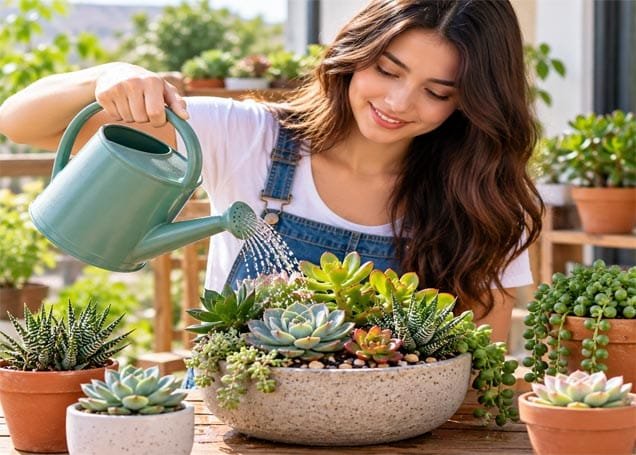
Succulents have a reputation for being easy houseplants, but there is one care mistake that causes problems again and again: watering too often.
Their thick leaves and stems are designed to store water, so succulents generally handle dry periods much better than constantly wet soil. That doesn’t mean they should receive only a few drops of water at a time. In fact, healthy succulent watering is almost the opposite: water thoroughly, then allow the potting mix to dry before watering again.
University of Minnesota Extension recommends thoroughly watering cacti and succulents until water flows through the drainage holes and allowing the soil to dry completely between waterings. Illinois Extension gives similar guidance and identifies overwatering as one of the most common succulent-care mistakes. University of Minnesota Extension
So if you’re wondering how to water succulents, forget about a rigid calendar. Learn to check the soil, pay attention to your plant, and adjust your watering as conditions change.
This guide explains exactly how to do that.
How to Water Succulents Correctly
For most potted succulents, use this simple method:
- Check that the potting mix has dried sufficiently.
- Take the plant to a sink or another place where it can drain freely.
- Pour water slowly over the potting mix.
- Continue until the entire root zone is moistened.
- Let excess water flow through the drainage hole.
- Allow the container to drain completely.
- Don’t water again simply because a certain number of days have passed.
This approach is often called the soak-and-dry method.
The idea is simple: thoroughly wet the root zone when the plant actually needs water, then provide a drying period.
Repeated shallow sprinkling is not a good substitute. University of Minnesota Extension specifically recommends thorough watering rather than repeated shallow applications. University of Minnesota Extension
How Often Should You Water Succulents?
This is probably the most common succulent question—and unfortunately, there isn’t one number that works for every plant.
You might hear advice such as “water every seven days” or “water twice a month.” Those schedules may happen to work under certain conditions, but they shouldn’t be treated as universal rules.
Illinois Extension notes that watering needs vary according to factors such as the time of year, air circulation, humidity, temperature, and available light. Its general guidance for indoor succulents is roughly every two to three weeks, but only after the soil has dried. Illinois Extension
Your succulent could need water sooner or considerably later.
Watering frequency depends on:
- Succulent species
- Pot size
- Pot material
- Potting mix
- Temperature
- Humidity
- Amount of light
- Air circulation
- Season
- Whether the plant is actively growing
That’s why checking the plant and soil is more useful than counting days.
Check the Soil Before Watering
Before picking up your watering can, check the potting mix.
For many succulents, you want the growing medium to dry thoroughly between waterings. University of Minnesota and Illinois Extension both recommend allowing succulent soil to dry before watering again. University of Minnesota Extension
Don’t judge only by the top surface.
The top can appear bone-dry while moisture remains farther down around the roots.
You can insert a finger into the growing medium when the pot is large enough to do so comfortably. A wooden skewer can also help you investigate moisture deeper in a container.
Another useful method requires no tools at all.
Learn the Weight of the Pot
Pick up the container shortly after watering and notice its weight.
Then lift it again after the soil has dried.
Dry potting mix weighs noticeably less than wet potting mix, particularly in smaller containers.
After caring for the same plant for a while, you can become surprisingly good at recognizing whether it still contains substantial moisture simply by lifting it.
How Much Water Do Succulents Need?
This is where succulent watering advice often becomes confusing.
Succulents need infrequent watering, but that doesn’t necessarily mean they need a tiny amount of water.
When it is genuinely time to water, thoroughly moisten the potting mix.
Let water reach the root zone and continue until excess water drains from the bottom.
Illinois Extension recommends soaking the soil completely and allowing excess water to drain from the container. Illinois Extension
Then wait.
Don’t return two days later to give the plant another small drink simply because the surface looks dry.
The drying period is an important part of the process.
Why Succulents Don’t Like Constantly Wet Soil
Succulents evolved to store water in fleshy leaves, stems, or other tissues.
Their roots still need both moisture and oxygen.
When potting mix stays saturated for extended periods, air spaces within the soil become filled with water. This creates unfavorable conditions for roots and can contribute to root decay.
University of Arizona Cooperative Extension describes overwatering combined with poor drainage as a major cause of succulent failure and emphasizes allowing the soil to dry between irrigations. UA Cooperative Extension
This is why the right pot and soil are just as important as your watering technique.
Always Use a Pot With Drainage Holes
If you remember only one container rule, make it this one:
Use drainage holes.
After you thoroughly water a succulent, excess water needs somewhere to go.
University of Minnesota Extension recommends growing succulents in pots with drainage holes because trapped excess moisture can lead to decay. University of Minnesota Extension
Decorative pots without drainage may look beautiful, but they make moisture management more difficult.
A simple solution is to keep your succulent in a smaller nursery pot with drainage holes and place that inside the decorative container.
When watering:
Remove the inner pot → water thoroughly → let it drain → return it to the decorative pot.
Also check that water hasn’t collected inside the outer container.
Don’t Leave Succulents Sitting in Water
After watering, empty excess water from the saucer.
A drainage hole doesn’t help much if the bottom of the pot remains submerged in standing water.
University of Arizona Extension warns that water left in a saucer can be reabsorbed into the pot, contributing to root problems and poor plant performance. UA Cooperative Extension
Let the plant drain properly before returning it to its usual location.
The Best Soil for Succulent Watering
Your watering technique and potting mix work together.
A dense mixture that holds moisture for a long time makes overwatering problems much more likely.
Succulents generally need a porous, fast-draining growing medium.
University of Minnesota Extension recommends well-drained sandy conditions for indoor cacti and succulents, while Illinois Extension recommends specialized succulent soil containing a substantial mineral component. University of Minnesota Extension
Commercial products labeled cactus and succulent potting mix can be a convenient starting point.
Materials commonly used to improve drainage include:
- Perlite
- Pumice
- Coarse sand
- Other suitable mineral components
The exact mixture can vary depending on the species, climate, and growing environment.
The important point is that water should move through the root zone rather than leaving the roots sitting in soggy soil for days.
Should You Mist Succulents?
For established succulents, misting isn’t a replacement for proper root-zone watering.
A light spray may wet the leaves and soil surface without delivering meaningful moisture to deeper roots.
For normal watering, focus on the potting mix and root system.
When the plant needs water, thoroughly wet the growing medium and allow the excess to drain.
Then let the soil dry appropriately before watering again.
Should You Water Succulent Leaves?
Aim your watering can primarily at the soil.
You don’t need to deliberately soak the foliage every time you water.
This is particularly useful for tightly packed rosette-forming succulents, where water can become trapped among leaves.
If leaves do get wet, that isn’t automatically a disaster. Good airflow helps moisture evaporate.
But the objective when watering is to hydrate the roots, not to keep the leaves wet.
Bottom Watering Succulents
Bottom watering means allowing potting mix to absorb water through drainage holes rather than pouring water over the top.
To bottom-water a succulent:
Place the pot in a shallow container of water.
Allow the potting mix to absorb moisture through the drainage holes.
Remove the pot once the growing medium has become adequately moistened.
Then let it drain thoroughly.
Illinois Extension describes bottom watering, or sub-irrigation, as a valid technique for houseplants. Illinois Extension
When Can Bottom Watering Help?
It can be useful when extremely dry potting mix has become difficult to wet evenly.
Sometimes water poured from above runs down the sides of very dry soil and exits the pot without adequately moistening the center.
Bottom watering can help rehydrate the growing medium more evenly.
However, you don’t have to bottom-water every time.
Occasional top watering also helps move accumulated soluble salts downward and out through the drainage hole.
How to Water Succulents Indoors
Indoor succulents require particular attention because conditions inside a home are very different from outdoor conditions.
Indoor plants may experience:
- Lower light
- Less airflow
- Stable temperatures
- Different humidity levels
- Slower evaporation
As a result, indoor potting mix can sometimes remain moist longer.
Place your succulent where it receives the amount of light appropriate for its species, and check the soil before watering.
Illinois Extension recommends ample light for indoor succulents and notes that insufficient sunlight is one of the main challenges of growing them indoors. Illinois Extension
Light and watering are closely connected.
A succulent growing actively in strong light may use water more rapidly than the same plant sitting in a dim corner.
How to Water Outdoor Succulents
Outdoor succulents face a different environment.
Sun, heat, wind, rainfall, and seasonal temperature changes can all affect how quickly their soil dries.
A container sitting outside in hot summer weather can lose moisture far faster than one sitting indoors.
Therefore, don’t simply transfer your indoor watering schedule to outdoor plants.
Check the root zone.
Outdoor succulents planted directly in the landscape also behave differently from plants confined to containers.
University of Arizona Extension recommends adjusting irrigation according to the plant, soil type, and conditions rather than relying blindly on a fixed interval. UA Cooperative Extension
How to Water Succulents in Summer
Many succulents use more water when they’re actively growing and receiving stronger light.
Warm temperatures can also make containers dry faster.
This means you’ll probably need to check them more frequently.
Notice the wording: check more frequently, not automatically water more frequently.
If the soil is still moist, wait.
Some succulent species have different seasonal growth cycles, so learn the requirements of your particular plant rather than assuming every succulent behaves identically.
How to Water Succulents in Winter
Winter often changes indoor succulent care substantially.
Days become shorter, light intensity drops and many succulents grow more slowly.
University of Minnesota Extension recommends much less water during low-light winter months—only enough to prevent excessive shrinking and wilting—and notes that water requirements rise again as light increases in spring. University of Minnesota Extension
Illinois Extension similarly notes that many succulents require considerably less frequent watering during winter. Illinois Extension
Again, don’t rely on the calendar alone.
Check the plant and growing medium.
Does Pot Material Affect Watering?
Yes.
Two identical succulents planted in different containers may dry at different rates.
Terracotta Pots
Unglazed terracotta is porous.
Moisture can evaporate through the container walls, helping the potting mix dry faster.
Illinois Extension specifically recommends clay and terracotta as useful options for succulents because their porous nature encourages faster drying. Illinois Extension
Plastic Pots
Plastic doesn’t lose moisture through its sides as readily.
The soil may therefore stay moist longer.
Glazed Ceramic Pots
Glazed ceramic also tends to retain moisture longer than unglazed terracotta.
None of these materials is automatically wrong.
You simply need to adjust your watering habits accordingly.
Signs of an Overwatered Succulent
Because overwatering is such a common problem, learn to recognize potential warning signs.
Possible symptoms include:
- Soft or mushy leaves
- Yellowing or translucent-looking leaves
- Leaves dropping unusually easily
- Soft stems
- Soil remaining wet for a long time
- Dark or unhealthy roots
- General decline despite moist soil
Overwatering can lead to root decay, particularly when combined with poor drainage. Illinois Extension
One symptom alone doesn’t always prove overwatering, so examine the soil, roots, light conditions, and recent watering history together.
What Should You Do?
If the soil is still wet, don’t add more water.
Make sure the drainage hole isn’t blocked and allow the growing medium to dry.
If the plant is seriously declining, you may need to inspect the roots and remove decayed material before repotting in fresh, fast-draining mix.
Signs of an Underwatered Succulent
Succulents can tolerate dry periods, but they can’t live without water forever.
Possible signs of prolonged dryness include:
- Wrinkled leaves
- Leaves becoming thinner
- Loss of firmness
- Dry, lightweight soil
- A noticeably lightweight pot
- Shriveling
Illinois Extension recommends checking both the soil and the plant, including whether leaves or stems have become soft or somewhat wrinkled. Illinois Extension
If the potting mix is completely dry and the plant shows signs of dehydration, thoroughly water it and allow excess water to drain.
Avoid trying to compensate with repeated tiny drinks.
Overwatered vs. Underwatered Succulents
This distinction can confuse beginners because both problems may produce unhealthy-looking leaves.
Start with the soil.
Wrinkled plant + completely dry soil: underwatering becomes more likely.
Soft plant + persistently wet soil: overwatering becomes more likely.
Then consider when you last watered, how quickly the pot normally dries, drainage, and the condition of the roots.
Don’t immediately water a struggling succulent without checking the soil first.
How to Water Aloe Vera
Aloe vera is a succulent, so it stores water in its thick leaves.
Allow its potting mix to dry well between waterings, then water thoroughly and let excess moisture drain.
Avoid keeping aloe constantly damp.
A container with a drainage hole and a fast-draining succulent mix makes watering much easier to manage.
How to Water Echeveria
Echeverias form beautiful rosettes and generally prefer a wet-dry watering cycle.
Water the soil thoroughly after it has dried sufficiently.
Try to direct water toward the potting mix rather than allowing it to remain trapped inside the rosette.
Good drainage is particularly important.
How to Water Jade Plants
Jade plants (Crassula) store moisture in thick leaves and stems.
Illinois Extension recommends allowing jade plant soil to become nearly dry between waterings. Illinois Extension
Penn State Extension goes further, recommending infrequent watering only when the soil has dried completely and emphasizing fast-draining soil. Penn State Extension
When the plant needs water, thoroughly moisten the root zone and allow excess water to drain.
How to Water Haworthia
Haworthias are compact succulents often grown indoors.
Like many succulents, they appreciate good drainage and drying between waterings.
Check the growing medium rather than watering each week automatically.
Their small pots can sometimes dry faster than large containers, but low indoor light can slow water use.
Observe the individual plant.
Do All Succulents Need the Same Amount of Water?
No—and this is important.
“Succulent” describes plants that store water in specialized tissues. It doesn’t mean every succulent evolved in the same environment.
Different species have different:
- Growth cycles
- Light requirements
- Temperature preferences
- Water needs
- Dormancy periods
Illinois Extension recommends researching individual varieties because their light and watering requirements differ. Illinois Extension
So use general succulent-watering principles as a starting point, then learn the requirements of the species you actually own.
Common Succulent Watering Mistakes
1. Watering Every Saturday
Plants don’t use calendars.
Check the soil first.
2. Giving Tiny Sips
A tablespoon of water every few days may leave much of the root system dry.
When watering is needed, water thoroughly.
3. Watering While the Soil Is Still Wet
This is one of the easiest ways to create problems.
Wait until the growing medium reaches the appropriate dryness for your succulent.
4. Using a Pot Without Drainage
Without an escape route for excess water, managing moisture becomes unnecessarily difficult.
5. Leaving Water in the Saucer
Empty it after the pot finishes draining.
6. Using Dense Soil
Succulent roots need a porous, well-draining growing medium.
7. Treating Every Season the Same
Your plant may use water differently in summer and winter.
8. Assuming Wrinkled Leaves Always Mean “Water Now”
Check the soil and roots first. Plant symptoms can have multiple causes.
9. Keeping Succulents in Poor Light
Watering and light are connected.
Poor light can slow growth and water use, leaving potting mix wet longer.
10. Treating Every Succulent Identically
Learn the needs of your particular species.
A Simple Succulent Watering Routine
If all this sounds complicated, use this routine:
Step 1: Check your succulent every few days rather than automatically watering it.
Step 2: Feel the potting mix and determine whether it has dried appropriately.
Step 3: Lift the pot and notice its weight.
Step 4: If the plant genuinely needs water, slowly soak the potting mix.
Step 5: Continue until excess water exits through the drainage hole.
Step 6: Allow the pot to drain thoroughly.
Step 7: Empty the saucer.
Step 8: Don’t water again until the soil has dried appropriately.
That’s the basic process.
The difficult part isn’t watering the plant—it’s learning when not to water it.
Frequently Asked Questions
How often should you water succulents?
There is no universal schedule. Many indoor succulents may go roughly two to three weeks between waterings under some conditions, but factors such as species, light, temperature, humidity, season, soil, and container size can dramatically change that interval. Check the soil instead of relying on a calendar. Illinois Extension
Should succulent soil dry completely before watering?
For many common indoor succulents, yes. University of Minnesota Extension recommends allowing the soil to dry completely between waterings for cacti and succulents. However, individual species can have different requirements. University of Minnesota Extension
Is it better to overwater or underwater succulents?
Neither is desirable, but succulents generally tolerate periods of dry soil better than prolonged saturation. Overwatering combined with poor drainage is a major cause of succulent failure. UA Cooperative Extension
Can I water succulents with a spray bottle?
Misting isn’t a good replacement for proper root-zone watering of established succulents. When the plant needs water, thoroughly moisten the growing medium and let excess water drain.
Should I water succulents from the top or bottom?
Both methods can work. Top watering is straightforward and allows excess water to drain through the pot. Bottom watering can be useful when very dry potting mix has become difficult to rehydrate evenly.
Do succulents need drainage holes?
Drainage holes are strongly recommended because they let excess water escape the container. University of Minnesota Extension specifically recommends pots with drainage holes for cacti and succulents. University of Minnesota Extension
Do succulents need less water in winter?
Many indoor succulents use considerably less water during low-light winter conditions, although species vary. Reduce watering according to the plant’s growth and how quickly its soil dries rather than following a fixed winter schedule. University of Minnesota Extension
Can you save an overwatered succulent?
Sometimes, particularly if the problem is caught early. Stop watering, improve drainage, and inspect the roots if the plant continues declining. Severely decayed roots or stems may require removing damaged material and propagating healthy portions.
Final Thoughts
Learning how to water succulents becomes much easier once you stop thinking in terms of a weekly schedule.
Instead, remember three basic ideas:
Check. Soak. Dry.
Check the soil before watering.
When water is actually needed, thoroughly moisten the root zone until excess water drains from the pot.
Then give the growing medium time to dry before watering again.
Combine that routine with a fast-draining potting mix, a container with drainage holes and enough light for your particular succulent.
And pay attention to your plant.
After a few watering cycles, you’ll begin noticing how heavy its pot feels when wet, how quickly its soil dries, and how its leaves look when properly hydrated. Those observations are far more useful than blindly following a watering calendar.
Sources & Further Reading
- University of Minnesota Extension — Cacti and Succulents — guidance on watering, drainage, potting mix and seasonal care. University of Minnesota Extension
- Illinois Extension — Low-Maintenance Succulents — practical guidance on indoor watering frequency, light and soil. Illinois Extension
- Illinois Extension — Houseplant Watering — explains how light, temperature, humidity, pot size and soil affect watering needs. Illinois Extension
- University of Arizona Cooperative Extension — Cacti, Agave and Yucca — detailed guidance on succulent irrigation and drainage. UA Cooperative Extension
Read more: Best Plants for Beginners