Table of Contents
You don’t need a large backyard or raised garden bed to enjoy fresh homegrown tomatoes. With the right container, potting mix, sunlight, water, and tomato variety, you can successfully grow tomatoes in pots on a patio, deck, balcony, or other sunny outdoor space.
Container gardening is particularly useful when garden space is limited. It also gives you more control over the growing medium and allows you to move smaller containers when necessary.
However, tomatoes are vigorous plants. Their roots need enough room, their leaves need plenty of sunlight, and container-grown plants can dry out much faster than tomatoes planted directly in the ground.
So, how do you grow tomatoes in pots successfully?
Start with a large container with drainage holes, fill it with a high-quality potting mix, choose a container-friendly tomato variety, provide at least 6–8 hours of direct sunlight, and keep the soil consistently moist without making it waterlogged. University of Maryland Extension recommends 6–8 hours of direct sun for warm-season container crops such as tomatoes and lists 5 gallons as a minimum container volume for standard tomatoes. University of Maryland Extension
This complete beginner’s guide explains the process step by step.
Why Grow Tomatoes in Pots?
Growing tomatoes in containers has several advantages, especially for gardeners with limited outdoor space.
You can grow tomatoes on:
- Patios
- Decks
- Balconies
- Driveways
- Small yards
- Other sunny outdoor spaces
Containers can also be positioned where sunlight is strongest. If one area becomes too shaded during part of the growing season, movable pots give you some flexibility.
Container gardening does require closer attention to watering and nutrition because the roots have access to a limited amount of growing medium. But once you understand these basic requirements, tomatoes can be excellent container crops.
1. Choose the Right Tomato Variety
The first step is choosing a tomato that matches the amount of space you have.
Tomatoes are generally described as either determinate or indeterminate.
Determinate Tomatoes
Determinate tomatoes have a more compact growth habit and tend to produce much of their crop over a shorter period.
They are often particularly suitable for pots and small gardens.
Illinois Extension notes that determinate varieties are easier to control in limited spaces, while dwarf types can remain especially compact. Illinois Extension
Look for tomato varieties described on the seed packet or plant label as:
- Determinate
- Bush
- Dwarf
- Patio
- Compact
- Container suitable
Indeterminate Tomatoes
Indeterminate tomatoes continue growing and producing throughout the growing season until conditions stop their growth.
They can become large plants and generally require stronger support and larger containers.
You can still grow indeterminate tomatoes in pots, but give them considerably more root space and plan for a sturdy cage or trellis.
What About Cherry Tomatoes?
Cherry tomatoes are excellent for container gardening.
Some cherry varieties are compact, while others produce vigorous vines, so don’t assume every cherry tomato stays small.
Check the mature plant size before choosing your container.
2. Choose a Large Enough Pot
Container size can make a major difference in tomato growth.
A small pot holds less growing medium, which means less room for roots and less available water and nutrients. Small containers also dry out quickly during hot weather.
For a standard tomato, 5 gallons should be considered a minimum rather than an ideal maximum. University of Maryland Extension lists 5 gallons as the minimum for standard tomatoes, while its more detailed container guidance recommends 8–10 gallons of growing medium and 12–16 inches of depth for large vegetables such as tomatoes. University of Maryland Extension
For vigorous indeterminate tomatoes, going larger can make management easier.
Good Containers for Tomatoes
You can use:
- Plastic pots
- Fabric grow bags
- Wooden planters
- Large nursery containers
- Food-safe buckets adapted for gardening
- Self-watering containers
The material matters less than adequate size and good drainage.
3. Make Sure the Pot Has Drainage Holes
Never overlook drainage.
Your tomato container needs holes that allow excess water to escape.
Tomatoes need consistent moisture, but their roots also need oxygen. A container that remains waterlogged can cause poor root health and weak growth.
Don’t add a layer of gravel or rocks to the bottom in an attempt to improve drainage. University of Maryland Extension advises against this because it takes up valuable root space and can actually worsen drainage behavior. University of Maryland Extension
Instead, use a suitable potting mix and a container with proper drainage holes.
4. Use Potting Mix, Not Heavy Garden Soil
One of the most common container-gardening mistakes is filling pots with ordinary soil dug directly from the yard.
Garden soil can become dense and poorly aerated inside a container.
A quality container or potting mix is generally a better choice because it is formulated to balance moisture retention with drainage and root aeration.
Illinois Extension recommends well-aerated, well-draining growing media for container gardens and notes that commercial soilless potting mixes commonly contain materials such as peat, bark, coconut coir, perlite, or vermiculite. Illinois Extension
University of Maryland Extension similarly emphasizes that container roots depend entirely on the limited growing medium for water, nutrients, air, and physical support. University of Maryland Extension
What Should Tomato Potting Mix Be Like?
Look for a mix that is:
- Light and loose
- Well-draining
- Able to retain adequate moisture
- Suitable for vegetables or containers
- Resistant to excessive compaction
You can also incorporate mature compost when appropriate, but don’t fill the entire pot with dense compost or garden soil.
5. Plant Tomatoes at the Right Time
Tomatoes are warm-season plants and are sensitive to frost.
If you live in an area of the United States with cold winters, wait until the danger of frost has passed before moving tomatoes permanently outdoors.
University of Maryland Extension describes tomatoes as very tender warm-season plants and recommends transplanting after frost danger has passed and conditions have warmed. University of Maryland Extension
Your exact planting date depends heavily on where you live.
A gardener in Florida, for example, follows a very different planting calendar from someone in Minnesota.
For this reason, check your local university Cooperative Extension planting calendar rather than relying on a single nationwide date.
6. Plant Tomato Seedlings Deeply
Tomatoes have an interesting characteristic: buried portions of their stems can develop additional roots.
When transplanting a young tomato plant, you can remove some of the lowest leaves and plant the seedling deeper than it was growing in its nursery pot.
This can help establish a stronger root system.
University of Maryland Extension recommends setting tomato transplants deeply enough that only a few sets of true leaves remain exposed and notes that roots can develop along buried stem sections. University of Maryland Extension
If your seedling is particularly tall or leggy, part of the stem can also be positioned at an angle under the growing medium.
Handle the stem and roots carefully while transplanting.
7. Give Potted Tomatoes Plenty of Sunlight
Tomatoes love sunlight.
Aim for at least 6–8 hours of direct sunlight per day, with more sun often benefiting tomato growth and fruit production when temperatures and plant conditions are suitable.
University of Maryland recommends 6–8 hours of direct sun for container-grown warm-season crops and notes that tomatoes in garden settings prefer about 8–10 hours when available. University of Maryland Extension
Where Should You Put Tomato Pots?
Look for an open location such as a:
- Sunny patio
- South- or west-facing growing area
- Sunny deck
- Bright balcony
- Open section of driveway or yard
Observe the location throughout the day before deciding.
An area that appears sunny in the morning may be shaded by a building or tree for much of the afternoon.
8. Water Potted Tomatoes Correctly
Watering is one of the most important parts of learning how to grow tomatoes in pots.
Containers can dry considerably faster than garden soil, particularly during hot, dry, or windy weather.
Check the growing medium frequently.
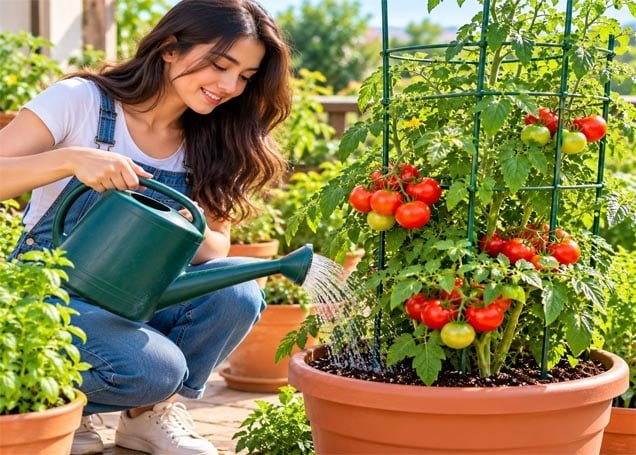
When watering, apply enough water to thoroughly moisten the root zone and allow excess water to drain through the bottom.
Illinois Extension recommends watering containers thoroughly until water reaches the bottom and drains out, while avoiding both complete drying and prolonged waterlogging. Illinois Extension
How Often Should You Water Tomatoes in Pots?
There is no single schedule that works everywhere.
You may need to check containers every day during hot summer weather. In cooler or cloudy conditions, they may dry more slowly.
Watering frequency depends on:
- Container size
- Plant size
- Temperature
- Sun exposure
- Wind
- Humidity
- Pot material
- Potting mix
- Growth stage
The goal is consistent moisture, not constantly saturated soil.
Water the Soil, Not the Leaves
Apply water near the base of the plant.
Keeping foliage unnecessarily wet can encourage some foliar diseases, so watering the root zone is generally preferable. Illinois Extension
9. Keep Soil Moisture Consistent
Tomatoes respond poorly to extreme swings between very dry and very wet growing conditions.
Consistent soil moisture is particularly important once plants begin flowering and producing fruit.
University of Maryland Extension includes steady soil moisture among the key practices for reducing common tomato problems. University of Maryland Extension
A layer of organic mulch on top of the potting mix can help reduce rapid moisture loss.
Possible container mulches include clean straw or shredded leaves.
Keep mulch from being packed tightly against the plant stem.
10. Support Your Tomato Plants
Don’t wait until a tomato plant is falling over before thinking about support.
Install a cage, stake, or trellis while the plant is still relatively small.
Possible supports include:
Tomato cages: Convenient for bushy plants.
Stakes: Useful when plants are trained upward.
Trellises: Helpful for vigorous indeterminate varieties.
Indeterminate tomatoes typically require more substantial support because they continue growing throughout the season. Illinois Extension
Installing support early also reduces the risk of damaging established roots later.
11. Fertilize Container Tomatoes
Tomatoes are relatively heavy feeders, and container plants have access only to nutrients available within the pot.
Many commercial potting mixes already contain starter fertilizer, so read the package before adding anything.
As plants grow and begin producing fruit, additional fertilizer may be necessary.
University of Maryland Extension notes that long-season container vegetables such as tomatoes may need light fertilizer applications approximately every two weeks, depending on the growing medium and fertilizer used. It also emphasizes following the product label and avoiding overfertilization. University of Maryland Extension
Don’t Assume More Fertilizer Means More Tomatoes
Excess fertilizer can damage roots or cause excessive leafy growth at the expense of fruit production.
Follow the fertilizer manufacturer’s directions and adjust according to the product formulation and whether your potting mix already contains nutrients.
Also, don’t automatically add Epsom salt to tomato containers. University of Maryland Extension advises against using Epsom salts unless a magnesium deficiency has actually been identified. University of Maryland Extension
12. Should You Prune Potted Tomato Plants?
That depends largely on the type of tomato.
Determinate Tomatoes
These plants generally require little pruning.
Removing too much growth can reduce potential fruit production because determinate plants have a limited growth pattern.
Indeterminate Tomatoes
Indeterminate varieties can become vigorous and crowded.
Selective removal of suckers can make plants easier to manage, improve airflow, and help maintain a more controlled shape.
University of Maryland Extension notes that moderate pruning of staked tomatoes can keep plants manageable, while Illinois Extension emphasizes that support and pruning requirements differ among tomato types. University of Maryland Extension
Avoid excessive pruning, particularly if you’re new to tomato growing.
13. Watch for Common Tomato Problems
Even well-cared-for container tomatoes can experience problems.
Blossom-End Rot
Blossom-end rot appears as a dark, sunken area at the blossom end of the fruit.
It is associated with calcium availability within developing fruit and is often connected with inconsistent soil moisture.
Maintaining steady moisture is therefore an important preventive practice.
Cracked Tomatoes
Fruit may crack when water availability changes rapidly, particularly after the growing medium becomes dry and then receives a large amount of water.
Consistent watering can help.
Yellow Leaves
Yellow leaves can have many causes, including:
- Natural aging of lower foliage
- Watering problems
- Nutrient issues
- Root stress
- Disease
Don’t immediately add fertilizer simply because you see one yellow leaf.
Look at the whole plant and growing conditions first.
Few Flowers or Fruits
Poor fruit production can result from several factors, including insufficient sunlight, temperature extremes, excess nitrogen, or pollination conditions.
Start by making sure your container receives adequate direct sunlight.
14. Check for Pests Regularly
Inspect tomato plants every few days, especially the undersides of leaves.
Common tomato pests can include aphids, whiteflies, hornworms, and spider mites, although pest pressure varies by region.
Early detection makes many problems easier to manage.
Look for:
- Holes in leaves
- Discolored foliage
- Sticky residue
- Unusual insects
- Eggs under leaves
- Sudden leaf loss
Before applying any pesticide, correctly identify the pest and follow guidance from your local Cooperative Extension service.
15. Help Flowers Pollinate
Tomato flowers are self-fertile, meaning each flower contains the structures necessary for pollination.
Outdoors, wind and normal plant movement often help release pollen.
Container tomatoes on sheltered balconies or patios may sometimes benefit from gently shaking the support or flowering stems.
Avoid damaging flowers or branches.
16. Protect Tomatoes From Extreme Weather
Containers respond to temperature changes more quickly than garden soil.
During extreme summer heat, potting mix may dry very quickly.
Check soil moisture more frequently during hot weather, particularly in small or dark-colored containers.
Strong winds can also knock over tall container tomatoes.
Use stable containers and securely anchor cages or stakes where necessary.
If cold weather or frost is expected early or late in the season, follow your local weather forecast and Extension recommendations for plant protection.
17. Harvest Tomatoes at the Right Time
You don’t necessarily need to leave tomatoes on the vine until they become completely ripe.
Tomatoes can be harvested once they begin showing their mature color and allowed to finish ripening indoors.
University of Maryland Extension recommends harvesting when fruit color begins to change, which can also reduce losses from cracking, pests, and some other problems. University of Maryland Extension
Handle ripe tomatoes carefully because they bruise easily.
For best eating quality, allow harvested tomatoes to ripen at room temperature rather than automatically refrigerating them.
Step-by-Step: How to Grow Tomatoes in Pots
Here is the entire process in a simple sequence:
- Choose a determinate, dwarf, patio, or other container-suitable tomato.
- Select a large pot with drainage holes.
- Fill it with quality container potting mix.
- Transplant after frost danger has passed.
- Plant the tomato somewhat deeper than it grew in its nursery container.
- Position the pot where it receives at least 6–8 hours of direct sun.
- Install a cage or other support early.
- Check soil moisture frequently.
- Water thoroughly when needed and allow excess water to drain.
- Fertilize according to the potting mix and fertilizer label.
- Monitor for pests and disease.
- Maintain relatively consistent moisture as fruit develops.
- Harvest tomatoes as they begin reaching mature color.
Best Tomatoes for Pots
Rather than choosing varieties based only on fruit size, look at the mature size and growth habit of the plant.
For smaller containers and spaces, look for labels such as:
Dwarf: Plants bred to remain relatively compact.
Patio: Varieties selected for container or small-space growing.
Bush: Generally more compact growth.
Determinate: Plants with a more limited mature size than typical indeterminate vines.
Cherry tomatoes can also work extremely well, but remember that some cherry tomato varieties are large indeterminate vines.
Always read the seed packet or plant label before buying.
Can You Grow Tomatoes in 5-Gallon Buckets?
Yes. A 5-gallon container is commonly used as a minimum size for a standard tomato plant, according to University of Maryland Extension. University of Maryland Extension
However, larger containers can provide more root space, hold moisture longer, and better support vigorous plants. Maryland’s container guidance recommends 8–10 gallons for large vegetables such as tomatoes. University of Maryland Extension
If using a bucket, make sure it is suitable for gardening and has adequate drainage holes.
Generally, grow one standard tomato plant per container rather than crowding several plants into one small pot.
How Deep Should a Pot Be for Tomatoes?
A container around 12–16 inches deep or more provides useful root space for larger tomato plants, and total soil volume matters just as much as depth. University of Maryland Extension
A wide, stable pot can also be less likely to tip over once the tomato plant becomes tall and heavy with fruit.
How Much Sun Do Tomatoes in Pots Need?
Tomatoes should receive at least 6–8 hours of direct sunlight daily. University of Maryland Extension
If your plants produce lots of weak growth but little fruit, insufficient light is one factor worth investigating.
Before planting, observe your patio or balcony at several times during the day to determine how many hours of direct sun it actually receives.
How Often Should I Water Potted Tomatoes?
Don’t rely on a rigid schedule.
Check the growing medium regularly and water when necessary to maintain consistent moisture.
During hot, dry summer weather, containers may require daily watering. Illinois Extension notes that container plants can sometimes need daily or even more frequent watering depending on conditions. Illinois Extension
Larger containers generally dry more slowly than small ones.
Can I Grow Tomatoes on a Balcony?
Yes, provided the balcony receives sufficient direct sunlight and can safely accommodate the weight of the containers.
Remember that a large container filled with moist potting mix can become extremely heavy. University of Maryland Extension notes that even a 20-inch container filled with moist growing medium and plants can weigh around 100 pounds. University of Maryland Extension
Also consider wind exposure, access to water, and where drainage water will go.
Can I Grow Tomatoes From Seeds in Pots?
Yes.
You can start tomatoes from seed in small containers and transplant the seedlings into their final pots later.
Gardeners in colder regions of the United States commonly start tomato seeds indoors before outdoor growing conditions become warm enough.
Follow the seed packet for sowing depth and timing because recommended starting dates depend on your region and expected last frost.
Beginners can also purchase healthy young transplants from a garden center, which makes the process faster and simpler.
Common Mistakes When Growing Tomatoes in Pots
Avoiding a few mistakes can dramatically improve your chances of success.
Using a pot that’s too small: Tomato roots need space, and tiny containers dry very quickly.
Using garden soil: Dense soil may provide poor drainage and aeration in containers.
Insufficient sunlight: Tomatoes are sun-loving plants.
No drainage holes: Excess water needs somewhere to escape.
Inconsistent watering: Large swings in soil moisture can contribute to fruit problems.
Overfertilizing: More fertilizer does not automatically produce more tomatoes.
Adding support too late: Install cages or stakes before plants become large and difficult to handle.
Crowding multiple plants into one pot: Give each standard tomato sufficient root space.
Ignoring mature plant size: An indeterminate tomato can become much larger than expected.
Frequently Asked Questions
Are tomatoes easy to grow in pots?
Yes. Tomatoes can grow very successfully in containers when they receive enough root space, direct sunlight, water, nutrients, and support. Compact determinate and dwarf varieties are particularly convenient for beginners.
What size pot is best for tomatoes?
Five gallons is a commonly recommended minimum for standard tomatoes, but larger containers—such as 8–10 gallons or more—provide additional root space and moisture capacity. University of Maryland Extension
How many tomato plants can I put in one pot?
For standard tomatoes, growing one plant per appropriately sized container is usually the simplest approach. This reduces competition for root space, water, and nutrients.
Do tomato pots need drainage holes?
Yes. Good drainage allows excess water to escape and helps prevent the root zone from remaining waterlogged.
Do tomatoes grow better in pots or in the ground?
Both methods can produce excellent tomatoes. Garden soil provides more root space, while containers offer flexibility and control over the growing medium. The better option depends on your available space and growing conditions.
Do tomatoes need cages when grown in pots?
Many do. Indeterminate varieties particularly benefit from strong cages, stakes, or trellises. Compact determinate varieties may require less support, although fruit-heavy branches can still benefit from it.
Can tomatoes grow in partial shade?
Tomatoes perform best with substantial direct sunlight. Aim for at least 6–8 hours daily. Plants receiving significantly less light may grow and fruit poorly. University of Maryland Extension
When should I plant tomatoes?
Tomatoes are warm-season plants. In climates with frost, transplant them outdoors after frost danger has passed and growing conditions have warmed. Your local Cooperative Extension planting calendar can provide region-specific timing. University of Maryland Extension
Final Thoughts
Learning how to grow tomatoes in pots is mostly about getting a few fundamentals right.
Give each tomato enough root space. Use a well-draining potting mix rather than heavy garden soil. Place the container where it receives at least 6–8 hours of direct sunlight. Check moisture frequently, water thoroughly when needed, and avoid letting the pot repeatedly swing between extremely dry and waterlogged conditions.
For beginners, a compact determinate, patio, or dwarf tomato is usually easier to manage than a huge indeterminate vine.
Most importantly, don’t underestimate container size. A larger container gives tomato roots more room and generally makes moisture management easier.
With the right setup and consistent care, even a small sunny patio or balcony can produce a rewarding crop of homegrown tomatoes.
Sources & Further Reading
These are the references I recommend keeping at the bottom of your published IdeaSproutly article:
University of Maryland Extension — Growing Tomatoes in a Home Garden
Covers sunlight, planting, watering, pruning, support, and harvesting. University of Maryland Extension
Growing Tomatoes in a Home Garden
University of Maryland Extension — Growing Vegetables in Containers
Covers container location, sunlight, watering, and container vegetable basics. University of Maryland Extension
Growing Vegetables in Containers
University of Maryland Extension — Types of Containers for Growing Vegetables
Useful guidance on container size and depth for tomatoes and other vegetables. University of Maryland Extension
Types of Containers for Growing Vegetables
Illinois Extension — How to Grow Tomatoes
Covers determinate versus indeterminate tomatoes and container suitability. Illinois Extension
How to Grow Tomatoes — Illinois Extension