Table of Contents
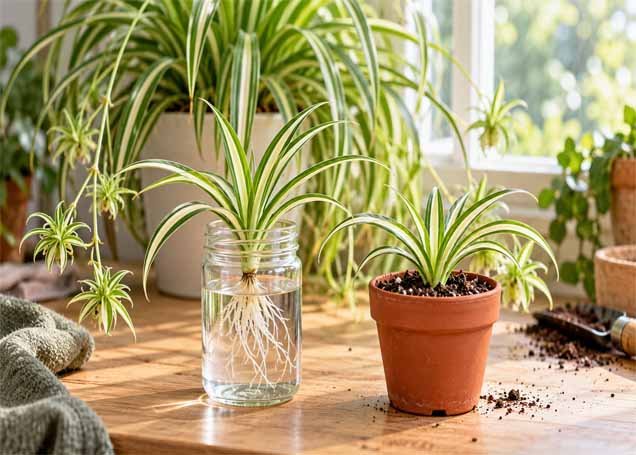
Those little plants dangling from your spider plant can become a collection of new houseplants. Known as spiderettes, babies, or plantlets, they give you a simple way to grow more greenery without buying another plant.
If you’re wondering how to propagate spider plant babies, you have two main options: root them in water or plant them in potting mix. You can also let a baby develop roots in soil while it remains connected to its parent.
This guide explains how to choose a plantlet, where to cut, and how to help it settle into its own pot.
When Is the Best Time to Propagate Spider Plants?
Spring through summer is generally the best time to propagate houseplants because they are growing actively. Indoor propagation can also work at other times of year when conditions support healthy growth.
Start with a healthy parent plant. If it has pests, disease, or weak growth, address those problems before taking babies for propagation. Iowa State University Extension
Choose a Spider Plant Baby That Is Ready
Look underneath the baby for small rootlets emerging from its base. Choose one with several developed leaves and a firm, healthy center.
A tiny plantlet with barely any leaves is better left attached to its parent. If you’re unsure whether it is ready to live independently, use the attached-soil method below.
The New York Botanical Garden recommends allowing a plantlet to develop several leaves and small rootlets before removing it for water propagation. New York Botanical Garden
What You’ll Need
Gather your supplies before cutting:
- A healthy spider plant baby
- Clean, sharp scissors
- A small glass for water propagation
- A small plant pot with drainage holes
- Fresh houseplant potting mix
- Water
- A bent paper clip, if rooting a baby while attached
Choose the method that suits the plantlet you have:
| Method | When to choose it |
|---|---|
| Water propagation | You want to watch roots develop |
| Direct soil propagation | Your baby already has developing roots |
| Rooting while attached | You want to establish roots before separating the baby |
Where to Cut a Spider Plant to Propagate
Find the thin runner connecting the baby to the parent. Cut through that runner beside the baby, keeping its leafy center and root-forming base intact.
Avoid cutting through the base of the plantlet. That is the part you need for rooting.
For water propagation, select a developed baby with visible rootlets before making the cut. New York Botanical Garden
How to Propagate Spider Plant in Water
Water propagation makes it easy to see what is happening beneath the plant.
1. Position the Baby in a Glass
Add enough water to reach the rootlets at the base. Keep the leaves and leafy center above the water rather than submerging the whole plantlet.
Choose a glass that supports the baby without crushing its leaves.
2. Let the Roots Develop
Keep the plantlet in a warm location with indirect light. Check that the rootlets remain in contact with water as the level drops.
Watch root development rather than relying on a fixed number of days. The New York Botanical Garden recommends allowing roots to reach at least about an inch before potting. New York Botanical Garden
3. Move It Into Potting Mix
Once roots have developed, transfer the baby into a small pot of houseplant potting mix. Make room for the roots, settle them into the mix, and gently firm it around them.
Water the pot and allow excess water to drain. Rooting plantlets in water before moving them into potting mix is an established propagation method. University of Saskatchewan
How to Propagate Spider Plant Directly in Soil
A baby that has already started developing roots can go straight into its own pot.
- Fill a small container with fresh potting mix.
- Make a shallow planting hole for the developing roots.
- Position the roots in the mix, keeping the leaves above the surface.
- Gently firm the mix so the baby sits securely.
- Water carefully and let the pot drain.
This method skips the glass of water and starts the plantlet in the medium where it will continue growing. University of Wisconsin Extension identifies potting up plantlets with developing roots as a common way to propagate spider plants. Wisconsin Horticulture
How to Root Spider Plant Babies While Still Attached
If the baby can reach a pot beside its parent, you can let it root before cutting the runner.
- Place a small pot of damp potting mix beside the parent plant.
- Rest the baby’s base against the surface.
- Use a bent paper clip to hold it gently in place.
- Keep the mix moist while roots develop.
- Cut the connecting runner once the baby has established roots.
This follows the plant’s natural habit of rooting wherever its dangling plantlets contact soil. University of Saskatchewan
How to Care for Your New Spider Plant
Place your new plant in bright, indirect light. Strong sunlight can scorch the leaves, while very low light can slow growth.
Keep the potting mix lightly moist without leaving the pot standing in water. Empty any water collected in the saucer or decorative outer pot. As growth slows in winter, watering usually becomes less frequent.
Check the mix before watering instead of following a rigid weekly schedule. Royal Horticultural Society
Common Spider Plant Propagation Problems
The Leaves Have Brown Tips
Brown tips can result from dry soil, low humidity, fertilizer buildup, or sensitivity to substances in tap water. They do not automatically mean propagation has failed.
Review the growing conditions, and consider rainwater or distilled water if browning persists. University of Saskatchewan
The Potting Mix Stays Soggy
Check that the container has drainage holes and that water can escape. Overwatering and poorly drained mix can lead to root rot. Wisconsin Horticulture
The Parent Has No Babies
Young plants may need more time. Low light, cool conditions, and an overly large pot can also discourage plantlet production. Some related Chlorophytum types do not produce babies.
For a mature plant without offsets, division may be an alternative. Each division needs roots and at least one growing point. Royal Horticultural Society
Frequently Asked Questions
Can You Propagate a Spider Plant From a Leaf?
A detached leaf is not a standard propagation method for spider plants. Use plantlets, layering, or division instead. Iowa State University Extension
Do Spider Plant Babies Need Roots Before You Cut Them?
Choosing a baby with developing roots makes it easier to judge readiness. If roots have not developed, leave it attached and root its base in a nearby pot first. Wisconsin Horticulture
Is Water or Soil Better for Spider Plant Propagation?
Both methods work. Water lets you observe the roots; soil lets the baby begin growing directly in potting mix. Rooting while attached is another option when the runner can reach a nearby pot. Royal Horticultural Society
Growing your indoor plant collection? Our poinsettia care guide explains how to look after another popular houseplant.