

Table of Contents
Few houseplants are as eye-catching as the Polka Dot Begonia. With dark green leaves covered in silvery-white spots, dramatic reddish undersides, and elegant clusters of flowers, this tropical plant can transform an ordinary indoor corner into a beautiful display.
Also known as Begonia maculata, the Polka Dot Begonia has become a favorite among indoor gardeners who appreciate unusual foliage. Its distinctive spotted leaves make it instantly recognizable, while its upright stems create an architectural appearance that works beautifully in modern homes.
However, successful Polka Dot Begonia care requires more than occasional watering. This tropical houseplant prefers bright, indirect light, a well-draining potting mix, consistent moisture, and protection from extreme temperatures.
Whether you recently purchased your first spotted begonia or want to revive a struggling plant, these 11 practical care tips will help you understand its needs, encourage healthy foliage, and avoid common growing mistakes.
What Is a Polka Dot Begonia?
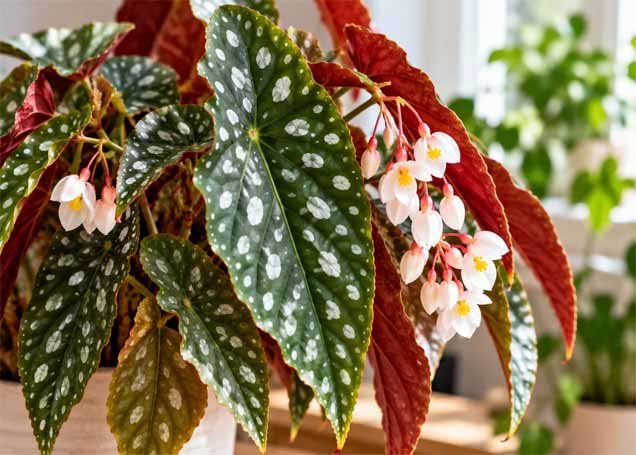
The Polka Dot Begonia is a tropical flowering plant native to Brazil. Its botanical name is Begonia maculata, and it belongs to the Begoniaceae family.
It is a cane-type begonia, meaning it produces upright, bamboo-like stems rather than forming a low, compact mound.
The plant’s most distinctive feature is its asymmetrical, wing-shaped leaves. Each leaf has a deep green upper surface decorated with silver spots and a reddish or burgundy underside.
Under suitable growing conditions, mature plants may also produce delicate clusters of white or pale pink flowers.
Because of its leaf shape, the plant is sometimes described as an angel wing begonia. However, the term angel wing begonia also applies to other cane begonia varieties, so it is not an exact botanical synonym for every Polka Dot Begonia.
Polka Dot Begonia Quick Care Guide
| Feature | Growing Requirements |
|---|---|
| Botanical name | Begonia maculata |
| Common names | Polka Dot Begonia, Spotted Begonia |
| Plant family | Begoniaceae |
| Plant type | Tropical cane begonia |
| Light | Bright, indirect sunlight |
| Watering | When the upper potting mix begins to dry |
| Soil | Airy, well-draining potting mix |
| Humidity | Moderate to high |
| Temperature | Approximately 65–80°F (18–27°C) |
| Fertilizer | Diluted houseplant fertilizer during active growth |
| Propagation | Stem cuttings |
| Flowers | Usually white or pale pink |
| Pet safety | Toxic if eaten by cats and dogs |
1. Provide Bright, Indirect Light
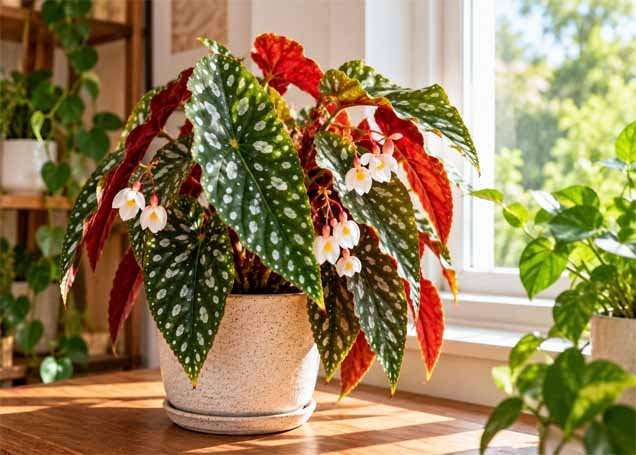
Getting the lighting right is one of the most important parts of Polka Dot Begonia care.
This tropical plant prefers bright, indirect light, similar to the filtered sunlight it receives in its natural environment.
An east-facing window is often a good location because it provides gentle morning sunlight without prolonged exposure to intense afternoon rays.
A bright north-facing window may work in some homes, although light levels vary with season and location. Near a south- or west-facing window, a sheer curtain can help soften harsh direct sunlight.
Signs Your Begonia Needs More Light
A plant receiving insufficient light may show:
- Long, stretched stems
- Large gaps between leaves
- Slow or weak growth
- Fewer flowers
- Leaning toward a window
Signs of Too Much Direct Sun
Excessive sunlight may cause:
- Pale or bleached foliage
- Brown, scorched patches
- Crispy leaf edges
- Increased water stress
Care tip: Rotate the pot occasionally so the plant receives balanced light and develops a more even shape.
If your home has very limited natural light, explore our Low Light Indoor Plants guide for other houseplants that may be better suited to darker rooms.
2. Water Your Polka Dot Begonia Correctly

Watering mistakes are among the most common causes of spotted begonia problems.
Polka Dot Begonia prefers a potting mix that remains lightly moist during active growth but does not stay constantly saturated.
Rather than watering on a fixed schedule, check the soil regularly.
When the upper 1–2 inches of potting mix begin to dry, it may be time to water. The exact depth depends on pot size, growing medium, and indoor conditions.
How to Water Polka Dot Begonia
- Insert your finger into the upper layer of the potting mix.
- Check whether the soil feels dry or still noticeably moist.
- If watering is needed, apply water slowly and evenly.
- Allow excess water to drain through the pot.
- Empty any water collected in the saucer.
Avoid allowing the pot to remain in standing water.
Overwatering vs. Underwatering
| Overwatering Signs | Underwatering Signs |
|---|---|
| Yellowing leaves | Dry, crispy leaf edges |
| Persistently wet soil | Very dry potting mix |
| Soft or declining stems | Wilting with dry soil |
| Possible root damage | Drooping foliage |
| Unpleasant smell from soil | Premature leaf drop |
These symptoms can overlap. Always inspect soil moisture and drainage before changing your watering routine.
3. Choose the Best Soil for Begonia Maculata
A well-draining potting mix helps prevent excessive moisture around the roots.
Begonia maculata grows well in an airy medium that holds some moisture without becoming dense or waterlogged.
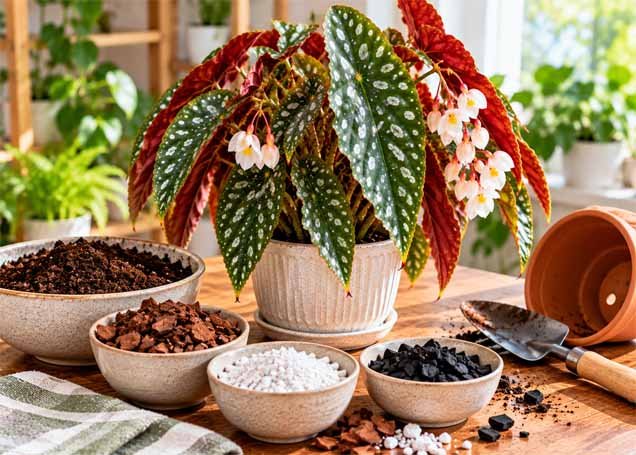
A suitable mix can include:
- Quality indoor potting mix
- Perlite for improved aeration
- Fine orchid bark for additional structure
A practical starting blend is approximately two parts indoor potting mix, one part perlite, and one part fine orchid bark. Adjust the mixture based on how quickly it drains and dries in your home.
This is a suggested growing-medium blend, not a requirement for every plant.
Why Drainage Matters
Dense, compacted soil can hold too much water, reducing the oxygen available to roots.
Over time, this can increase the risk of root problems and declining foliage.
Always choose a container with drainage holes.
Avoid adding a layer of rocks to the bottom of a pot as a substitute for proper drainage. The potting mix and drainage holes are more important.
4. Maintain Comfortable Humidity Levels
Polka Dot Begonia naturally grows in humid tropical environments.
Although it can adapt to ordinary household conditions, moderate to higher humidity often helps maintain attractive foliage.
A relative humidity range of approximately 50–60% can be a useful target, but healthy growth is possible outside that range depending on other conditions.
Dry indoor air, especially during winter heating, may contribute to crispy leaf margins.
How to Increase Humidity
Use a humidifier: A small room humidifier can help maintain more consistent moisture in the air.
Group compatible plants: Nearby houseplants may create a slightly more humid microclimate.
Choose a suitable location: Keep the plant away from heating vents and strong air-conditioning drafts.
Monitor humidity: A simple hygrometer can help you understand conditions rather than guessing.
Avoid repeatedly soaking the foliage to increase humidity. Wet leaves combined with poor airflow can encourage disease problems.
Good air circulation remains important even when humidity is relatively high.
5. Keep Temperatures Warm and Stable
Begonia maculata performs best in a comfortable indoor environment.
A temperature range around 65–80°F (18–27°C) is generally suitable for active growth.
Avoid exposing the plant to cold drafts, freezing temperatures, or sudden temperature changes.
Best Temperature Practices
- Keep the plant away from cold exterior doors.
- Avoid placing it directly beside heating vents.
- Protect it from strong air-conditioning airflow.
- Move outdoor plants indoors before cold weather arrives.
- Maintain relatively stable indoor temperatures.
Polka Dot Begonia is not frost-hardy.
In most parts of the United States, it is best grown as an indoor plant or moved indoors before temperatures become too cold.
6. Fertilize During Active Growth
Polka Dot Begonia does not need constant feeding, but modest fertilization can support healthy foliage and flowering.
During spring and summer, apply a balanced liquid houseplant fertilizer at the label-recommended rate.
If the fertilizer is concentrated, a diluted application may be appropriate according to the product instructions.
Fertilizing Tips
- Feed during active growth when needed.
- Follow the fertilizer label.
- Avoid applying fertilizer to severely stressed plants.
- Reduce feeding when growth slows.
- Watch for excessive salt accumulation in the potting mix.
Overfertilization may damage roots and cause leaf-edge browning.
If you notice a white crust on the soil surface, investigate whether mineral or fertilizer salts are accumulating.
Healthy growing conditions are more important than frequent fertilizer applications.
7. Prune Polka Dot Begonia for Fuller Growth
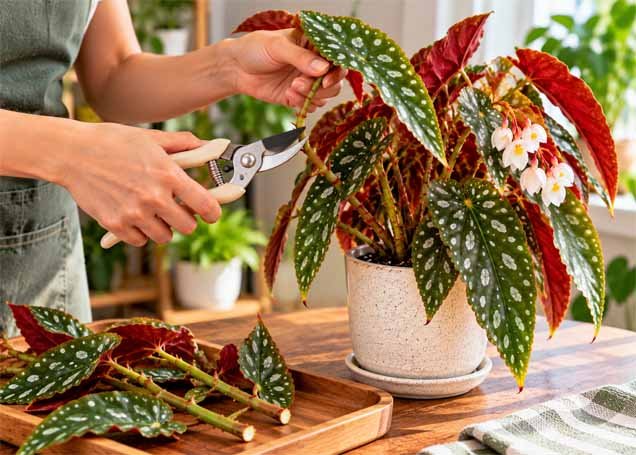
Polka Dot Begonia can develop tall, upright stems over time.
Without occasional pruning, older plants may become leggy or uneven.
Pruning encourages branching and helps maintain a fuller appearance.
How to Prune Begonia Maculata
- Examine the plant and identify excessively long stems.
- Use clean, sharp pruning shears.
- Cut just above a healthy leaf node.
- Remove dead or damaged foliage.
- Avoid removing too much healthy growth at once.
- Monitor new shoots as the plant recovers.
Spring and early summer are convenient times for significant shaping because the plant is usually growing actively.
If stems become heavy, use a small stake or plant support.
Helpful tip: Save healthy stem cuttings from pruning. They can be used to propagate new plants.
8. Propagate Polka Dot Begonia From Stem Cuttings

Polka Dot Begonia propagation is one of the most rewarding ways to expand your indoor plant collection.
Because Begonia maculata is a cane begonia, stem cuttings are a practical propagation method.
You can root cuttings in water or a suitable moist potting medium.
How to Propagate Polka Dot Begonia in Water
- Select a healthy stem with at least one or two nodes.
- Cut below a node using clean pruning shears.
- Remove any leaves that would sit below the waterline.
- Place the cutting in a clean container of water.
- Keep it in bright, indirect light.
- Replace cloudy water as needed.
- Transfer the cutting to potting mix after a healthy root system develops.
Roots may begin appearing within a few weeks, although timing varies with temperature, light, and plant condition.
Propagation in Soil
Alternatively, place a healthy stem cutting into a lightly moist, well-draining propagation mix.
Keep the medium consistently but lightly moist and provide bright, indirect light.
Avoid placing newly propagated cuttings in harsh direct sunlight.
Water vs. Soil Propagation
| Method | Advantages | Considerations |
|---|---|---|
| Water propagation | Easy to observe root development | Roots must adjust after transfer to soil |
| Soil propagation | Roots develop directly in potting medium | Root growth is less visible |
Both methods can work well when the cutting has a healthy node and suitable growing conditions.
9. Repot Your Spotted Begonia When Needed
Repotting gives a growing Polka Dot Begonia fresh potting mix and additional root space.
However, moving it into an unnecessarily large pot can increase the amount of soil that remains wet around its roots.
Signs Your Plant May Need Repotting
- Roots are emerging from drainage holes.
- Water runs through unusually quickly because the pot is root-filled.
- The potting mix has broken down and become compacted.
- The plant dries out much faster than before.
- Growth has slowed despite suitable light and care.
Choose a pot only slightly larger than the current container, often around 1–2 inches wider.
Spring is generally a convenient time to repot.
After repotting, water appropriately and keep the plant in stable conditions while it adjusts.
Avoid fertilizing heavily immediately after disturbing the roots.
10. Identify and Fix Common Polka Dot Begonia Problems
Even well-maintained plants sometimes develop leaf problems.
The key is to identify the underlying cause instead of treating every symptom as a watering issue.
Polka Dot Begonia Problems and Solutions
| Problem | Possible Cause | What to Do |
|---|---|---|
| Brown leaf tips | Dry air, inconsistent watering, or salt buildup | Check humidity, moisture, and fertilizer use |
| Yellow leaves | Overwatering, root stress, or natural aging | Inspect soil and roots |
| Drooping leaves | Dry soil, wet roots, or environmental stress | Check moisture before watering |
| Leaf drop | Temperature changes, moisture stress, or relocation | Stabilize growing conditions |
| Leggy stems | Insufficient light | Move to a brighter location |
| Pale patches | Excessive direct sunlight | Filter harsh sunlight |
| White powdery coating | Possible powdery mildew | Improve airflow and seek accurate diagnosis |
| Fine webbing or stippled leaves | Possible spider mites | Inspect leaf undersides and identify pests |
Why Are My Polka Dot Begonia Leaves Turning Brown?
Brown leaf edges can occur when indoor air is too dry, the plant experiences inconsistent watering, or mineral salts accumulate in the potting mix.
Direct sunlight may also scorch exposed foliage.
Check several factors before making changes.
Why Are the Leaves Turning Yellow?
Yellow leaves may indicate prolonged wet soil, poor drainage, or root damage.
However, individual older leaves naturally age and eventually fall.
One yellow leaf is not necessarily evidence of a serious problem.
Why Is My Polka Dot Begonia Drooping?
Drooping can happen when roots cannot supply enough water to the leaves.
This may occur in very dry soil, but damaged roots in saturated soil can produce similar symptoms.
Always inspect the growing medium before watering again.
Common Pests
Watch for mealybugs, aphids, spider mites, and other houseplant pests.
Inspect new plants before placing them near your collection.
If pests appear, isolate the affected plant and identify the insect before choosing an appropriate treatment.
For additional foliage maintenance advice, read our How to Clean Indoor Plant Leaves guide.
11. Encourage Healthy Growth and Beautiful Flowers
Although its spotted foliage is the main attraction, Polka Dot Begonia can also produce attractive flower clusters.
Flowers are commonly white or pale pink, depending on the plant and growing conditions.
Healthy flowering is more likely when the plant receives sufficient light and consistent care.
How to Encourage Flowers
- Provide bright, indirect light.
- Maintain stable indoor temperatures.
- Avoid prolonged drought or waterlogged soil.
- Fertilize moderately during active growth.
- Allow the plant to develop healthy, mature stems.
Not every plant flowers regularly indoors.
A healthy begonia may produce beautiful foliage even when flowering is limited.
How Tall Does Polka Dot Begonia Grow?
Indoors, Polka Dot Begonia can grow several feet tall under favorable conditions.
Its ultimate size depends on the cultivar, container, light exposure, and pruning.
Some plants need staking as their upright stems become taller.
Regular shaping can help keep the plant manageable in smaller spaces.
Polka Dot Begonia vs. Polka Dot Plant
The similar common names can cause confusion, but these are two different plants.
| Feature | Polka Dot Begonia | Polka Dot Plant |
|---|---|---|
| Botanical name | Begonia maculata | Hypoestes phyllostachya |
| Leaf shape | Long, asymmetrical, wing-shaped | Smaller, oval-shaped |
| Leaf pattern | Distinct silver spots | Pink, white, or red speckling |
| Growth habit | Upright cane stems | Bushy, compact growth |
| Typical indoor use | Statement foliage plant | Small colorful foliage plant |
When searching for Begonia maculata care, make sure the instructions apply to the correct species.
Where Should You Place a Polka Dot Begonia Indoors?
A Polka Dot Begonia works beautifully as a decorative houseplant when its light and temperature requirements are met.
Consider these locations:
Bright living room: Position it near a window with filtered daylight.
Home office: Its dramatic leaves make an attractive accent beside a desk, provided the area receives sufficient light.
Bedroom: Place it near a bright window, away from heating and cooling vents.
Indoor plant display: Combine it with other houseplants that appreciate similar environmental conditions.
If you enjoy decorative foliage plants, explore our Rubber Plant Care guide for another indoor gardening project.
Seasonal Polka Dot Begonia Care
Indoor conditions change throughout the year, even when plants remain in the same location.
Adjusting care seasonally can help prevent unnecessary stress.
| Season | Recommended Care |
|---|---|
| Spring | Resume active-growth care, prune, and repot if needed |
| Summer | Monitor watering, humidity, and intense sunlight |
| Fall | Reduce watering frequency as growth slows |
| Winter | Protect from cold drafts and avoid overwatering |
In winter, shorter days and cooler indoor conditions may slow plant growth.
Check the soil rather than continuing the same watering schedule used during summer.
Frequently Asked Questions
Is Polka Dot Begonia easy to care for?
Polka Dot Begonia is manageable for gardeners who can provide bright, indirect light, well-draining soil, and consistent moisture. It may be less forgiving than some very low-maintenance houseplants.
How often should I water Polka Dot Begonia?
Water when the upper layer of potting mix begins to dry. The exact frequency depends on light, temperature, humidity, pot size, and soil composition.
Does Polka Dot Begonia need direct sunlight?
It prefers bright, indirect light. Gentle morning sunlight may be tolerated, but strong afternoon sun can damage leaves.
Can Polka Dot Begonia grow in low light?
It may survive in moderately lower light, but weak light often causes leggy growth and reduced flowering. A brighter position is generally preferable.
Why are my Polka Dot Begonia leaves crispy?
Crispy leaves can result from dry air, insufficient water, strong sunlight, or fertilizer salt accumulation. Check the growing conditions before making adjustments.
Can I propagate Polka Dot Begonia in water?
Yes. Stem cuttings containing healthy nodes can develop roots in water before being transferred to potting mix.
Is Polka Dot Begonia toxic to cats and dogs?
Yes. Begonias contain soluble calcium oxalates and are considered toxic to cats and dogs if eaten. Keep the plant out of reach of pets and contact a veterinarian if ingestion occurs.
Does Polka Dot Begonia flower indoors?
Yes. Under favorable conditions, mature plants may produce clusters of white or pale pink flowers.
Should I mist my Polka Dot Begonia?
Misting is not necessary and does not provide a reliable long-term humidity increase. A humidifier is generally a more effective option when indoor air is too dry.
Why is my Begonia maculata losing leaves?
Leaf drop can result from moisture problems, temperature changes, relocation stress, or normal aging. Inspect the plant and its environment to identify the most likely cause.
Final Thoughts
The Polka Dot Begonia is a remarkable indoor plant that combines striking silver-spotted foliage with elegant upright growth.
Successful Polka Dot Begonia care comes down to understanding a few essential needs: bright, indirect sunlight, well-draining soil, appropriate watering, comfortable humidity, and stable temperatures.
Once those conditions are established, pruning and propagation become much easier, and the plant can develop into a beautiful focal point for your indoor garden.
Whether you call it a spotted begonia, an angel wing begonia, or Begonia maculata, this tropical houseplant rewards attentive care with distinctive foliage and the possibility of delicate flowers.
References and Further Reading
- Costa Farms — Polka Dot Begonia Plant Finder — Light, watering, humidity, fertilizer, and pruning guidance.
- Costa Farms — Meet Polka Dot Begonia — Botanical features, growth, and flowering.
- Costa Farms — Begonia Maculata — Indoor growing requirements and plant characteristics.
- ASPCA — Begonia Toxicity — Pet safety information.


