
Table of Contents
Growing vegetables in the same garden beds every year may seem convenient, but repeatedly planting the same crops in the same soil can create problems over time. Certain pests and diseases may become established, and nutrient management can become more difficult.
This is where crop rotation can help.
What is crop rotation? Crop rotation is the practice of growing different crops in a planned sequence in the same garden bed or field over multiple growing seasons.
Instead of planting tomatoes in the same bed every year, for example, you might grow tomatoes one year, beans the next, and cabbage in a later season.
A thoughtful crop rotation plan can help manage soil health, reduce certain pest and disease problems, and make vegetable gardening more sustainable.
Whether you grow vegetables in a backyard garden, raised beds, or a small community garden, understanding crop rotation is a useful gardening skill.
What Is Crop Rotation? A Simple Definition
Crop rotation means changing the types of crops grown in a particular location according to a planned schedule.
The important point is that crops are rotated over time, not simply moved around randomly.
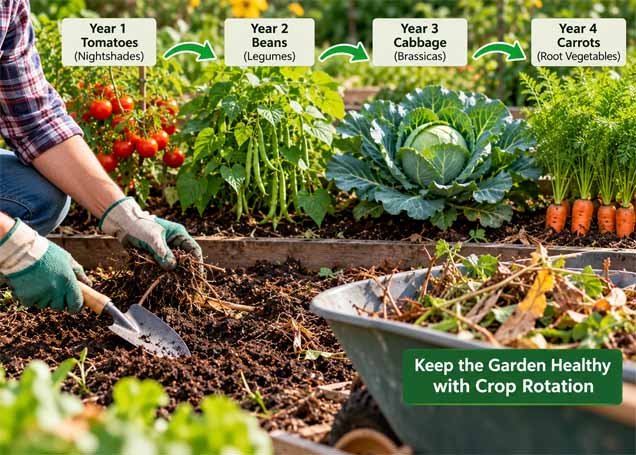
For example:
- Year 1: Tomatoes
- Year 2: Bush beans
- Year 3: Cabbage
- Year 4: Carrots
After several years, tomatoes may return to the original bed.
This is a simple example rather than a universal planting prescription. A good rotation depends on the vegetables you grow, the available space, previous disease problems, and local conditions.
When gardeners ask, “What is crop rotation in agriculture?” the principle is essentially the same. Farmers use planned crop sequences across fields, often including grains, legumes, and cover crops.
Home gardeners apply the same idea on a smaller scale.
How Does Crop Rotation Work?
Crop rotation works by changing the plants grown in a particular area from season to season or year to year.
Different crops interact with the soil in different ways.
Some plants have relatively shallow root systems, while others develop deeper roots. Some crops have substantial nutrient requirements. Legumes, including beans and peas, can form relationships with nitrogen-fixing bacteria.
Plants also differ in the pests and diseases that affect them.
When the same crop or closely related crops occupy the same soil repeatedly, certain soilborne pathogens and pests may have a continuing source of suitable host plants.
Changing crop families can interrupt some of these cycles.
However, crop rotation does not eliminate every pest or disease. Windborne diseases, highly mobile insects, and pathogens that survive for long periods may still cause problems.
For the best results, combine crop rotation with healthy soil management, sanitation, appropriate spacing, and regular garden observation.
What Is the Purpose of Crop Rotation?
The primary purpose of crop rotation is to maintain a more productive growing environment by varying the crops planted in a particular area.
A well-designed rotation may help gardeners:
- Reduce the buildup of certain crop-specific pests.
- Lower the risk of some soilborne diseases.
- Manage nutrient use more effectively.
- Improve crop diversity.
- Incorporate legumes and cover crops.
- Support better long-term soil management.
- Organize vegetable planting across multiple seasons.
The purpose is not to avoid growing a favorite vegetable every year.
Instead, you can continue growing tomatoes, peppers, beans, and other vegetables annually while changing which garden beds they occupy.
For example, a gardener with four raised beds can grow tomatoes every summer while moving them to a different bed each year.
This approach is particularly useful when several beds are available.
Why Is Crop Rotation Important?
Crop rotation is important because garden soil is a living system, and repeated planting decisions can influence its condition.
Growing the same crop family in the same location every year can increase the risk of certain recurring problems.
For example, tomatoes, peppers, potatoes, and eggplants belong to the nightshade family. Some diseases can affect several members of this family.
Replacing tomatoes with peppers in the same bed does not necessarily provide an effective rotation.
A better approach is to follow tomatoes with a crop from a different family.
Crop rotation also encourages gardeners to think beyond a single growing season.
Instead of planning only what to grow this spring, you begin considering how today’s planting choices affect future crops.
According to University of Minnesota Extension, rotation based on plant families can help manage disease problems and nutrient use in vegetable gardens.
7 Essential Benefits of Crop Rotation

1. Helps Reduce Certain Soilborne Diseases
One of the most valuable benefits of crop rotation is reducing repeated exposure to some crop-specific soilborne pathogens.
When susceptible crops grow in the same soil year after year, disease-causing organisms may persist and accumulate.
Changing to a non-host crop can reduce opportunities for some pathogens to reproduce.
For example, rotating nightshade crops with unrelated vegetable families may help reduce certain disease pressures.
However, the effectiveness depends on the particular pathogen and how long it survives in the soil.
Crop rotation should be considered part of an overall disease-management strategy, not a guaranteed cure.
2. Helps Manage Some Garden Pests
Some insect pests depend on particular crops or plant families.
Moving host crops to different locations may make it harder for certain pests to establish large populations in the same area.
This can be especially useful for pests that remain near their host plants or overwinter in garden soil.
However, highly mobile insects can easily travel between beds.
Crop rotation works best alongside pest monitoring, physical barriers when appropriate, and good garden sanitation.
3. Supports Better Nutrient Management
Different crops have different nutrient requirements.
For example, fruiting vegetables such as tomatoes and squash often need careful fertility management to support vigorous growth and fruit production.
Other crops may have different nutrient demands or root characteristics.
Rotating crops can help gardeners avoid repeating the same nutrient-use pattern in one bed.
Still, crop rotation does not replace compost, soil testing, or appropriate fertilization.
A soil test remains one of the most reliable ways to determine whether your garden needs additional nutrients.
4. Creates Opportunities to Use Nitrogen-Fixing Legumes
Beans and peas belong to the legume family.
Under suitable conditions, many legumes form partnerships with rhizobia bacteria that convert atmospheric nitrogen into forms plants can use.
This process can contribute nitrogen to the cropping system.
However, the amount of nitrogen left for the following crop varies.
Harvesting plants, removing residues, soil conditions, and the effectiveness of nitrogen fixation all influence the result.
Therefore, planting beans before tomatoes does not automatically eliminate the need for fertilizer.
5. Encourages Greater Crop Diversity
A rotation plan encourages gardeners to grow vegetables from several botanical families.
Instead of filling every bed with tomatoes or peppers, you might include leafy greens, legumes, root vegetables, and squash.
This variety can make the garden more interesting and help spread gardening activities across the season.
It also provides opportunities to experiment with new vegetables.
6. Can Support Soil Health
Crop rotation can contribute to better soil management when combined with compost, mulching, cover crops, and reduced soil disturbance.
Different plants contribute different root systems and plant residues.
Over time, diverse cropping systems can help support nutrient cycling and other soil processes.
However, the benefits depend on the rotation design and management practices.
Simply changing crops without protecting or improving the soil may provide limited results.
7. Makes Long-Term Garden Planning Easier
A written rotation plan gives every garden bed a purpose.
You can track what grew in each location, which crops performed well, and where problems appeared.
This information becomes valuable when planning future seasons.
Instead of guessing where to plant tomatoes next year, you can check your records and select a suitable bed.
For beginners, this organizational benefit alone can make crop rotation worth learning.
Understanding Vegetable Plant Families

The most important rule of crop rotation is to rotate plant families, not just individual vegetables.
Many related crops share similar pests and diseases.
Use the following table when planning your vegetable garden.
| Plant Family | Common Vegetables |
|---|---|
| Solanaceae — Nightshades | Tomatoes, peppers, potatoes, eggplants |
| Brassicaceae — Brassicas | Cabbage, broccoli, kale, cauliflower, radishes |
| Fabaceae — Legumes | Beans, peas |
| Cucurbitaceae — Cucurbits | Cucumbers, pumpkins, zucchini, melons |
| Apiaceae — Carrot Family | Carrots, parsnips, celery |
| Amaryllidaceae — Alliums | Onions, garlic, leeks, chives |
| Asteraceae — Daisy Family | Lettuce, endive |
| Amaranthaceae — Amaranth Family | Spinach, beets, Swiss chard |
| Poaceae — Grass Family | Sweet corn |
Important: Tomatoes followed by peppers are not an effective family rotation because both belong to Solanaceae.
Similarly, replacing zucchini with cucumbers does not change the crop family.
Whenever practical, select a crop from a different family for the next rotation.
A Simple 3-Year Crop Rotation Plan
A three-year rotation can be a practical starting point for gardeners with three separate beds.
Consider these three crop groups:
- Group A: Tomatoes and peppers
- Group B: Beans and peas
- Group C: Cabbage and kale
Here is a simple example:
| Year | Bed 1 | Bed 2 | Bed 3 |
|---|---|---|---|
| Year 1 | Nightshades | Legumes | Brassicas |
| Year 2 | Legumes | Brassicas | Nightshades |
| Year 3 | Brassicas | Nightshades | Legumes |
Each crop family moves to a different bed annually.
This schedule provides a useful introduction to rotation planning.
However, a three-year rotation may not be long enough for every soilborne disease problem. Some crops or diseases require longer breaks.
If you have a history of serious disease, consult your local Cooperative Extension service before choosing a rotation interval.
A Practical 4-Year Crop Rotation Plan
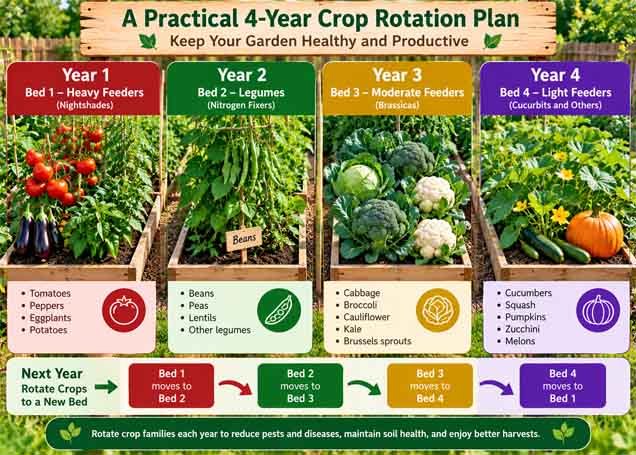
A four-year rotation provides more flexibility for gardeners with four separate beds.
For this example, divide vegetables into four groups:
- Group A: Nightshades — tomatoes, peppers, eggplants
- Group B: Legumes — beans, peas
- Group C: Brassicas — broccoli, cabbage, kale
- Group D: Cucurbits — cucumbers, squash, pumpkins
Four-Bed Rotation Chart
| Year | Bed 1 | Bed 2 | Bed 3 | Bed 4 |
|---|---|---|---|---|
| Year 1 | A | B | C | D |
| Year 2 | B | C | D | A |
| Year 3 | C | D | A | B |
| Year 4 | D | A | B | C |
After Year 4, the sequence begins again.
This means a crop family returns to the same bed every four years.
A four-year rotation is a useful general framework, but it is not suitable for every disease situation or garden design.
Adjust the plan according to your crops, space, growing season, and local extension recommendations.
Crop Rotation Examples for Common Vegetables
Tomatoes
Tomatoes belong to the nightshade family.
Avoid following tomatoes with peppers, eggplants, or potatoes when trying to rotate away from that family.
Instead, choose an unrelated crop family.
For example, a bed that previously grew tomatoes could grow beans or leafy brassicas the following season.
Potatoes
Potatoes are also nightshades.
Moving potatoes into a bed previously used for tomatoes does not create a meaningful plant-family rotation.
Keep records of where both crops have grown.
Cucumbers and Squash
Cucumbers, zucchini, pumpkins, and melons belong to the cucurbit family.
Rotate these crops with unrelated vegetables rather than substituting one cucurbit for another in the same location.
Broccoli and Cabbage
Broccoli, cabbage, cauliflower, kale, and radishes belong to the brassica family.
Avoid treating these vegetables as separate rotation groups.
This is especially important where brassica-related soil diseases have occurred.
Beans and Peas
Beans and peas are legumes.
They can be useful components of a rotation plan, particularly when their nitrogen-fixing characteristics are considered alongside soil fertility needs.
Do not assume that legumes automatically restore all nutrients removed by previous crops.
Crop Rotation for Raised Garden Beds
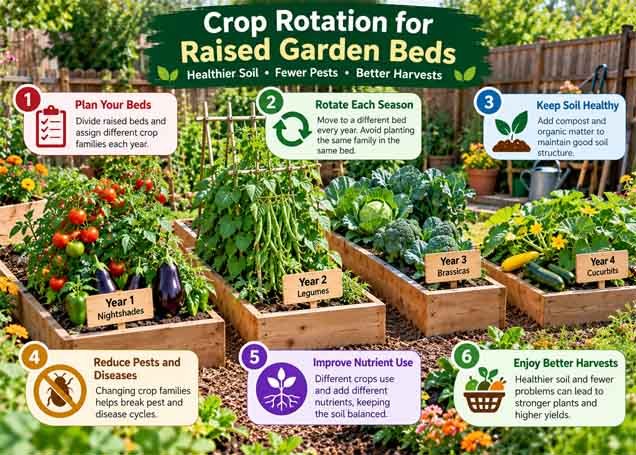
Raised beds are especially convenient for crop rotation because each bed can be treated as a separate planting area.
For example, if you have four raised beds, label them A, B, C, and D.
Record the crop family planted in each bed every year.
At the beginning of the next season, move each group to its designated new bed.
You can also use a notebook or spreadsheet to track your garden history.
For gardeners planning new raised beds, see our guide to how to build a raised garden if that article is available on your website.
Good soil preparation is equally important. Learn more about compost for raised bed gardens and how organic matter supports garden soil management.
What If You Have Only One Raised Bed?
Crop rotation is more challenging when you have just one small bed.
You can still improve your gardening approach by:
- Growing a mixture of unrelated plant families.
- Avoiding repeated planting of the same crop whenever possible.
- Using containers to create additional growing areas.
- Maintaining healthy soil with appropriate organic matter.
- Removing diseased plant material.
- Considering suitable cover crops between growing seasons.
University of Minnesota Extension recommends using a diversity of crop families when there is insufficient space for a traditional rotation.
Crop Rotation vs. Companion Planting
Crop rotation and companion planting are different gardening practices.
Crop rotation changes which crops occupy a location over time.
Companion planting involves growing different plants near one another during the same season.
For example, planting tomatoes in Bed A this year and beans there next year is crop rotation.
Growing tomatoes and basil near one another in the same season is companion planting.
Companion planting combinations are sometimes promoted with exaggerated pest-control claims. Not every popular combination has strong scientific evidence.
Neither method replaces proper watering, soil care, pest monitoring, or suitable plant spacing.
Crop Rotation in Agriculture vs. Home Gardening
What is crop rotation farming, and how is it different from rotating vegetables in a backyard?
The underlying principle is the same: growing crops in a planned sequence over time.
However, commercial farms often use larger fields, specialized equipment, and rotations designed around economic and environmental goals.
For example, a farmer might alternate corn and soybeans or include wheat and cover crops in a longer rotation.
A home gardener might rotate tomatoes, beans, cabbage, and squash among several raised beds.
Agricultural rotations may be designed to address soil erosion, weed pressure, nutrient management, and farm profitability.
Home garden rotations are usually simpler and focus on healthy vegetables, manageable pest pressure, and productive use of limited space.
How to Start Crop Rotation in Your Vegetable Garden
If you are new to crop rotation, follow these steps.
Step 1: Draw a Garden Map
Sketch your garden and label each bed or planting area.
The map does not need to be complicated.
A simple drawing on paper is enough.
Step 2: List Your Vegetables
Write down everything you plan to grow.
Include tomatoes, peppers, beans, cucumbers, carrots, leafy greens, and other vegetables.
Step 3: Identify Plant Families
Group your vegetables by botanical family.
This is the most important step because related crops may share pests and diseases.
Step 4: Review Last Year’s Planting Locations
Check which crops grew in each bed during the previous season.
If you have no records, start keeping them now.
Step 5: Create a Rotation Schedule
Assign different crop families to each bed for the coming year.
If possible, plan several seasons ahead.
Step 6: Consider Sunlight and Growing Seasons
Not every crop grows well in every location.
Tomatoes and peppers generally require substantial sunlight, while some cool-season vegetables have different temperature preferences.
Your rotation must still respect each crop’s environmental needs.
For help getting started, read our how to start vegetable gardening guide.
Step 7: Record Results Every Year
At the end of each season, note:
- Which vegetables grew in each bed.
- Whether plants experienced disease or pest problems.
- Which crops produced good harvests.
- Whether compost or fertilizer was added.
- Any changes you want to make next year.
These records make future crop rotation decisions easier.
Common Crop Rotation Mistakes to Avoid
Rotating Individual Crops Instead of Families
Switching tomatoes with peppers does not provide a proper family rotation.
Always check botanical relationships before moving crops.
Assuming Crop Rotation Eliminates Every Disease
Some pathogens remain in soil for many years, while others spread through air, water, tools, or infected plant material.
Crop rotation reduces certain risks but cannot guarantee disease-free plants.
Ignoring Soil Fertility
Changing crops does not automatically correct nutrient deficiencies.
Use soil tests and appropriate amendments when needed.
Forgetting Cover Crop Families
Cover crops also belong to botanical families.
For example, mustard and oilseed radish are brassicas.
Growing a brassica cover crop before cabbage may interfere with a planned brassica rotation.
Making the Rotation Too Complicated
A simple plan that you consistently follow is often more useful than a complicated schedule that becomes difficult to maintain.
Start with the crops you actually grow.
Forgetting Local Growing Conditions
The ideal rotation for a warm Southern garden may differ from one in the northern United States.
Consider your growing season, soil conditions, and regional disease concerns.
Frequently Asked Questions About Crop Rotation
What is crop rotation in simple words?
Crop rotation means growing different types of crops in the same area during different seasons or years. The goal is to manage soil health and reduce certain recurring pest and disease problems.
What is crop rotation and why is it important?
Crop rotation is the planned sequence of different crops in one planting area. It is important because it can help manage soil nutrients, reduce certain crop-specific pests and diseases, and support more sustainable gardening practices.
What is a benefit of crop rotation?
One important benefit of crop rotation is reducing the repeated buildup of certain soilborne diseases that affect specific plant families.
What is the importance of crop rotation in agriculture?
In agriculture, crop rotation can support soil health, nutrient management, erosion control, pest management, and long-term productivity.
What is the crop rotation method for vegetables?
A common method is to divide vegetables into plant-family groups and move those groups among garden beds each year. A three-year or four-year plan can help organize this process.
How many years should you rotate vegetable crops?
A three- to four-year rotation is a useful general goal for many home vegetable gardens. However, the appropriate interval depends on the crop, available space, and specific disease risks.
Can I practice crop rotation in a small garden?
Yes. Small gardens can benefit from rotating crops among beds or containers. If space is extremely limited, growing diverse crop families and maintaining healthy soil are practical alternatives.
Does crop rotation replace fertilizer?
No. Crop rotation can support nutrient management, but soil testing and appropriate fertilization may still be necessary.
What is crop rotation short answer?
Crop rotation is the practice of growing different crops in a planned sequence on the same land over time to support soil management and reduce certain pest and disease problems.
Final Thoughts
Understanding what is crop rotation can help you plan a more productive vegetable garden over several growing seasons.
The most important principle is simple: avoid repeatedly planting the same crop family in the same location whenever practical.
Start by identifying your vegetables, drawing a garden map, and creating a manageable rotation schedule.
Remember that crop rotation works best alongside composting, soil testing, appropriate watering, and regular pest monitoring.
Whether you grow vegetables in raised beds or a traditional backyard garden, a thoughtful crop rotation plan can make your gardening routine more organized and support healthier growing conditions over time.
References and Further Reading
- University of Minnesota Extension — Promote Healthy Soil in Your Garden
- University of Minnesota Extension — Raised Bed Gardens
- Penn State Extension — Crop Rotation for the Home Vegetable Garden
- University of Wisconsin Extension — Using Crop Rotation in the Home Vegetable Garden
- USDA — Crop Rotation Practice Standard
- USDA NRCS — Rotations for Soil Fertility